
NCCIA October 2026: What Has Happened in the Last 15 Days?
The National Cyber Crime Investigation Agency (NCCIA) has been involved in a series of major developments across Pakistan during the second half of September and the beginning of October 2026.
Between approximately September 21 and October 5, 2026, reported developments have included raids against alleged illegal call centres, online financial fraud investigations, requests for additional police manpower, the planned strengthening of Cyber Crime Centres, closer cooperation on digital forensics, and the activation of cyber-patrolling units.
These developments are important because they show that cybercrime investigations in Pakistan are increasingly involving not only traditional complaints but also digital evidence, financial fraud, organised online scams, call-centre operations, social-media deception and specialised investigative resources.
In this NCCIA October 2026 update, we bring together the major developments reported during this 15-day period and explain what they mean for ordinary internet and mobile users.
Important: Arrests, detentions and allegations reported in these cases do not by themselves establish guilt. Investigations and legal proceedings can continue after an operation.
If you want to understand more about SIM Owner Details, SIM verification, mobile identity protection, CNIC-related SIM checks and other important SIM topics in Pakistan, visit our SIM Owner Details guide for practical, educational information and official self-check resources.
What Is NCCIA and What Does It Do?
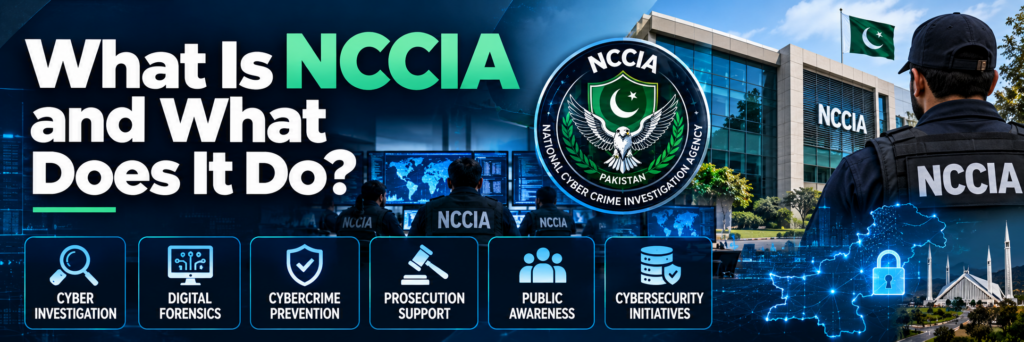
The National Cyber Crime Investigation Agency (NCCIA) is Pakistan’s specialised agency dealing with cybercrime investigations.
According to its official information, NCCIA’s functions include cyber investigations, digital forensics, prosecution and cybersecurity-related activities. Its stated mandate operates under the Prevention of Electronic Crimes Act (PECA) framework. NCCIA
NCCIA also describes digital forensics as the process of retrieving, preserving and analysing electronic data that may support criminal investigations and legal proceedings. Its published forensic capabilities include computer, mobile, audio/image and network forensics. NCCIA
That makes the latest developments particularly significant. Several recent operations have involved large quantities of computers, mobile phones and other digital material, while the agency is simultaneously seeking additional manpower and stronger forensic cooperation.
1. NCCIA Activates Cyber-Patrolling Units Across Pakistan
One of the most significant developments reported on October 5, 2026, was the activation of cyber-patrolling units across all regions.
NCCIA also reported establishing special units aimed at preventing what it described as “anti-state propaganda and fake news.” The measures were reviewed during Director General Syed Ali Nasir Rizvi’s five-day tour of NCCIA circles in Punjab. Dawn
During the tour, the DG reportedly:
- Inspected reporting centres and offices
- Reviewed the working of NCCIA circles
- Examined complaint and investigation processes
- Met more than 500 complainants
- Reviewed pending complaints and cases
- Directed officials to improve the complaint and verification system
- Emphasised timely justice
- Called for transparency and merit-based investigation
- Directed improvements in record maintenance and case disposal
The development is important because it represents an increased emphasis on proactive monitoring and cybercrime prevention, rather than relying exclusively on complaints after an incident has already occurred.
What Does Cyber Patrolling Mean?
Cyber patrolling generally refers to monitoring online spaces for activity that may require investigation or enforcement.
However, users should not interpret the announcement as meaning that every social-media post or online conversation automatically becomes a criminal case.
Whether particular online conduct constitutes an offence depends on the applicable law, facts and evidence.
NCCIA’s own current public messaging also highlights emerging threats such as AI-generated content, deepfakes, manipulated audio and video, identity deception, financial fraud and misuse of digital platforms. NCCIA
Why This Matters to Internet Users
The development reinforces the importance of responsible online behaviour.
Users should be especially careful with:
- Fake accounts
- Impersonation
- Fraudulent offers
- Financial scams
- Threatening or harassing communications
- Fake websites
- Phishing attempts
- Manipulated media
- Identity misuse
- Suspicious investment or payment requests
2. NCCIA Raids Alleged Illegal Call Centres in Lahore
Another major October 5 development involved raids on two alleged illegal call centres in Lahore.
According to NCCIA information reported by Dawn, operations were carried out in Faisal Town and Johar Town, with more than three dozen people detained. Investigators reportedly seized computers, laptops and mobile phones containing software and data allegedly connected with fraudulent activities. Dawn
The agency said the suspects allegedly targeted people abroad using fraudulent calls presented as mobile-upgrade or telecommunications services.
The operation also reportedly resulted in digital evidence being seized and sealed according to legal requirements.
The case was referred for registration of proceedings under relevant provisions of the Prevention of Electronic Crimes Act (PECA) and the Pakistan Penal Code (PPC), according to the report. Dawn
Why Are Call-Centre Scams a Serious Cybercrime Problem?
A call centre can provide scammers with a structured environment from which large numbers of potential victims can be contacted.
A fraudulent operation may use:
- Telephone calls
- Spoofed identities
- Fake company names
- Fake customer-support stories
- False account-verification requests
- Fake upgrades or service offers
- Requests for payment information
- Social engineering
The victim may believe they are speaking to a legitimate company representative.
The danger is therefore not necessarily sophisticated hacking. In many cases, the key weapon is deception.
3. Abbottabad Rs18 Million Online Fraud Case
On October 4, 2026, another major NCCIA case emerged from Abbottabad.
NCCIA’s Hazara Circle arrested five people in connection with an alleged online financial fraud worth approximately Rs18 million, according to officials cited by Dawn.
Investigators reportedly recovered Rs5.5 million from the arrested suspects. The investigation reportedly identified around 25 people from Abbottabad and Islamabad as potentially connected with the scam. Dawn
Reports said the alleged fraud involved fake online identities and promises connected with business opportunities.
Another report described an alleged social-media identity involving a person presented as a German woman, through which victims were approached online and encouraged to provide money for purported business opportunities. PhoneWorld
The Important Lesson From This Case
This case demonstrates why online fraud is not limited to fake links or malware.
A scam can begin with something as simple as a social-media conversation.
Fraudsters may first establish trust and then introduce:
- Business opportunities
- Investment claims
- Loans
- Jobs
- Trading opportunities
- Overseas opportunities
- Romantic relationships
- Emergency situations
Once trust has been established, the victim may become more willing to send money or personal information.
Warning Signs
Be particularly cautious when an online stranger:
- Develops a close relationship unusually quickly
- Refuses independent identity verification
- Avoids proper video calls or real-world verification
- Promises unusually attractive financial opportunities
- Pressures you to send money
- Requests secrecy
- Asks for banking information
- Wants cryptocurrency or unusual payment methods
- Claims an urgent financial problem
The safest approach is to independently verify the person and opportunity before transferring money.
4. NCCIA Requests 200 KP Police Personnel
Another important development concerns NCCIA’s manpower.
On October 3, 2026, reports said NCCIA had requested the services of 200 police officers and officials from Khyber Pakhtunkhwa on a deputation basis to strengthen its operational capacity. The News
The reported request included:
- 20 Deputy Superintendents of Police
- 24 Inspectors
- 71 Sub-Inspectors
- 21 Assistant Sub-Inspectors
- Male constables/head constables
- Female constables/head constables
The report also said that an earlier request had sought 147 personnel, followed by a further request for 53 additional personnel. The News
Why Is Additional Manpower Important?
Cybercrime investigations require more than computers and software.
Investigations can involve:
- Complaint assessment
- Interviews
- Evidence collection
- Financial investigations
- Digital evidence preservation
- Technical investigation
- Search and seizure procedures
- Investigation reports
- Legal coordination
- Prosecution
- Follow-up with complainants
A larger and specialised workforce can potentially help an agency handle more investigations.
However, it is important to distinguish between requesting personnel and actually receiving/deploying them.
The reported development concerns NCCIA’s request for manpower; it should not automatically be described as confirmation that all 200 personnel have already joined the agency.
5. NCCIA Seeks 120 Sindh Police Personnel for New Cyber Crime Centres
On October 1, 2026, another manpower-related development was reported from Sindh.
NCCIA’s Sindh Zone reportedly sought 120 police officers and officials from different Sindh Police ranges to strengthen manpower at newly establishing Cyber Crime Centres. The News
The proposed personnel were requested from six ranges:
- Karachi
- Hyderabad
- Sukkur
- Larkana
- Shaheed Benazirabad
- Mirpurkhas
The reported proposal included inspectors, sub-inspectors, lady sub-inspectors, ASIs, head constables/constables and female police personnel. The News
The proposal was reportedly connected with the expected increase in complaints, inquiries, investigations and other operational requirements associated with the new centres.
What Could New Cyber Crime Centres Mean for Citizens?
The purpose of expanding physical capacity is generally to make it easier for an agency to handle cases in different areas.
For ordinary users, the practical importance is straightforward:
Cybercrime is no longer only an online problem; investigating it requires physical investigators, technical specialists, legal staff and evidence-handling capabilities.
The proposal reported in Sindh is therefore another indication that NCCIA is looking at expanding operational capacity.
Again, however, the reported figure of 120 represents the requested manpower, not necessarily 120 personnel already deployed.
6. NCCIA and NFA Strengthen Digital Forensics Cooperation
One of the most technically important developments came on September 23–24, 2026, when NCCIA leadership visited the National Forensics Agency (NFA) in Islamabad.
NCCIA Director General Syed Ali Nasir Rizvi and NFA officials discussed closer cooperation in analysing evidence from cybercrime cases and ways to make forensic examination and investigations faster and more effective. The News
The NCCIA DG also inspected the NFA’s Digital Forensics Laboratory and reviewed its facilities and technology.
Discussions reportedly focused on:
- Evidence analysis
- Technical protocols
- Forensic examination
- Procedural bottlenecks
- Faster case processing
- Evidence-based investigations
- Institutional coordination The News
What Is Digital Forensics?
Digital forensics is the examination of electronic evidence.
Depending on the case, digital evidence can potentially come from:
- Computers
- Mobile phones
- Storage devices
- Network systems
- Digital communications
- Images
- Videos
- Audio
- Other electronic systems
NCCIA itself describes computer, mobile and network forensics as part of its forensic capabilities. NCCIA
Why Does Digital Evidence Matter?
Suppose someone reports an online fraud.
The investigation may need to establish:
- Who communicated with the victim?
- Which devices were used?
- What accounts were involved?
- What information was stored?
- Where did money move?
- What digital records exist?
- Can the evidence be preserved and analysed?
A strong forensic process can help investigators answer questions that cannot be resolved simply by looking at screenshots.
That is why the NCCIA-NFA cooperation is potentially one of the most important developments in this 15-day period.
7. NCCIA Detains 212 People in Islamabad Call-Centre Operation
On September 22, 2026, NCCIA conducted a major operation against three alleged illegal call centres in Islamabad.
The facilities were located in E-11 and G-10.
According to NCCIA’s spokesperson, 212 people were taken into custody during the operation. Investigators reportedly recovered:
- 306 mobile phones
- 383 computers/CPUs
- 299 monitors and laptops Dawn
The agency said the alleged network was connected with different forms of online fraud, including Google-related scams, loan schemes, dating-related schemes, fake social-media profiles and fraudulent trading offers. Initial investigation reportedly indicated alleged international links involving India and Brazil. Associated Press of Pakistan
A case was registered and further investigation was reported to be underway.
Why Was This Operation Significant?
The scale of the seizure is notable.
Hundreds of digital devices can potentially contain large quantities of evidence.
Investigators may need to determine:
- Which devices belonged to which suspects
- Which accounts were used
- Which communications took place
- What data was stored
- Whether victims were contacted
- How money was requested or transferred
- Whether different people performed different roles
This illustrates why modern cybercrime investigations can become technically complex very quickly.
NCCIA’s Recent Call-Centre Crackdowns Show a Clear Pattern
The Lahore and Islamabad operations occurred at different times, but they reveal a similar investigative challenge.
An alleged fraudulent call-centre operation may involve several components:
People → Computers → Phones → Software → Online Accounts → Victims → Financial Transactions
Investigators therefore need to connect the different parts.
For example, a phone number by itself may not tell the entire story.
A computer may contain communication records.
A mobile phone may contain account credentials or messages.
Financial records may connect a suspect to a victim.
Digital forensic examination can potentially help investigators establish relationships between these pieces of evidence.
This is one reason why the September cooperation between NCCIA and NFA is relevant to the October enforcement activity.
Another September Development: NCCIA Capacity and Resources
On September 24, Interior Secretary Ahmad Raza Sarwar reportedly visited NCCIA headquarters and described cybercrime as a major challenge.
He said the Ministry of Interior would provide possible resources, modern technology and manpower to strengthen NCCIA. The report also highlighted recent action against illegal call centres and online fraud networks. DAWN
The same report said NCCIA leadership was focusing on:
- Complaint redressal
- Faster disposal of pending cases
- Modern investigation methods
- Transparency
- Merit-based investigations
- Public facilitation
- Regular open courts/Khuli Kutchery DAWN
This development fits closely with the manpower and forensic announcements that followed.
What These NCCIA October 2026 Developments Tell Us
When the seven major developments are considered together, several themes become visible.
1. More Focus on Organised Online Fraud
The recent cases involve alleged:
- Financial fraud
- Call-centre scams
- Social-media deception
- Fake identities
- Fraudulent offers
- International scam operations
This suggests that cybercrime investigations are increasingly dealing with organised activities rather than isolated incidents.
2. Digital Evidence Is Becoming More Important
The Islamabad operation alone reportedly involved hundreds of devices.
The NCCIA-NFA discussions specifically focused on forensic analysis and evidence handling.
That means digital evidence is becoming increasingly central to cybercrime investigations.
3. Manpower Is a Major Operational Requirement
Requests for:
- 200 personnel from KP
- 120 personnel from Sindh
show that investigation capacity depends on people as much as technology.
Cybercrime investigators need technical and conventional investigative skills.
4. Physical Cybercrime Centres Still Matter
Although cybercrime happens online, victims still need practical channels for reporting and investigation.
The proposed Cyber Crime Centres in Sindh indicate an effort to strengthen physical investigative capacity.
5. Cybercrime Prevention Is Moving Toward Proactive Monitoring
The October 5 announcement regarding cyber-patrolling units indicates a stronger emphasis on monitoring cyberspace.
At the same time, users should remember that the legal status of specific online activity depends on the applicable law and circumstances.
How Online Call-Centre Fraud Can Affect Ordinary Users
The recent NCCIA raids provide useful lessons for anyone using a phone or computer.
A fraudulent caller may claim to represent:
- A bank
- A telecom company
- A technology company
- A delivery company
- A government department
- A financial service
- A foreign business
The caller may then ask for:
- OTP codes
- Card information
- Account passwords
- CNIC information
- Banking details
- Verification codes
- Remote-access permissions
Never Give Sensitive Information Just Because Someone Sounds Professional
A scammer does not need to sound suspicious.
They may have:
- Professional language
- Background noise resembling an office
- A company logo
- A fake employee ID
- A convincing script
- Your basic personal information
Always verify through an official channel that you independently locate.
Social Media Fraud: Why Fake Identities Are Dangerous
The Abbottabad case highlights another important trend: social-media identity deception.
A fake account can create a false sense of trust.
A scammer might claim to be:
- A foreign professional
- A business owner
- An investor
- A doctor
- A company representative
- A potential romantic partner
The conversation may remain harmless initially.
The financial request may come later.
This is why users should evaluate the entire relationship, not just the final payment request.
If someone you met online suddenly introduces a financial opportunity, stop and independently verify everything.
What To Do If You Become a Victim of Online Fraud
If money has already been transferred, do not waste time blaming yourself.
Take practical steps immediately.
Step 1: Preserve Evidence
Save:
- Screenshots
- Phone numbers
- Usernames
- Profile URLs
- Emails
- Messages
- Transaction receipts
- Bank details
- Account numbers
- Payment confirmations
- Voice messages
- Relevant files
Do not intentionally alter the original evidence.
Step 2: Contact Your Financial Institution
If money was transferred through a bank, wallet or payment service, contact the relevant provider immediately and ask what fraud-reporting or transaction-dispute options are available.
Step 3: Report the Cybercrime
NCCIA provides official cybercrime-related services, including investigation and digital-forensic functions. NCCIA
Use the official NCCIA complaint channels rather than relying on random social-media accounts claiming to represent the agency.
Step 4: Keep the Complaint Information
Save:
- Complaint number
- Application copy
- Supporting evidence
- Relevant correspondence
- Dates of communication
Step 5: Do Not Pay Another “Recovery Agent”
A common secondary scam is someone claiming:
“We can recover your stolen money if you first pay us a fee.”
Be extremely cautious.
Someone who already knows you lost money may target you again.
How to Protect Your Mobile and Online Identity
Cybercrime is not limited to large call centres.
Individuals can also become victims through compromised accounts, SIM-related fraud, phishing and social engineering.
Basic precautions include:
Protect Your OTPs
Never share a one-time password with someone who calls you unexpectedly.
Protect Your Account Recovery Codes
Verification codes can be enough to take control of some accounts.
Use Two-Factor Authentication
Where supported, enable stronger account security.
Review Linked Devices
Regularly check whether unfamiliar devices are connected to your important accounts.
Avoid Suspicious Links
Do not open unknown links simply because they arrive through WhatsApp, SMS or social media.
Verify Before Paying
If someone requests money, independently verify their identity and the reason for payment.
Keep Evidence
If something goes wrong, records can become extremely important.
Why Digital Forensics Is Important in Cybercrime Cases
Digital forensics is not simply “checking a phone.”
It can involve the structured examination of electronic evidence.
NCCIA’s published information identifies several forensic areas, including:
- Computer forensics
- Mobile forensics
- Audio/image forensics
- Network forensics NCCIA
This matters because modern cybercrime can leave evidence across multiple devices and platforms.
For example:
Victim → Social Media Account → Phone → Computer → Payment Account → Network Activity
Investigators may need to understand how these pieces connect.
That is why preserving evidence properly is important.
What the Recent NCCIA Manpower Requests Could Mean
The reported requests for 200 KP personnel and 120 Sindh personnel should be viewed as capacity-building proposals, rather than proof that all requested officers have already been deployed.
If approved and implemented, additional personnel could potentially help with:
- Complaint processing
- Investigation
- Field operations
- Cybercrime case management
- Administrative support
- Evidence collection
- Public facilitation
However, the real impact will depend on recruitment/deputation, training, resources, technology and how effectively personnel are integrated into NCCIA operations.
NCCIA October 2026 Timeline
| Date | Major Development |
|---|---|
| September 22 | 212 people detained during raids on three alleged illegal call centres in Islamabad |
| September 23–24 | NCCIA and NFA discussed stronger digital-forensics cooperation |
| September 24 | Interior Ministry assured resources, technology and manpower for NCCIA |
| October 1 | NCCIA Sindh sought 120 police personnel for new Cyber Crime Centres |
| October 3 | NCCIA sought 200 KP police personnel on deputation |
| October 4 | Five suspects arrested in reported Rs18 million Abbottabad online-fraud case |
| October 5 | NCCIA reported cyber-patrolling units and special units for fake-news/anti-state-propaganda concerns |
| October 5 | NCCIA raided two alleged illegal call centres in Lahore |
NCCIA October 2026: Key Numbers at a Glance
| Development | Reported Figure |
|---|---|
| Islamabad call-centre operation | 212 detained |
| Mobile phones seized in Islamabad | 306 |
| Computers/CPUs seized | 383 |
| Monitors/laptops seized | 299 |
| Abbottabad alleged fraud | Rs18 million |
| Reported recovery in Abbottabad | Rs5.5 million |
| Suspects identified in Abbottabad investigation | Around 25 |
| KP police personnel requested | 200 |
| Sindh police personnel requested | 120 |
| Punjab complainants met during DG tour | 500+ |
| Lahore call-centre operation | More than 3 dozen detained |
The figures above are based on the reports cited in the relevant sections and should be understood as reported investigation/operation figures rather than final court findings. Dawn
What Ordinary Users Should Learn From These NCCIA Updates
The biggest lesson from the past 15 days is simple:
Cybercrime increasingly combines technology with human deception.
You do not have to download malware to become a victim.
You can lose money through:
- A phone call
- A social-media conversation
- A fake business offer
- A fraudulent trading opportunity
- A fake customer-service representative
- A fake dating profile
- A fake loan offer
- A fake government representative
Technology makes communication easier for criminals, but social engineering often makes the fraud successful.
Frequently Asked Questions About NCCIA October 2026
What is NCCIA in Pakistan?
NCCIA stands for the National Cyber Crime Investigation Agency. It is Pakistan’s specialised cybercrime investigation agency, with functions including cyber investigation, digital forensics, prosecution and cybersecurity-related work. NCCIA
What were the major NCCIA updates in October 2026?
Major reported developments included cyber-patrolling units, special units related to fake news and anti-state propaganda concerns, raids against alleged illegal call centres, online fraud investigations and requests for additional police manpower.
Did NCCIA arrest 212 people in October?
The 212-person operation took place on September 22, 2026, in Islamabad. The people were taken into custody during raids on three alleged illegal call centres. Dawn
What happened in the Rs18 million Abbottabad case?
NCCIA’s Hazara Circle reported arresting five suspects in an alleged online financial fraud case involving approximately Rs18 million. Officials said Rs5.5 million had been recovered and around 25 people were identified during the investigation. Dawn
Did NCCIA receive 200 police officers from KP?
Reports said NCCIA requested the services of 200 KP police personnel on deputation. The request should not be interpreted as confirmation that all 200 had already joined NCCIA. The News
Why did NCCIA request 120 police personnel from Sindh?
The reported request was intended to strengthen manpower at newly establishing Cyber Crime Centres in Sindh and support complaints, inquiries, investigations and operational requirements. The News
What is digital forensics?
Digital forensics involves retrieving, preserving and analysing electronic data that may be relevant to an investigation or legal proceeding. NCCIA identifies computer, mobile and network forensics among its capabilities. NCCIA
What should I do if I am a victim of online fraud?
Preserve all evidence, contact your financial institution if money is involved, secure your affected accounts and report the matter through an official cybercrime reporting channel.
Can I trust someone who contacts me online with a business opportunity?
Not automatically. Verify their identity, company, claims and payment details independently before sending money.
Are all online call centres illegal?
No. A call centre itself is not automatically illegal. The recent NCCIA operations concern alleged illegal or fraudulent operations, and the legal status of particular suspects must be determined through investigation and due process.
Does cyber-patrolling mean every social-media user is under investigation?
No such blanket conclusion should be drawn. NCCIA reported activation of cyber-patrolling units for monitoring cyberspace, but whether particular activity constitutes an offence depends on the applicable law and circumstances. Dawn
Official NCCIA Resources
For cybercrime-related information, reporting and official guidance, users should rely on NCCIA’s official channels.
NCCIA official website:
National Cyber Crime Investigation Agency (NCCIA)
NCCIA Complaint Portal:
NCCIA Complaint Portal
NCCIA Mandate & Functions:
NCCIA Mandate and Functions
NCCIA Digital Forensics:
NCCIA Digital Forensics Information
NCCIA’s official material states that its services include cyber investigation, digital forensics, prosecution and cybersecurity-related functions. NCCIA
Final Takeaway
The NCCIA October 2026 developments of the past 15 days show a broadening cybercrime response in Pakistan.
The reported operations range from alleged illegal call centres in Islamabad and Lahore to an Rs18 million online-fraud investigation in Abbottabad. At the same time, NCCIA has sought additional manpower from KP and Sindh, discussed faster digital-forensics cooperation with the National Forensics Agency, and announced cyber-patrolling units across its regions.
Taken together, these developments point toward several priorities:
stronger investigations, more manpower, greater use of digital evidence, increased operational capacity and more proactive attention to online activity.
For ordinary users, however, the most important lesson remains prevention.
Do not trust unexpected callers simply because they sound professional. Do not send money to online contacts without independent verification. Never share OTPs or account-recovery codes. Preserve evidence if something goes wrong, and use official reporting channels rather than unofficial “recovery agents.”
Cybercrime can happen through a phone, social-media account, computer or simple conversation. Staying cautious before a loss occurs is usually much easier than trying to recover from one afterward.
This article is an educational news update based on publicly reported developments. Allegations, arrests and detentions should not be treated as final findings of guilt unless established through the appropriate legal process.
Leave a Reply