
What Can Someone Do With Your CNIC Number?
What Can Someone Do With Your CNIC Number? This is an important question in Pakistan because a CNIC is an official identity document, and CNIC information can be involved in telecom, financial, government and other verification processes.
However, there is an important distinction that is often missed online:
Knowing your CNIC number does not automatically give another person complete access to your identity, SIMs, calls, messages, bank accounts or live location.
The actual risk depends on what other information is available and what verification a particular service requires.
NADRA identifies the CNIC as official proof of a citizen’s identity, nationality and legal status in Pakistan. Its current verification ecosystem can involve biometric verification, photographs, OTP-based verification and other authentication mechanisms.
For telecom users, one of the most practical things you can do is regularly review your SIM Owner Details — specifically, the SIM registrations associated with your own CNIC.
This can help you notice an unexpected registration and take the appropriate official steps.
Important: This guide is for educational and self-check purposes. It does not provide access to another person’s private CNIC, SIM, address, call history or live-location information.
Why Your CNIC Number Is Sensitive
A CNIC number is not just an ordinary number.
It is an identity reference used within Pakistan’s identity and verification ecosystem. NADRA issues the CNIC and maintains the national identity database.
Because of this, you should avoid unnecessarily publishing or sharing your CNIC.
But being careful does not mean you should believe every frightening claim you see online.
There is a major difference between:
Someone knows your CNIC number
and
Someone has enough information and access to impersonate you in a particular service.
For example, a person might know:
- your name
- your CNIC number
- your mobile number
- your network
- your approximate location
- information about your family
- information copied from an old form
They could then use those details to make a scam call appear convincing.
The CNIC number may therefore become one piece of a larger fraud attempt.
That is why CNIC protection should be considered together with:
- SIM security
- SIM Owner Details
- OTP security
- biometric protection
- account security
- phone security
- safe online verification
What Can Someone Actually Do With Your CNIC Number?
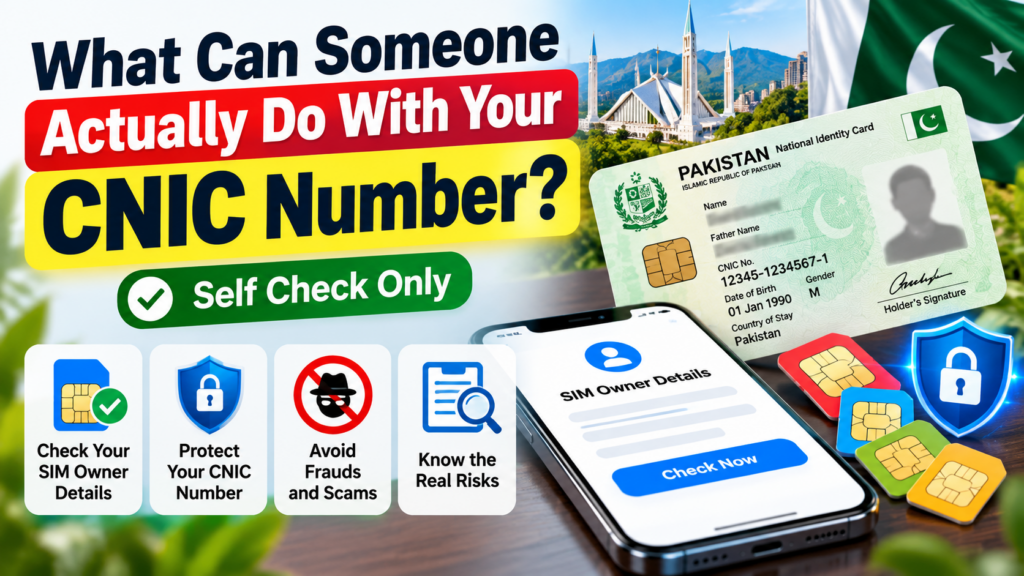
The answer depends on the circumstances.
A leaked CNIC number could potentially be used as an identifying piece of information in an attempted scam, impersonation attempt, fraudulent form, social-engineering attack or unauthorized verification attempt.
Possible risks include:
1. Targeted Scam Attempts
A scammer may already know some information about you.
Adding your CNIC number can make a fake call or message sound more believable.
2. Fake Verification Requests
Someone may claim:
“Your CNIC needs verification.”
They may then ask for:
- OTP
- CNIC photograph
- fingerprint
- bank information
- password
- payment
The danger is often not the CNIC number itself but the additional information the scammer is trying to obtain.
3. SIM-Related Fraud Attempts
A person’s identity information can potentially be involved in unauthorized SIM-registration activity.
PTA’s cyber-safety guidance specifically warns about illegal SIM issuance and recommends that people periodically check SIMs issued in their name.
4. Identity-Based Social Engineering
Someone may use your identity information to convince another person that they are you.
This can be particularly dangerous when several pieces of personal information are already available.
5. Privacy Exposure
A leaked CNIC can make it easier for someone to connect information from different sources.
That is why unnecessary sharing should be avoided.
What a CNIC Number Alone Does NOT Automatically Give Someone
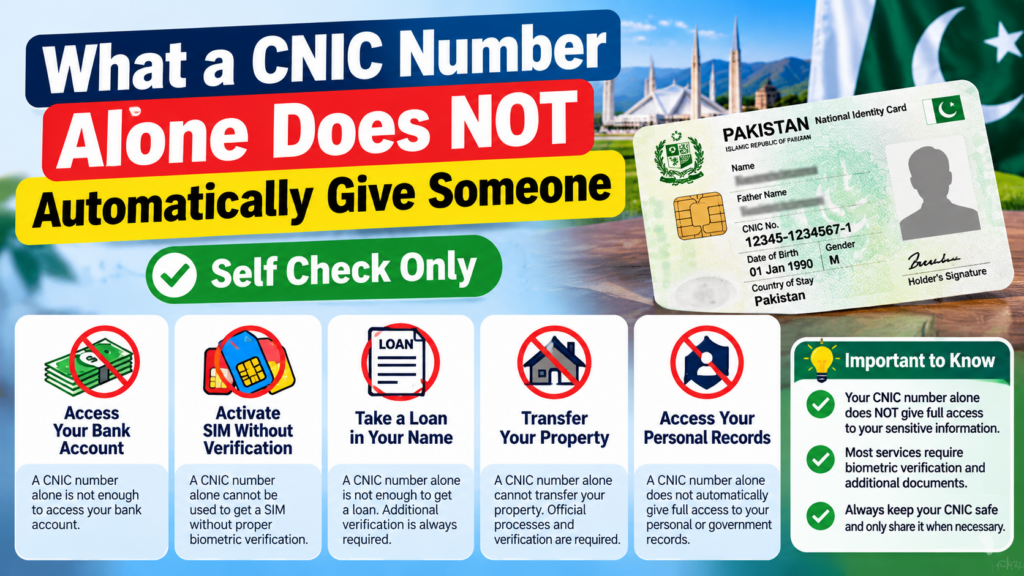
This is one of the most important sections of the article.
A CNIC number alone does not automatically mean that another person can:
- read your WhatsApp messages
- listen to your calls
- see your live location
- access your phone
- know your passwords
- enter your banking app
- obtain every SIM number registered to you
- access your complete NADRA record
- access private telecom records
Different services use different authentication requirements.
NADRA’s own verification services include biometric verification and OTP-based verification, demonstrating that identity verification is not necessarily just a matter of typing a CNIC number.
So if somebody tells you:
“I have your CNIC number, so I can access everything.”
Do not automatically accept that claim.
Instead ask:
What other information do they actually possess?
What service are they trying to access?
What verification does that service require?
That distinction makes CNIC security much easier to understand.
CNIC Number vs CNIC Copy vs Biometric vs OTP
People often treat all personal information as though it has exactly the same security significance.
It does not.
| Information | What it represents | Why you should protect it |
|---|---|---|
| CNIC number | Identity reference | Can identify you in verification contexts |
| CNIC copy/photo | More complete identity information | Contains additional personal details |
| Fingerprint/biometric | Physical identity characteristic | Used in stronger identity-verification processes |
| OTP | Authentication code | May authorize a specific verification/action |
| Password/PIN | Account credential | May directly protect an account |
| Registered mobile number | Telecom/account identifier | Often involved in account communication or verification |
NADRA’s current verification infrastructure includes biometric and OTP-based mechanisms, while its identity-document framework has also been updated with QR-based verification and stronger authentication controls in 2026.
So:
Never treat an OTP or biometric request as “just another verification detail.”
How CNIC Is Connected to SIM Owner Details
This is where the topic becomes especially important for our SIM Owner Details focus.
A CNIC represents an identity.
A SIM represents a telecom connection.
SIM registration creates a relationship between the subscriber’s identity and the telecom connection under the applicable verification process.
Therefore, when you perform a CNIC-based SIM check, the useful question is:
How many SIM registrations are associated with my own CNIC?
That is very different from asking:
What private information can I find about another person’s mobile number?
The first is a legitimate self-check concept.
The second involves another person’s private information and should not be treated as an ordinary public lookup.
Our existing SIM Owner Details guidance follows this self-check principle: review information connected with your own identity rather than treating subscriber information as a public database.
What Does SIM Owner Details Actually Mean?
The phrase SIM Owner Details is commonly used online, but it can mean different things depending on the context.
For responsible self-checking, it should primarily be understood as information related to the registration of a SIM or the SIM connections associated with your own identity.
A CNIC-based SIM check can help answer:
Which SIM registrations are associated with my CNIC?
It should not be interpreted as:
Give me every private detail about another subscriber.
This distinction is extremely important.
A legitimate SIM registration review is not the same thing as an unrestricted “SIM database.”
Why You Should Check SIM Owner Details on Your Own CNIC
Imagine someone has been using your old SIM-registration information without your knowledge.
You may not immediately notice it.
Or perhaps:
- you changed networks
- you stopped using an old SIM
- you replaced a lost SIM
- you have multiple connections
- you have a data SIM
- you forgot about an older registration
Your memory may not match the current registration record.
That is why periodic SIM Owner Details checking can be useful.
PTA’s published cyber-crime prevention guidance specifically recommends periodically checking the number of SIMs issued in your name and blocking illegally issued SIMs.
This is not a guarantee that every type of identity misuse will be detected.
It is simply an important telecom-security check.
How to Check SIM Owner Details on Your Own CNIC
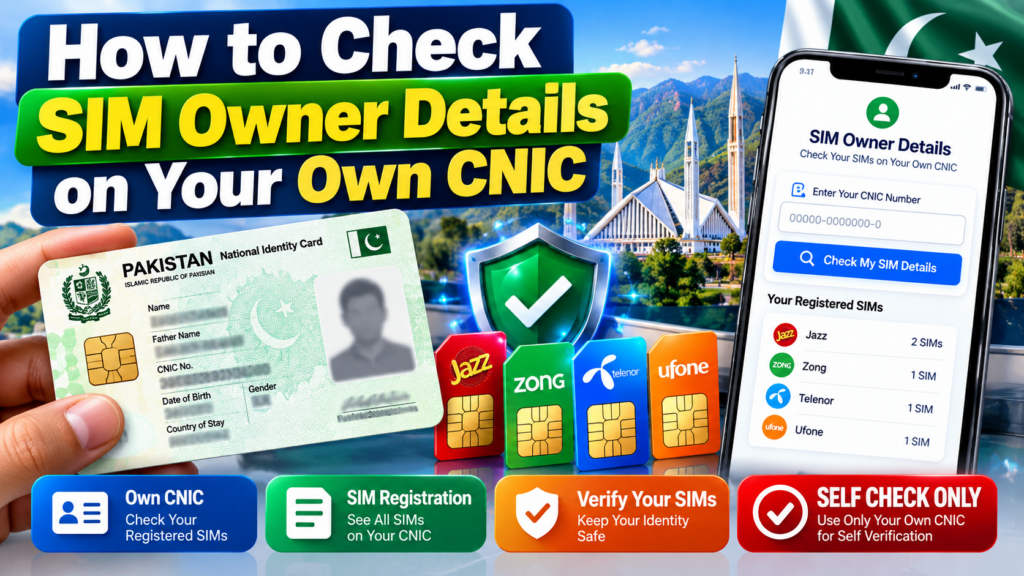
For a personal SIM-registration check, use the recognized official route intended for your own CNIC.
PTA’s published guidance references sending your CNIC number to 668 to check the number of SIMs issued in your name.
Our current FreshSimTracker guidance also explains the distinction between CNIC-based SIM checking and other SIM-related verification services.
Basic self-check process
Step 1 — Use your own CNIC
The purpose is to review your own registration information.
Step 2 — Use the recognized SIM-registration checking route
Follow the current instructions provided by the relevant official service.
Step 3 — Review the result
Look at the registration count and network information presented.
Step 4 — Compare it with your actual connections
Think about:
- current SIMs
- old SIMs
- secondary numbers
- data connections
- previously used networks
Step 5 — Investigate anything you genuinely do not recognize
Do not immediately assume that every unfamiliar result is criminal activity.
First verify it.
Step 6 — Contact the operator if necessary
If you believe a SIM was registered without your authorization, contact the relevant mobile operator through its official support channel.
Step 7 — Escalate when appropriate
If the issue is unresolved or involves suspected fraud, use the appropriate official complaint route.
668 and SIM Owner Details: What Is the Difference?
One common source of confusion is the relationship between 668, online SIM checking and other short codes.
The important point is that different telecom services can have different purposes.
For example, our existing guide explains that 668 is associated with checking SIM registrations linked to your own CNIC, while 667 is associated with a different SIM-related verification/MNP process.
Therefore, do not assume:
667 = 668
or that every short code provides the same information.
Telecom procedures can change, so users should confirm the current instructions through recognized official sources before acting.
Can Someone Get a SIM Using Only Your CNIC Number?
A CNIC number alone should not be assumed to be sufficient for legitimate SIM issuance.
Telecom identity verification exists specifically to establish subscriber credentials.
PTA’s cyber-safety guidance describes unauthorized SIM issuance as a risk and notes that illegal SIM provision can involve misuse of biometric information. It recommends buying SIMs through cellular franchises rather than informal kiosks and periodically checking SIMs issued in your name.
The practical conclusion is:
Knowing your CNIC number is not the same as successfully passing the required subscriber verification.
But that does not mean unauthorized activity is impossible.
That is precisely why SIM Owner Details checks matter.
What If an Unknown SIM Appears on Your CNIC?
Suppose you perform a self-check and the result does not match your understanding.
Do not panic.
Start with verification.
Step 1: Check your own records
Think about old numbers, replacement SIMs and secondary connections.
Step 2: Identify the relevant operator
Determine which network is associated with the unexpected registration.
Step 3: Contact the operator
Explain that you do not recognize the registration and ask for the appropriate verification/correction process.
Step 4: Keep your complaint information
Save:
- complaint/reference number
- date
- operator response
- relevant screenshots
Step 5: Escalate if needed
If the operator-related issue remains unresolved, the PTA complaint route may be relevant. Our dedicated PTA complaint guide covers the official-route approach for telecom complaints.
This approach is much better than searching for an unofficial “SIM database” to investigate the issue yourself.
Can Someone Find Your Full SIM Owner Details From Your CNIC?
Be careful with this question.
A legitimate CNIC-based SIM self-check is designed for reviewing SIM registrations associated with your own identity.
It should not be interpreted as a public database containing every private subscriber detail.
For example, a legitimate self-check should not be treated as a public method for obtaining another person’s:
- home address
- biometric information
- private account records
- call history
- live location
- complete identity profile
Our own SIM Owner Details guide makes the same distinction between a CNIC-linked registration check and unrestricted private subscriber information.
This is one reason why pages claiming to provide “complete SIM owner details” should be approached carefully.
Why Unofficial SIM Databases Can Be Dangerous
You may find websites or social-media posts promising:
“Complete SIM Owner Details”
“SIM database by CNIC”
“SIM owner by number”
“Live SIM data”
“100% verified CNIC data”
A search box does not prove that the underlying information is official.
The information may be:
- outdated
- inaccurate
- incomplete
- unlawfully obtained
- copied from another source
- impossible for you to verify
More importantly, entering your own CNIC into an unknown website creates an additional privacy question:
Who now has your CNIC?
That is why your first choice should be a recognized official route.
What If Someone Has a Photo of Your CNIC?
A CNIC photograph or scanned copy can contain considerably more information than the number alone.
Depending on the document, it may expose information such as:
- name
- CNIC number
- photograph
- date of birth
- other identity-related information
This does not mean that a person holding a CNIC image automatically has access to all your services.
But it may give them more information to use in a targeted scam.
For example, a scammer may combine:
CNIC image + phone number + name
and then attempt to convince you that they represent a bank, telecom operator or government organization.
That is why CNIC copies should be provided only when there is a genuine need.
Never Give an OTP Because Someone Knows Your CNIC
This is one of the simplest rules of identity protection.
Imagine receiving a call:
“We already have your CNIC number. We just need the OTP to complete verification.”
The fact that the caller knows your CNIC does not prove that the caller is legitimate.
Do not share the OTP.
Instead:
- End the conversation.
- Identify which service generated the OTP.
- Contact that service independently.
- Ask whether a verification request was actually initiated.
NADRA’s verification ecosystem itself includes OTP-based verification, which is why an OTP should be treated as an authentication credential rather than ordinary information.
Protect Your Biometric Information
Fingerprints and other biometric information deserve special care.
NADRA’s verification services include biometric matching, while its current identity framework recognizes fingerprints and other biometric modalities as part of identity assurance.
PTA’s cyber-safety guidance also warns about illegal SIM issuance involving misuse of biometric information.
Therefore:
Do not provide a fingerprint scan simply because an unknown person says “verification is required.”
Instead:
- confirm the purpose
- confirm the organization
- use an authorized service point
- do not let strangers operate your identity-verification process without understanding what you are authorizing
Common CNIC Scams You Should Recognize
Fake SIM Blocking Call
Someone says:
“Your SIM will be blocked today.”
They then request your CNIC, OTP or other information.
What to do: Contact your operator independently.
Fake PTA Message
You receive a message claiming that your SIM or phone has violated a rule.
It contains a link.
What to do: Do not enter your identity or banking information into an unknown page.
Fake NADRA Verification
Someone claims:
“Your CNIC record needs urgent verification.”
They request a CNIC photograph or OTP.
What to do: Verify through NADRA’s official channels instead of the contact details supplied by the caller.
Fake Prize or Loan Offer
A caller claims your CNIC was selected for a government benefit, prize or loan.
They ask for money or personal information.
What to do: Independently verify the program.
Fake SIM Upgrade
Someone claims:
“We need your biometric verification to upgrade your SIM.”
If you did not request the upgrade, stop and verify the request.
CNIC Number vs SIM Owner Details: Don’t Confuse the Two
These terms are related, but they are not identical.
| Term | Meaning |
|---|---|
| CNIC | Official identity document |
| CNIC number | Identity reference |
| SIM registration | Association of a telecom connection with subscriber identity |
| SIM Owner Details | General term used for SIM/subscriber registration information |
| CNIC SIM check | Self-check of SIM registrations associated with your identity |
| Operator verification | Process used to resolve a specific SIM/account issue |
| PTA complaint | Regulatory escalation for applicable telecom complaints |
Understanding these differences prevents many online misconceptions.
What If Your CNIC Is Lost?
A lost CNIC is more serious than simply someone knowing the number because the physical document contains additional identity information.
NADRA provides official options for reprinting or replacing lost identity documents, including services through PakID and NADRA registration channels.
After losing your CNIC, consider reviewing important identity-linked services.
For telecom security, a SIM Owner Details self-check can be one useful step.
If you notice something you did not authorize, contact the relevant organization.
Modern CNIC Security Is Changing
Pakistan’s identity-verification system is also evolving.
In February 2026, the Federal Government notified amendments introducing QR-based verification and strengthening authentication controls within the national identity-card framework. NADRA also announced a new QR-code-based national identity card in August 2026.
NADRA’s digital identity ecosystem also includes features such as consent-based access and digital verification.
The practical lesson is simple:
Use the current official verification method rather than relying on old social-media posts or unofficial websites.
Procedures can change.
Short codes, apps, portals and verification requirements can be updated.
Always verify the current procedure before submitting sensitive information.
How to Protect Your CNIC in Everyday Life
You do not need a complicated security system.
A few consistent habits can make a meaningful difference.
1. Don’t publish your CNIC
Avoid posting your CNIC number publicly on:
- WhatsApp groups
- public comments
- forums
- social media
2. Don’t upload CNIC copies unnecessarily
If a random website asks for a CNIC image just to provide “SIM Owner Details,” stop and question why it is required.
3. Protect OTPs
Never disclose an unexpected OTP.
4. Protect biometrics
Use authorized verification channels.
5. Check your SIM registrations
Make SIM Owner Details checking part of your telecom-security routine.
6. Protect your phone
Use a screen lock and keep important apps protected.
7. Be skeptical of urgent calls
“Your SIM will be blocked in 10 minutes” is exactly the type of urgency that should make you slow down rather than act immediately.
A Practical SIM Owner Details Security Checklist
Save this checklist.
CNIC
☐ I do not publish my CNIC publicly.
☐ I only provide it when there is a legitimate reason.
SIMs
☐ I know which SIMs I currently use.
☐ I periodically check SIM registrations associated with my CNIC.
☐ I investigate unfamiliar registrations.
OTP
☐ I never give an OTP to an unexpected caller.
☐ I verify unexpected OTP messages independently.
Biometrics
☐ I use authorized verification channels.
☐ I understand what service I am authorizing.
Online
☐ I avoid unofficial SIM databases.
☐ I do not upload my CNIC to random websites.
Complaints
☐ I keep evidence if I discover suspicious activity.
☐ I know which organization handles the particular issue.
What Should You Do If You Suspect Identity Misuse?
The correct response depends on what actually happened.
If it is a SIM problem
Start with the relevant mobile operator.
If it is a CNIC/document problem
Use NADRA’s official support and identity-service channels.
If it is an unresolved telecom complaint
Use the applicable PTA complaint route.
If it involves suspected cybercrime or identity fraud
Use the appropriate official law-enforcement/cybercrime reporting channel.
Do not rely on a person online who says:
“Send me your CNIC and I will remove your SIM.”
That can create another privacy risk.
When Should You Contact NADRA?
NADRA is the relevant authority for national identity-document and identity-record services.
Examples include:
- CNIC issuance
- CNIC renewal
- CNIC modification
- lost/reprint services
- identity verification
- identity-record issues
NADRA’s current official services include PakID for identity-related applications and tracking, while its verification services include biometric and consent-based verification mechanisms.
For an ordinary telecom registration problem, however, the mobile operator is usually the appropriate first point of contact.
When Should You Use PTA Support?
PTA is relevant to telecom regulatory and consumer matters.
If you have:
- an unauthorized SIM issue
- an unresolved operator complaint
- a telecom-service dispute
- a SIM-related regulatory problem
the appropriate operator/PTA route may be relevant.
Our dedicated PTA complaint guide explains the official-route approach to telecom complaints.
The key is to send the complaint to the organization responsible for the actual problem.
What About the Law?
Pakistan’s legal framework includes protections relating to identity information and unauthorized electronic activity.
But legal questions should be handled carefully.
Not every instance of someone knowing your CNIC is automatically identity theft.
Likewise, not every request for a CNIC is fraudulent.
The important distinction is between:
legitimate identity verification
and
unauthorized acquisition, use or misuse of identity information.
NADRA’s current identity-security framework emphasizes stronger authentication, while NADRA and the National Forensics Agency announced cooperation in 2026 covering identity-related challenges, biometric disputes, identity fraud and forensic examination within their legal mandates.
If you believe an actual offence has occurred, document the evidence and use the relevant official reporting route rather than relying on social-media legal advice.
CNIC Misuse: Myths vs Facts
| Myth | Fact |
|---|---|
| Anyone with my CNIC can see everything about me | A CNIC number alone does not automatically provide access to every service |
| CNIC number automatically gives live location | A CNIC number is not a live-location tool |
| Someone can read WhatsApp using CNIC | CNIC knowledge alone does not provide WhatsApp access |
| 668 gives private details of anyone | The self-check concept is for SIM registrations associated with your own CNIC |
| Every SIM database website is official | An online search result does not prove official authorization |
| Biometric verification makes fraud impossible | It is an important security control, but suspicious activity should still be investigated |
| No unknown SIM means my identity is completely safe | SIM checking is one security measure, not a complete identity audit |
| I should give an OTP because the caller knows my CNIC | Knowing your CNIC does not prove the caller is legitimate |
10 Questions to Ask Before Sharing Your CNIC
Before giving your CNIC to a person or website, ask:
1. Who is requesting it?
2. Why do they need it?
3. Is the request legitimate?
4. Is this an official channel?
5. Do they actually need a copy?
6. Am I being asked to click an unknown link?
7. Are they asking for an OTP?
8. Are they unexpectedly asking for biometric verification?
9. Can I independently verify the request?
10. Is there a safer official method?
If you cannot answer these questions confidently, stop before sharing the information.
Frequently Asked Questions About CNIC and SIM Owner Details
Can someone misuse my CNIC number?
A CNIC number can become part of an identity-misuse or social-engineering attempt, especially when combined with other information. However, the number alone does not automatically provide access to every service associated with you.
Can someone register a SIM using my CNIC?
Legitimate SIM registration involves subscriber verification. PTA’s cyber-safety guidance nevertheless warns about illegal SIM issuance and recommends periodically checking SIMs issued in your name.
How can I check SIM Owner Details?
For your own identity, use the recognized SIM-registration self-check route. PTA’s published guidance references sending your CNIC number to 668 to check the number of SIMs issued in your name.
Can I check someone else’s SIM Owner Details?
This guide is for self-checking your own information. Private subscriber information should not be treated as a public lookup service.
Can my CNIC number reveal my live location?
No. A CNIC number by itself is not a live-location tracking tool.
Can someone read my WhatsApp messages using my CNIC?
Knowing a CNIC number does not by itself provide access to WhatsApp messages.
What if an unknown SIM appears against my CNIC?
Review your own records first, then contact the relevant mobile operator. If necessary, use the appropriate PTA complaint route.
Should I upload my CNIC to a SIM Owner Details website?
Avoid unofficial websites requesting sensitive identity information. Use recognized official verification routes instead.
Is a CNIC photo more sensitive than the number?
A CNIC image contains more identity information than the number alone, so it should be protected accordingly.
Should I give my OTP to a person who knows my CNIC?
No. Knowing your CNIC does not prove that the caller is legitimate.
Does checking SIM Owner Details prove that my CNIC has never been misused?
No. It checks an important telecom-related part of your identity footprint but cannot detect every type of identity misuse.
How often should I check SIM Owner Details?
A periodic review is reasonable, particularly after losing a SIM, changing networks, discovering suspicious activity or realizing that you have several old connections.
Can a CNIC number alone open a bank account?
Do not assume that. Financial services use their own applicable customer-identification and authentication procedures.
Is every request for my CNIC suspicious?
No. Legitimate organizations may require identity information for valid services. The important issue is whether the request is genuine, necessary and made through an appropriate channel.
Final Takeaway
Your CNIC number deserves protection, but understanding the actual risk is more useful than panicking over every exposure.
A CNIC number alone does not automatically unlock your phone, messages, live location, bank account or every SIM registered in your name.
The greater concern is when identity information is combined with other sensitive information such as:
- CNIC copies
- mobile numbers
- OTPs
- passwords
- biometric information
- account credentials
For telecom security, one of the most practical habits is to understand and periodically review your SIM Owner Details.
Check the SIM registrations associated with your own CNIC.
If everything matches your records, continue normal monitoring.
If something looks unfamiliar, investigate it through the relevant mobile operator.
If an issue remains unresolved, use the appropriate official complaint route.
And if someone contacts you claiming to be from PTA, NADRA, a bank or a mobile operator, do not trust the request simply because they know your CNIC number.
Verify the organization independently. Never give away an unexpected OTP. Protect your biometric information. Avoid unofficial SIM databases. And keep your CNIC copies under control.
The goal of SIM Owner Details checking is not to search other people’s private information.
The goal is much more useful:
Understand the SIM registrations connected to your own identity, identify anything you genuinely do not recognize, and take action through the proper official channel.
Pakistan’s identity-verification environment is continuing to evolve, including stronger digital and QR-based verification mechanisms, so users should also avoid relying on outdated procedures copied from old articles or social-media posts.
For current identity matters, use NADRA’s official services. For telecom registration matters, use the relevant operator and PTA channels. For your own SIM Owner Details, keep the process focused on self-checking, privacy and responsible verification.
Leave a Reply