Track Phone Number in Pakistan is a common search when people receive unknown calls, suspicious messages, harassment, or threats involving a mobile number.
If you have received a suspicious call, an unknown WhatsApp message, repeated harassment, or a threat such as “I know your location”, you may immediately search for a way to track the phone number in Pakistan.
But there is an important difference between checking information about a number and secretly obtaining someone’s private location, call records, messages, or identity information.
A normal mobile user cannot simply enter any Pakistani number into a website and legally obtain its live location, private call history, or complete subscriber record. Some information can be checked through official self-service systems, while more sensitive telecom and digital information may be available to authorised investigators through legal procedures.
This guide explains the difference in simple terms and focuses on what an ordinary person in Pakistan can legally check for themselves, what requires an official investigation, and how to respond if someone is misusing a phone number.
Educational note: This article is for general information and self-check guidance. Specific legal cases can depend on the facts, applicable law and current procedures.
If you want to learn more about SIM ownership, CNIC-based SIM checks, mobile number verification, privacy protection, and other related topics in Pakistan, explore our SIM Owner Details guide. It brings together practical, educational information to help you understand what you can check yourself through official channels and how to protect your mobile identity.
Quick Answer: Can You Track a Phone Number in Pakistan?
Not in the way many websites advertise.
A phone number can be associated with telecom records, subscriber information and network activity, but that does not mean the general public has access to someone’s live location or private telecom records.
There are several different things people mean when they say “track a number”:
- checking which network a number belongs to;
- checking how many SIMs are registered against your own CNIC;
- investigating an unknown SIM appearing against your own identity;
- identifying a number through information that has been voluntarily made public;
- finding the location of your own lost device through its own account/device features;
- obtaining telecom traffic data during an authorised investigation;
- collecting information in real time under a lawful process.
These are not the same activity.
Pakistan’s current electronic-crime framework includes specific procedures for investigation and access to certain types of data. For example, PECA provides mechanisms concerning traffic data, stored content and real-time collection, while the law also establishes the NCCIA as the investigation agency for offences covered by the Act.
What Does “Track a Phone Number” Actually Mean?
Before discussing the law, it helps to separate the different types of information involved.
1. Network information
This tells you which mobile network a number is associated with.
It does not normally tell you:
- the person’s live GPS position;
- their home address;
- their current street;
- their private messages;
- their call recordings.
Pakistan’s official SIM Information System currently provides a network-check facility. It states that you can send:
N 03xx3456789
to 76367 to check the network of a number, subject to the stated charge.
2. SIM registration information
This concerns subscriber registration and SIMs associated with an identity.
For example, you can check the number of SIMs registered against your own CNIC through the official SIM Information System.
3. Traffic data
This is much more technical than a simple “owner lookup.”
Depending on the system and applicable records, traffic information can relate to communications activity and associated technical information.
It should not automatically be described as the contents of calls or messages.
4. Content data
Content is different from traffic information.
For example, a person’s actual stored communication content is a much more sensitive category of information.
PECA Section 34 provides a court-based mechanism for disclosure of stored content data when the statutory requirements for a criminal investigation or proceeding are met.
5. Real-time information
Real-time collection is different again.
Section 39 of PECA provides for court-authorised real-time collection or recording in connection with a specific criminal investigation when the statutory conditions are satisfied. The provision also sets limits and requires the application to identify the relevant offence and explain why the collection is necessary.
So, “phone number tracking” is not one single service. It can refer to several completely different categories of information.
What Can You Check Yourself in Pakistan?
For an ordinary user, the safest approach is to start with information that official systems actually make available.
1. Check the Network of a Mobile Number
If your question is simply:
“Which network does this number use?”
you do not need a “live tracker.”
The official SIM Information System currently provides a network-check method using 76367.
This is useful when:
- you are checking an unfamiliar number;
- you want to know its current network;
- you are troubleshooting a telecom issue;
- you want to verify network information before contacting an operator.
Important: Network information is not the same as subscriber identity or location.
2. Check SIMs Registered Against Your Own CNIC

This is one of the most useful self-checks for Pakistani mobile users.
If you want to know:
“How many SIMs are registered against my CNIC?”
use the official SIM Information System rather than an unofficial database.
The official system specifically provides a CNIC-based facility for checking the total number of SIMs registered against your identity.
Official SIM Information System — CNIC SIM Check
Why this check matters
You should periodically review your registered SIM information because an unfamiliar SIM association can indicate a problem that deserves further investigation.
If you find something you do not recognise, don’t immediately assume that an online “SIM tracker” can solve it.
Instead:
- record the information shown by the official system;
- contact the relevant mobile operator;
- ask about the proper verification/disowning process;
- preserve evidence if you suspect misuse of your identity;
- use the appropriate official complaint channel if necessary.
3. Can You Find the Owner of Any Pakistani Number?
This is where many online searches become misleading.
People often search:
“SIM owner details by number”
or:
“Find CNIC from mobile number.”
A public user should not assume that a website displaying a name or CNIC is providing an authorised, current telecom subscriber record.
There is a major difference between:
Publicly available information
and
private subscriber information held within telecom systems.
If someone has placed their number publicly on a business page, advertisement or social profile, you may be able to identify them from that public information.
That is completely different from obtaining confidential subscriber information from a telecom operator.
4. Can You Get Someone’s Live Location From Their Number?
This is one of the biggest myths surrounding phone-number tracking in Pakistan.
Entering a phone number into a random website does not automatically give you that person’s live GPS location.
A mobile number itself is not a magic GPS key.
Location-related information can involve:
- device/network information;
- cellular infrastructure;
- application permissions;
- account-based location services;
- technical network records;
- investigative tools.
These systems are not equivalent.
A website claiming:
“Enter any number and see its live location”
should therefore be treated with extreme caution.
A page displaying a fake map, loading animation or supposed “GPS coordinates” does not prove that it has access to a person’s actual location.
5. What About CDR — Call Detail Record?
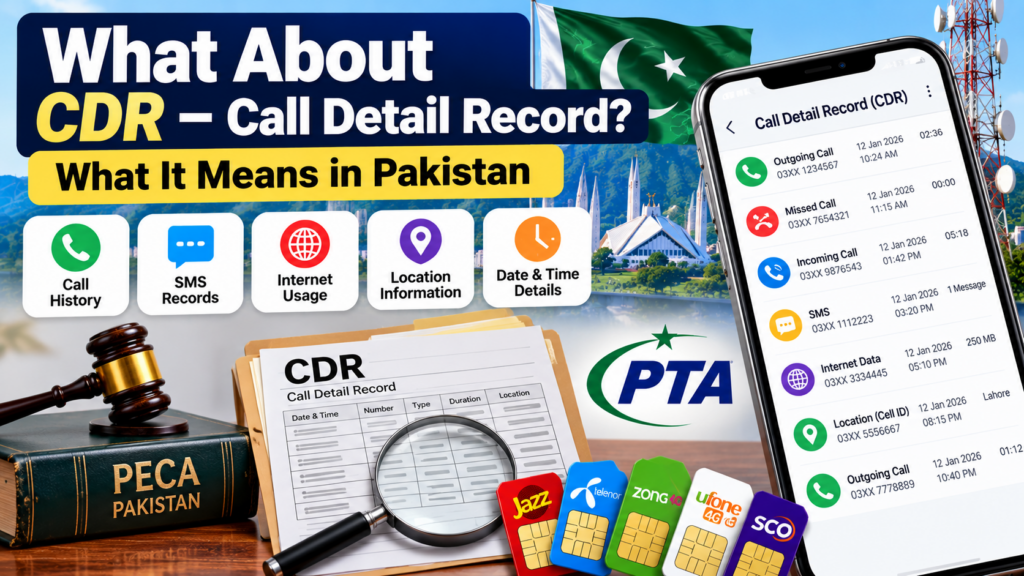
CDR is another term frequently misunderstood.
A Call Detail Record should not simply be described as a recording of someone’s phone call.
Traffic and telecom records can contain technical information associated with communications, but traffic information and communication content are separate concepts.
This distinction is important because many websites use phrases such as:
“Get complete CDR”
as if an ordinary person can instantly obtain another subscriber’s complete private telecom history.
That is not how the official legal framework should be understood.
PECA Section 32 addresses retention of specified traffic data by service providers and provides for its provision to the investigation agency or authorised officer subject to a court-issued warrant.
What Does the Law Say About Telecom and Digital Tracking?
Pakistan’s legal framework contains several provisions relevant to digital investigations.
The current Pakistan Code version of PECA identifies offences and investigation procedures covering unauthorised access, unauthorised copying or transmission, unauthorised identity-information use, unauthorised interception, cyber stalking and related matters.
Let’s break down the important concepts.
PECA Section 16 — Unauthorised Use of Identity Information
Identity information is particularly important when discussing SIM databases and personal information.
Section 16 addresses obtaining, selling, possessing, transmitting or using another person’s identity information without authorisation. The section also provides a mechanism through which a person whose identity information has been affected may seek measures concerning that information.
This is highly relevant to situations where somebody claims to have:
- your CNIC details;
- your SIM information;
- your identity information;
- your personal database record.
If someone is circulating or misusing your identity information, don’t assume that buying another person’s database from the internet is an appropriate response.
PECA Section 17 — Unauthorised SIM Issuance
PECA also contains a specific provision concerning unauthorised issuance of SIM cards and similar subscriber-identification modules.
Section 17 addresses providing SIMs without obtaining and verifying subscriber antecedents according to the mode and manner approved by PTA.
This demonstrates why SIM registration is not simply an informal database matter.
The identity attached to a SIM is part of a regulated telecom process.
PECA Section 19 — Unauthorised Interception
Another important provision is Section 19.
It addresses unauthorised interception by technical means of certain non-public transmissions and electromagnetic emissions carrying data.
This matters because “tracking someone’s phone” can sometimes cross into activities involving interception or unauthorised access.
Simply being curious about a number does not give someone automatic authority to access another person’s private communications.
PECA Section 24 — Cyber Stalking
Phone-number abuse can also become a cyber-stalking issue.
The current PECA text describes cyber stalking in circumstances involving conduct such as repeatedly contacting someone despite clear disinterest, monitoring electronic communications, or watching/spying in a manner that causes fear, serious alarm or distress.
This is particularly relevant if a person is:
- repeatedly calling you;
- repeatedly messaging you;
- monitoring you online;
- threatening you;
- claiming they are watching your movements;
- using digital tools to intimidate you.
The important point is that the problem may not be “phone tracking” alone. The broader conduct can matter.
For reliable information about SIM registration, telecom services, and identity-related matters in Pakistan, it is better to use official government sources instead of unofficial SIM databases. You can visit the Pakistan Telecommunication Authority (PTA) for telecom-related information, consumer guidance, and regulatory updates. For CNIC and identity-related services, the National Database and Registration Authority (NADRA) is the appropriate official source. Always verify sensitive SIM or CNIC information through these official channels before sharing personal details with any third-party website.
Who Can Investigate Cybercrime-Related Cases?
The current PECA framework establishes the National Cyber Crime Investigation Agency (NCCIA) for inquiry, investigation and prosecution of offences specified under the Act.
The NCCIA’s own FAQ states that it is the authorised law-enforcement agency under Section 29(1) of the amended PECA framework for relevant inquiries, investigations and prosecutions.
NCCIA Complaint Registration Portal
So if the issue involves:
- cyber harassment;
- online fraud;
- identity misuse;
- threats;
- digital stalking;
- hacking;
- serious online abuse;
- suspected cybercrime,
the appropriate route is an official complaint/investigation process rather than purchasing data from an unofficial tracker.
How Does Lawful Data Investigation Work?
The legal process is more structured than the typical “enter number and track” websites suggest.
Traffic Data — Section 32
Under PECA Section 32, service providers are required, within their existing or required technical capability, to retain specified traffic data for at least one year or another period notified by the Authority, and provide that data to the investigation agency or authorised officer subject to a court-issued warrant.
That does not mean a member of the public can request another person’s traffic records simply because they know the phone number.
Stored Content — Section 34
Stored content is treated separately.
Under Section 34, an authorised officer can apply to the court where there are reasonable grounds to believe that stored content data is required for a criminal investigation or proceeding concerning an offence under the Act. The court may then order disclosure subject to the statutory requirements.
This is another reason why:
CDR ≠ call recording ≠ live GPS ≠ private messages.
Each category involves different information and potentially different legal procedures.
Real-Time Collection — Section 39
Section 39 is particularly important when people use the word “live tracking.”
The provision states that where a court is satisfied, based on information from an authorised officer, that there are reasonable grounds to believe information is reasonably required for a specific criminal investigation, the court may order real-time collection or recording in accordance with the statutory framework.
The provision also states that the initial real-time collection or recording should not exceed what is absolutely necessary and, under the section, should not be ordered for more than seven days without an authorised extension.
Therefore, a legitimate investigative capability should not be confused with a public “live location by mobile number” website.
What About Section 54 of the Telecom Act?
The Pakistan Telecommunication (Re-organization) Act, 1996 also contains provisions concerning national security and interception/tracing.
Section 54 provides a framework under which the Federal Government may authorise interception of calls and messages or tracing of calls through a telecommunication system in the circumstances specified by the section.
A 2024 government notification also referred to Section 54 in authorising specified ISI officers of the required rank to intercept calls/messages or trace calls in the circumstances stated in the notification.
The important takeaway for an ordinary mobile user is simple:
The existence of lawful interception or tracing powers does not mean that those powers are available to private individuals.
Private Phone Tracking vs Lawful Investigation
| Activity | Ordinary user | Official investigation |
|---|---|---|
| Check network of a number | ✅ | ✅ |
| Check SIMs against your own CNIC | ✅ | ✅ |
| Check your own device location | ✅ | ✅ |
| Ask a random website for someone’s live GPS | ❌ Not a reliable official method | — |
| Obtain another person’s private CDR | ❌ | May be obtained through lawful process |
| Obtain stored private content | ❌ | Subject to applicable legal process |
| Real-time investigative collection | ❌ | Subject to statutory/court requirements |
| Investigate cybercrime | Report it | NCCIA/investigative process |
| Use another person’s identity data without authorisation | ❌ | Governed by law |
Why Do Some Websites Claim They Can Track Any Number?
Search results can make this area confusing.
You may see websites or apps promising:
- “Live SIM Tracker”
- “Mobile Number GPS”
- “SIM Owner Database”
- “Complete CDR”
- “CNIC Details”
- “Exact Location”
- “Live Number Tracking”
- “Private SIM Data”
The existence of such a claim does not establish that the service has legitimate access to official telecom information.
Some pages may simply:
- collect your phone number;
- show a generic map;
- display public information;
- ask you to install an application;
- request payment;
- request an OTP;
- request CNIC information;
- redirect you to advertising;
- attempt to collect personal data.
Never confuse a search result with an official telecom record.
A professional-looking website can still be unofficial.
A Major Warning: Never Give Your OTP to a “Tracker”
This deserves special attention.
Suppose a website says:
“We need to verify your number. Enter the OTP sent to your phone.”
Stop before entering it.
An OTP can be connected to:
- account login;
- number verification;
- password reset;
- payment authentication;
- social-media account access;
- other sensitive services.
If someone asks for your OTP while claiming to be providing a phone-tracking service, verify exactly what service is being authenticated.
An OTP is not a tracking tool.
It may be an authentication credential.
Should You Upload Your CNIC to a Random SIM Database?
No.
If a website says:
“Upload your CNIC to unlock SIM owner details”
you should first ask:
- Who operates this website?
- Why does it need my CNIC?
- Is the service officially authorised?
- What happens to the uploaded document?
- Is the information stored?
- Who can access it?
- Is there an official alternative?
For your own SIM-count check, use the official SIM Information System rather than handing your identity document to an unknown website.
What If Someone Says “I Know Your Location”?
Don’t automatically believe the claim.
A person can say:
“I know where you are.”
That statement alone does not prove they have live GPS access.
Consider other possibilities:
- They may know your location because you told them.
- They may have seen a public post.
- They may know your workplace or neighbourhood.
- They may be bluffing.
- Someone may have shared your information.
- A location-sharing feature may have been enabled.
- Your account or device may actually have been compromised.
What should you do?
- Don’t argue with the person about technical details.
- Save screenshots.
- Save the phone number/account username.
- Preserve dates and times.
- Don’t send them additional personal information.
- Review location-sharing settings on your own accounts.
- Change passwords if compromise is suspected.
- Enable two-factor authentication.
- Block/report the account where appropriate.
- If the behaviour amounts to cybercrime or a serious threat, consider an official complaint.
NCCIA provides official complaint channels and asks complainants to provide relevant information/evidence.
What If an Unknown SIM Appears Against Your CNIC?
This is a different problem from tracking a phone number.
Suppose you check your CNIC and discover a SIM association that you don’t recognise.
Your priority should be identity protection, not trying to find the person yourself.
Recommended sequence
Step 1 — Confirm the information
Use the official SIM Information System.
Step 2 — Identify the relevant operator
Determine which network is involved.
Step 3 — Contact the operator
Ask about the official procedure for verification, correction or disowning.
Step 4 — Preserve evidence
Keep screenshots, complaint numbers and relevant documents.
Step 5 — Escalate if necessary
If you suspect deliberate identity misuse or cybercrime, consider using the appropriate official complaint mechanism.
PECA Section 16 specifically addresses unauthorised use of identity information.
What If Someone Is Harassing You Through a Phone Number?
You do not need to become a private investigator.
Start by preserving evidence.
Keep:
- screenshots;
- call logs;
- SMS messages;
- WhatsApp messages;
- usernames;
- profile links;
- dates and times;
- payment requests;
- threatening statements;
- any relevant audio/video evidence that you are lawfully able to preserve.
Don’t delete everything immediately.
Evidence can become important if the situation develops into a formal complaint.
The current PECA text specifically addresses cyber stalking and related conduct.
NCCIA’s official complaint system allows citizens to submit cybercrime complaints and provides information about complaint centres.
Can You Track Your Own Lost Phone?
This is a completely different situation.
If you are trying to find your own lost or stolen phone, use the official device/account recovery tools associated with your device platform.
Depending on the device and settings, these services may help you:
- locate your own device;
- make it ring;
- lock it;
- display a message;
- review its last known location;
- protect your account.
This should not be confused with secretly tracking another person’s device.
If the device has been stolen, preserve the relevant device information and consider reporting the theft through appropriate official channels.
Phone Number Tracking vs SIM Owner Details
These terms are often mixed together.
| Term | What it generally refers to |
|---|---|
| Phone number | The number used for communication |
| SIM | Subscriber identity module associated with mobile service |
| SIM owner details | Subscriber/registration information |
| Network check | Identifying the mobile network |
| CNIC SIM check | SIM associations with your own identity |
| CDR | Telecom/traffic record information |
| Location data | Information relating to device/network location |
| Live tracking | Real-time location or information collection |
| Call content | Actual communication content |
| Identity information | Information capable of identifying/authenticating a person or system |
Understanding these differences prevents many online scams.
What You Should NOT Believe
Myth 1: “Every mobile number can be tracked by Google.”
Reality: A search engine does not provide ordinary users with a private telecom live-location database.
Myth 2: “A SIM owner website can always show the current owner.”
Reality: An unofficial website’s displayed information should not automatically be treated as an authoritative current subscriber record.
Myth 3: “CDR means the complete recording of calls.”
Reality: Traffic/telecom records and communication content are different categories.
Myth 4: “If a website shows a map, it has my GPS.”
Reality: A map interface can be generated without having your actual live location.
Myth 5: “If someone knows my number, they know my location.”
Reality: Knowing a phone number alone does not establish that the person has your live GPS location.
Myth 6: “I can buy someone else’s CNIC/SIM data online.”
Reality: The existence of a seller does not make the acquisition or use of another person’s identity information lawful.
PECA Section 16 specifically addresses unauthorised handling of another person’s identity information.
A Better Self-Check Method
If you are searching “track phone number in Pakistan”, first identify what you actually need.
If you want to know the network:
Use the official network-check facility.
If you want to know how many SIMs are on your CNIC:
Use the official SIM Information System.
If you see an unknown SIM:
Contact the relevant operator and investigate possible identity misuse.
If somebody is harassing you:
Preserve evidence and use an appropriate complaint route.
If you want another person’s live location:
Don’t rely on random tracking websites.
If you need private telecom records for a legal case:
Use the proper investigative/legal process rather than purchasing data online.
If your own phone is lost:
Use the device’s official recovery/location tools.
A Simple Phone Number Tracking Decision Tree
You have a phone number. What do you want to know?
“Which network is this?”
→ Official network check.
“Is a SIM registered against my CNIC?”
→ Official CNIC SIM check.
“Who is secretly using my CNIC?”
→ Confirm official records → operator → complaint if necessary.
“Who keeps harassing me?”
→ Preserve evidence → block/report → official complaint if necessary.
“Where is another person’s phone right now?”
→ A public number lookup is not a legitimate substitute for authorised location access.
“Where is my own lost phone?”
→ Use the device’s official account/location service.
“I need telecom records for an investigation.”
→ Follow the applicable legal/investigative procedure.
This approach is much safer than searching random “SIM tracker” websites.
How to Protect Your Phone Number and SIM Information
Phone-number privacy begins with reducing unnecessary exposure.
Keep your CNIC private
Don’t upload a CNIC image to an unknown website just because it promises SIM details.
Don’t share OTPs
Treat unexpected OTP requests as a security warning.
Review your SIM registrations
Periodically check the SIMs associated with your own CNIC through the official system.
Review app permissions
Pay particular attention to:
- location;
- contacts;
- SMS;
- phone;
- microphone;
- camera.
Only allow permissions that make sense for the app’s function.
Protect your accounts
Use strong, unique passwords and two-factor authentication where available.
Be careful with public location posts
A person may learn your approximate location from your own public content without having access to telecom tracking.
Don’t buy leaked databases
Besides the legal/privacy issues, such databases may be outdated, fabricated or malicious.
If Someone Claims to Have Your SIM Data
Ask yourself what they actually showed you.
There is a big difference between:
“I know your mobile number.”
and:
“I have access to private telecom records.”
Someone may know your number from:
- an old contact list;
- a business listing;
- a WhatsApp profile;
- a social network;
- an online advertisement;
- a previous conversation;
- a leaked or publicly exposed database.
Therefore, don’t confirm additional personal details simply because someone claims to already know them.
For example, if a stranger says:
“Your CNIC ends in XXXX, right?”
don’t respond:
“Yes, and my address is…”
That gives the person more information.
What Evidence Should You Keep?
If tracking, harassment or identity misuse becomes a serious issue, create a simple evidence folder.
Include:
- original screenshots;
- phone number;
- profile URL;
- date/time;
- call history;
- messages;
- transaction details;
- emails;
- complaint numbers;
- relevant documents.
Avoid editing the original evidence unnecessarily.
Keep an original copy and a separate working copy if you need to highlight information.
NCCIA’s official FAQ specifically mentions providing a CNIC copy and evidence copy when registering a complaint.
When Should You Consider an Official Complaint?
Consider escalating when the issue involves circumstances such as:
- repeated digital harassment;
- threats;
- impersonation;
- identity misuse;
- online fraud;
- account compromise;
- unauthorised access;
- serious stalking;
- distribution of private information;
- suspected cybercrime.
NCCIA currently provides an online complaint registration portal and lists reporting centres and contact information.
Submit a Cybercrime Complaint to NCCIA
For an urgent physical safety threat, don’t rely solely on an online form; contact the appropriate emergency/law-enforcement service as appropriate to the circumstances.
Can PTA or NCCIA Give You Someone’s Personal Details?
You should not interpret official complaint or regulatory systems as public reverse-lookup databases.
The purpose of an investigation is different from giving private subscriber information to anyone who asks for it.
NCCIA’s current official material describes its role in cyber investigation, digital forensics and prosecution, while its complaint process is designed for reporting cybercrime.
Therefore, if your purpose is:
“I just want to know who owns this number.”
that is different from:
“This number is being used to threaten or defraud me, and I need authorities to investigate.”
The second situation has an identifiable investigative context.
Important Difference Between Legal Authority and Public Access
This distinction is often missed.
A law may give an authorised institution certain investigative powers.
That does not mean every citizen has the same access.
For example, PECA provides legal mechanisms involving:
- preservation of data;
- retention of traffic data;
- search and seizure;
- disclosure of stored content;
- real-time collection.
These are investigative mechanisms governed by statutory procedures rather than public self-service tools.
So when reading about “government phone tracking,” don’t conclude:
“Therefore I can track anyone’s phone number.”
The two situations are fundamentally different.
What Information Is Safe to Self-Check?
| Information | Self-check possibility |
|---|---|
| Your own CNIC’s SIM count | ✅ Official system |
| Network of a number | ✅ Official network check |
| Your own device location | ✅ Device/account tools |
| Publicly posted business number | ✅ Public information |
| Another person’s live GPS | ❌ Not a normal public lookup |
| Another person’s private CDR | ❌ Not a normal public lookup |
| Another person’s private messages | ❌ Not a normal public lookup |
| Another person’s confidential CNIC data | ❌ Do not seek through unofficial databases |
| Cybercrime evidence about your case | ✅ Preserve and submit through proper channels |
Frequently Asked Questions
Can I track a mobile number in Pakistan for free?
It depends on what you mean by “track.”
You may be able to perform certain official checks, such as checking a number’s network or checking SIMs associated with your own CNIC. These are not the same as obtaining someone’s live location.
Can I find the exact location of a phone number?
A normal public user should not expect an official public service that reveals another person’s exact live GPS location simply from their phone number.
If a website promises this, investigate the service carefully before providing information or payment.
Can I find SIM owner details from a mobile number?
Do not treat random online databases as authoritative subscriber records.
If the issue concerns your own CNIC or suspected identity misuse, use official telecom and complaint channels.
Can I get someone’s CDR?
Private telecom records are not a normal public lookup service.
PECA Section 32 provides a legal framework for specified traffic data and requires a court-issued warrant for provision to the investigation agency or authorised officer.
Is CDR the same as call recording?
No.
Traffic/record information and the actual content of a communication are different concepts. PECA separately addresses traffic data and stored content data.
Can NCCIA investigate a phone-number-related cybercrime?
NCCIA is the investigation agency established under the current PECA framework for relevant offences under the Act. Its official FAQ provides complaint and reporting-centre information.
Someone says they have my location. What should I do?
Don’t panic and don’t provide more information.
Save the messages, screenshots and number. Review your account/device location settings and consider an official complaint if the conduct involves harassment, threats or another cybercrime.
How can I check SIMs on my CNIC?
Use the official SIM Information System. It provides a facility for checking the total number of SIMs registered against a CNIC.
Check SIMs Registered Against Your CNIC
How can I check the network of a Pakistani number?
The official SIM Information System currently states that you can send “N 03xx3456789” to 76367 for the network check, with the stated charge plus tax.
Because telecom procedures and charges can change, verify the current instructions on the official system before using them.
Is a “live SIM tracker” website trustworthy?
Not automatically.
A website can claim to track a number without having legitimate access to telecom location information. Never provide your OTP, CNIC scan, account password or other sensitive information merely because a website promises a location result.
Final Takeaway
The phrase “Track Phone Number in Pakistan” covers several very different things.
You can perform legitimate self-checks such as:
- checking a number’s network;
- checking SIMs registered against your own CNIC;
- reviewing your own device’s location;
- investigating information that has been voluntarily made public.
But private information such as another person’s telecom records, stored communications or real-time investigative information should not be confused with ordinary public lookup services.
Pakistan’s current PECA framework contains provisions dealing with identity information, unauthorised interception, cyber stalking, traffic-data retention, stored-content disclosure and real-time collection. It also establishes NCCIA as the investigation agency for relevant offences under the Act.
The safest approach is therefore:
Self-check what official systems actually allow → protect your personal information → preserve evidence when something is wrong → use the proper operator or official complaint channel when an investigation is needed.
If your goal is simply to identify an unknown number, don’t hand over your CNIC or OTP to an unverified “tracker.” If your concern is that someone is actually harassing, threatening, impersonating or misusing your identity, preserve the evidence and use the appropriate official route.
Leave a Reply