ntroduction
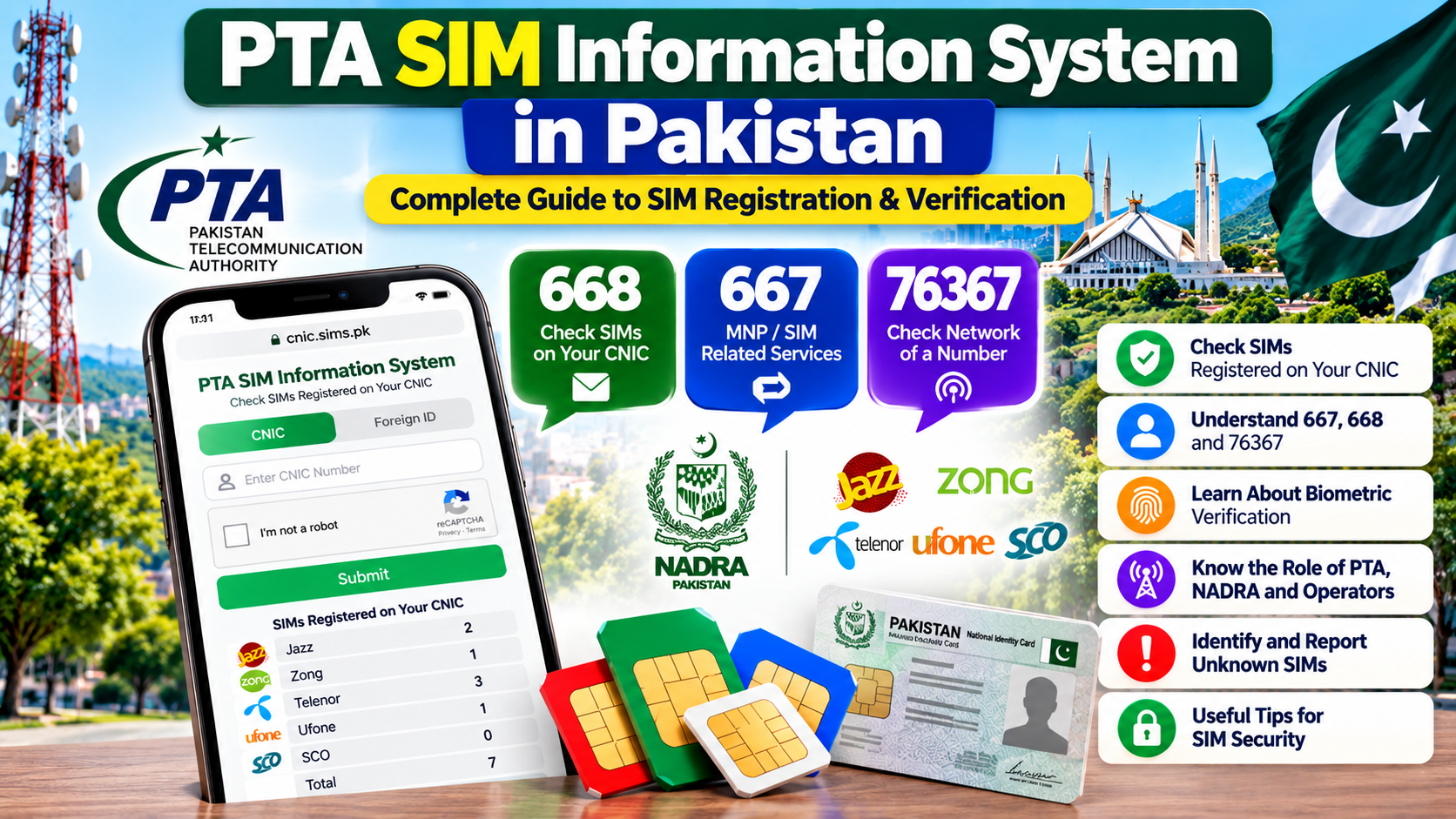
The PTA SIM Information System is one of the most important official resources available to mobile users in Pakistan who want to understand which SIM connections are registered against their own identity.
For many people, however, SIM verification can be confusing. Searches such as SIM Owner Details, PTA SIM Check, CNIC SIM Check, 668 SIM Check, and SIM Information Pakistan often lead users to different services, websites, and explanations. The problem is that these services do not all perform the same function.
A CNIC-based SIM check, for example, is different from checking the network of a mobile number. Likewise, SIM registration information should not be confused with call records, live location, WhatsApp activity, or other private telecommunications information.
Pakistan’s SIM verification environment involves several organizations and processes. PTA has the regulatory and public SIM-information role, NADRA provides identity and biometric verification services, while mobile operators manage customer connections and operator-level services. The public PTA system allows an individual to check SIMs registered against their own CNIC.
This guide explains how the system works from a user’s perspective, what you can check yourself, what the official systems do not reveal, how 667, 668, and 76367 differ, and what to do if an unexpected SIM appears against your CNIC.
Important: This is an educational self-check guide. It does not provide methods for obtaining another person’s private subscriber information.
What Is the PTA SIM Information System?

The PTA SIM Information System is an official public-facing facility that helps users check SIM registration information associated with their own identity.
The official web portal is:
cnic.sims.pk
According to the current PTA SIM Information System, a user can enter their CNIC and submit it to check the number of SIMs registered against that identity. The portal also provides a separate option for foreign IDs.
The system is particularly useful for personal security because a person may not always remember every SIM connection that has previously been registered using their identity.
For example, you may have:
- An active personal SIM
- An older SIM that you no longer use
- A replacement connection
- A SIM from another network
- A connection whose registration status you simply want to verify
The purpose of an official SIM check is therefore not merely to satisfy curiosity. It can help you understand the registration status associated with your own identity and identify situations that require further clarification.
Why Is SIM Registration Verification Important?
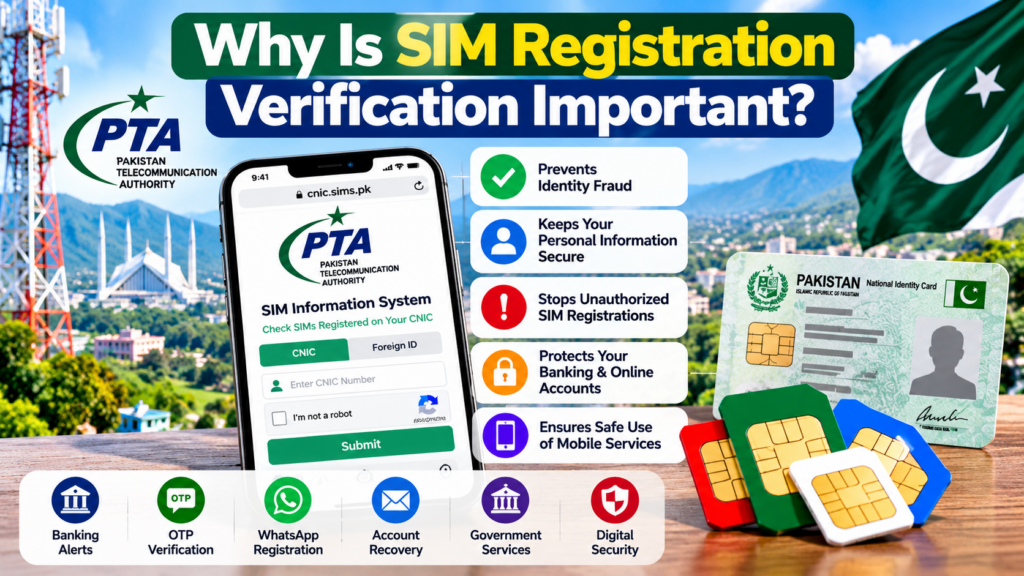
A mobile number is connected to more than communication. In modern Pakistan, SIMs may be used for:
- Banking alerts
- Account recovery
- OTP verification
- WhatsApp registration
- Government services
- Business accounts
- Email and social media security
That makes the relationship between a person’s identity and their registered SIM connections important.
PTA’s cyber-safety guidance recommends that users periodically check SIMs issued in their name and take action if an unauthorized SIM is discovered.
A simple self-check can therefore become an important part of your broader digital-security routine.
What Can You Check Through the Official PTA System?
The most important point to understand is what the public system actually provides.
The official PTA web interface is designed to show SIM registration information associated with your own CNIC. The result can present network-wise SIM information and a total count.
This makes the service useful for questions such as:
- How many SIMs are registered against my CNIC?
- Which networks have SIM registrations associated with my CNIC?
- Does the displayed information match my expectations?
- Is there a registration that I do not recognize?
These are legitimate self-verification questions.
However, the PTA SIM Information System should not be interpreted as a public database containing every private detail associated with a mobile user.
What the PTA SIM System Does Not Publicly Reveal
A common misunderstanding is that a SIM verification system should provide complete information about a subscriber.
That is not what a public CNIC-based self-check is designed to do.
A normal public SIM-registration check should not be treated as a tool for obtaining:
- Live phone location
- Private WhatsApp messages
- Call recordings
- Passwords
- OTPs
- Bank account information
- Private residential information
- Complete call history
- Another person’s confidential subscriber records
SIM registration information and telecom usage information are different categories of data.
This distinction is extremely important when evaluating websites that claim to provide “complete SIM owner details” simply by entering a mobile number.
How SIM Registration and Verification Works in Pakistan
From an ordinary user’s perspective, SIM registration can be understood through several connected functions rather than one single public database.
1. Identity Verification
The customer’s identity is established using an official identity document such as a CNIC.
NADRA is Pakistan’s national identity authority and provides identity and verification services. Its official information describes biometric verification capabilities used to verify identity information.
2. Biometric Verification
Biometric verification adds another layer of identity confirmation.
Rather than relying only on a typed CNIC number, biometric verification can be used to establish that the individual presenting the identity is associated with the relevant identity record.
NADRA officially describes biometric verification services that use fingerprints and photographic information for identity verification.
3. Telecom Operator Processing
The mobile network operator handles the customer’s SIM and telecom account.
This includes operator-specific services such as SIM activation, replacement, customer support, packages, and account-related matters.
4. Regulatory and Registration Information
PTA provides the regulatory framework and public SIM-information facilities through which users can check their own CNIC-linked SIM registration information.
This distinction matters: NADRA, PTA, and mobile operators have different responsibilities.
What Is NADRA’s Role in SIM Verification?
NADRA’s role is primarily connected with identity and identity verification, rather than acting as a public SIM-owner lookup website.
The CNIC is an official identity document issued by NADRA. NADRA also provides biometric verification services used in identity authentication.
For SIM registration, biometric verification is significant because it strengthens the connection between an identity record and the person undergoing verification.
NADRA’s verification services include biometric matching capabilities, while its broader identity infrastructure supports secure verification of identity information.
Why does this matter?
If someone is trying to understand SIM registration security, it is useful to distinguish:
Identity authority → NADRA
Telecom regulator → PTA
Mobile connection/service provider → Network operator
Each performs a different function.
What Is PTA’s Role?
PTA is Pakistan’s telecommunications regulator.
For ordinary SIM users, PTA is particularly relevant because its official SIM Information System provides a public route for checking SIMs associated with an individual’s CNIC.
The current PTA portal allows users to enter their CNIC and view registered SIM information.
PTA also provides a complaint-management mechanism for telecom consumers. Its official complaint system allows users to submit and track telecom-related complaints.
Therefore, when dealing with a SIM-registration issue, users should distinguish between:
- Checking the registration information
- Contacting the network operator
- Escalating a telecom complaint through PTA
- Reporting a separate cybercrime matter through the appropriate current authority
What Is the Role of Mobile Network Operators?
The mobile operator is responsible for the actual telecom service and customer account.
Pakistan’s major mobile operators include:
- Jazz
- Zong
- Telenor
- Ufone
- SCOM
Operator-level support can become important when a user discovers an unexpected SIM registration or has a problem involving:
- SIM replacement
- SIM activation
- Customer account access
- Network-specific services
- Connection blocking
- Account-related verification
The PTA public system and an operator’s customer-service system should therefore not be treated as identical sources of information.
What Is 668?
668 is historically associated with Pakistan’s CNIC-based SIM Information System.
Government documentation describes the SIM Identity System as a mechanism through which customers could check SIM information associated with their identity, including the number of SIMs registered across mobile companies.
PTA’s cyber-safety guidance also advises users to periodically check SIMs issued in their name and take action where unauthorized registrations are found.
For users, the important takeaway is:
668 is associated with checking SIM registration information linked to your own identity.
It should not be treated as a universal tool for obtaining another person’s complete private information.
What Is cnic.sims.pk?
cnic.sims.pk is the PTA SIM Information System’s public web interface.
The current portal provides a CNIC option where users can enter their identity information and submit a verification request. The resulting page can display SIM counts by network and a total.
Basic self-check process
- Open the official PTA SIM Information System.
- Select the appropriate identity option.
- Enter your own CNIC information.
- Complete the displayed verification.
- Submit the request.
- Review the network-wise information and total.
- If anything appears unfamiliar, investigate through the appropriate official channel.
Always verify that you are using the genuine official website before entering sensitive information.
667 vs 668: What Is the Difference?
667 and 668 are frequently confused because both are associated with SIM-related services.
However, they should not be treated as identical.
668
The 668 service is associated with CNIC-based SIM registration checking.
667
667 is associated with SIM/MNP-related processes. Operator documentation describes sending MNP to 667 as part of the Mobile Number Portability process.
The simple distinction
668 → CNIC-linked SIM registration check
667 → MNP/SIM-related process
This distinction prevents one of the most common misunderstandings surrounding Pakistan’s SIM verification services.
What Is 76367?
76367 serves a different purpose.
The current PTA SIM Information System instructs users to send:
N 03xx3456789
to 76367 for a network check. The portal currently lists a charge of Rs. 2 plus applicable tax for this service.
Therefore:
76367 = network identification
It should not be confused with a public owner-information service.
For example, checking which network a number belongs to is fundamentally different from trying to obtain the subscriber’s private identity information.
667 vs 668 vs 76367
| Service | Primary Purpose |
|---|---|
| 668 | Check SIM registration information associated with your own CNIC |
| cnic.sims.pk | Online CNIC-based SIM count check |
| 667 | MNP/SIM-related process |
| 76367 | Check the network associated with a mobile number |
Understanding this difference can save users from following the wrong procedure.
SIM Registration Data vs SIM Usage Data
One of the most important concepts in this entire topic is the difference between registration information and usage information.
SIM Registration Information
This concerns the registration relationship between a SIM connection and an identity.
Examples include:
- SIM registration
- CNIC association
- Network-wise SIM count
Telecom Usage Information
Usage records are a separate category.
They can relate to telecommunications activity such as:
- Calls
- SMS
- Data usage
- Call Detail Records (CDRs)
A CNIC SIM check does not equal a CDR check.
Likewise, knowing that a SIM is registered against a particular CNIC does not mean that a public user can view that person’s communications or live location.
Can You Check Someone Else’s SIM Owner Details?
This is where many unofficial websites create confusion.
The official public self-check system is intended for checking your own identity-linked SIM information.
It should not be used as a justification for obtaining another person’s confidential information.
If you receive a suspicious call or message and want to identify the person behind a number, do not rely on random websites claiming to expose private CNIC records.
Instead, consider the nature of the problem:
- Telecom service issue → contact the operator
- Unauthorized SIM on your CNIC → operator/PTA process
- Cyber fraud or identity misuse → appropriate cybercrime reporting channel
This approach protects both privacy and personal security.
What If an Unknown SIM Appears on Your CNIC?

Discovering an unfamiliar SIM registration can be concerning, but the correct response is to verify the information systematically.
Step 1: Recheck the official result
Make sure the result belongs to your own CNIC and that you have interpreted the network-wise figures correctly.
Step 2: Identify the relevant operator
Determine which network is associated with the unexpected registration.
Step 3: Contact the operator
Use the operator’s official customer-service or service-centre channel and explain the issue.
Step 4: Escalate if necessary
If the matter is not resolved at the operator level, PTA’s complaint mechanism can be used for relevant telecom complaints.
Step 5: Treat fraud differently
If the issue involves identity misuse, fraud, threats, or another cybercrime concern, use the appropriate current reporting authority rather than relying only on a telecom complaint.
Why Might Your SIM Count Look Unexpected?
An unexpected result does not automatically prove that a technical failure or fraudulent registration has occurred.
There can be several practical reasons why users become confused about their SIM count, including:
- An old connection they forgot about
- A recently changed or replaced SIM
- A registration they do not recognize
- Different network-wise counts being misunderstood
- Operator-level information requiring clarification
- A record that needs to be investigated through official channels
The safest approach is not to guess what happened.
Verify → identify the network → contact the operator → escalate where necessary.
What the Public SIM Information System Does Not Show
A strong understanding of the system also means knowing its boundaries.
The public SIM Information System is not a universal personal-data search engine.
It should not be expected to provide:
Live Location
SIM registration does not provide a public live GPS location service.
WhatsApp Conversations
SIM registration information does not provide access to private WhatsApp messages.
Call Recordings
A CNIC SIM check is not a public call-recording service.
Passwords or OTPs
No legitimate self-check requires you to give an unknown person your password or OTP.
Bank Information
SIM registration does not provide public access to bank accounts.
Complete Private Subscriber Profiles
A public SIM-count check should not be confused with access to confidential subscriber records.
Protecting Your SIM and CNIC Information
SIM security begins with protecting the identity information connected to the SIM.
Keep your CNIC private
Avoid uploading your CNIC unnecessarily to unknown websites, forms, social-media posts, or unofficial services.
Never share OTPs casually
An OTP should not be handed to someone simply because they claim to be calling from a network or verification service.
Use official websites
For sensitive checks, use official PTA and NADRA sources.
Check your SIM registrations periodically
PTA’s cyber-safety guidance recommends periodic checking of SIMs issued in your name.
Act on unexpected registrations
An unfamiliar SIM should not simply be ignored. Investigate it through the relevant operator and official complaint channels.
PTA SIM Information System and SIM Security
The public verification system is most useful when it becomes part of a broader security routine.
A practical routine can be:
Check → Review → Identify → Report
Check
Review your own SIM registration information.
Review
Compare the result with SIMs you actually use or remember.
Identify
If something appears unfamiliar, determine the network involved.
Report
Use the operator, PTA, or appropriate official authority depending on the nature of the problem.
This approach is more useful than repeatedly searching unofficial websites for private subscriber information.
Common Misunderstandings About SIM Information in Pakistan
“668 Shows Every Detail About a Person”
No. Its purpose is associated with SIM registration information, not a complete public personal profile.
“SIM Registration Means I Can Track the Phone”
No. SIM registration and live location are separate concepts.
“76367 Gives the Owner’s Full Information”
The PTA portal identifies 76367 as a network-check service.
“667 and 668 Are the Same”
No. 667 is associated with MNP/SIM-related processes, while 668 is associated with CNIC-based SIM registration checking.
“Every SIM Database Website Is Official”
No. Users should distinguish official government/telecom resources from third-party websites.
“SIM Information and CDR Are the Same”
No. Registration information and telecom usage records are different categories.
Frequently Asked Questions
What is the PTA SIM Information System?
It is PTA’s public SIM-information facility through which users can check SIM registrations associated with their own CNIC. The official web interface is cnic.sims.pk.
How can I check SIMs registered against my CNIC?
Use the official PTA SIM Information System and enter your own CNIC information. The system displays SIM information by network and total.
What is 668 used for?
668 is associated with CNIC-based SIM registration checking. Government documentation describes the service as a way for customers to check SIM information associated with their identity.
What is cnic.sims.pk?
It is the public web interface for the PTA SIM Information System.
What is 667 used for?
667 is associated with MNP/SIM-related processes. Current operator documentation describes sending MNP to 667 as part of MNP procedures.
What is 76367?
PTA’s portal lists 76367 for checking the network associated with a mobile number.
Can the PTA SIM system show someone’s live location?
No. A public SIM registration check is not a live-location service.
Can I see another person’s private SIM details?
A legitimate self-check should be limited to your own identity-linked information. Do not rely on unofficial databases to obtain private subscriber information.
What should I do if an unknown SIM appears on my CNIC?
Verify the result, identify the relevant operator, contact the operator, and use PTA’s complaint mechanism if the issue requires escalation.
What is NADRA’s role?
NADRA handles national identity and provides identity/biometric verification services.
Does SIM registration information include call history?
No. SIM registration and telecom usage records are separate categories.
Final Checklist: Verify Your Own SIM Information Safely
Before finishing your SIM verification, remember these points:
- Use the official PTA SIM Information System.
- Check only your own CNIC information.
- Review network-wise SIM counts carefully.
- Do not confuse 667 with 668.
- Use 76367 for its listed network-check purpose.
- Do not expect a SIM check to reveal live location.
- Do not share OTPs with unknown callers.
- Do not upload your CNIC to random SIM databases.
- Contact the relevant operator about unexpected registrations.
- Use PTA’s complaint system when appropriate.
- Use the appropriate cybercrime reporting channel for cyber-related incidents.
Final Thoughts
The PTA SIM Information System is best understood as a practical self-verification facility rather than a public database containing unlimited information about mobile users.
For an individual in Pakistan, the most important distinction is between what can legitimately be checked and what remains private.
The official PTA system provides a way to review SIM registration information associated with your own CNIC. NADRA plays an important role in identity and biometric verification, while mobile operators handle customer connections and network-level services. Meanwhile, 667, 668, and 76367 serve different purposes and should not be treated as interchangeable services.
If you want to protect your mobile identity, the simplest approach is also the most reliable:
Use official sources, verify your own information, protect your CNIC and OTPs, and investigate unexpected SIM registrations through the proper channels.
For the official self-check, use the PTA SIM Information System at cnic.sims.pk rather than relying on unofficial databases.
Official References
- PTA SIM Information System: cnic.sims.pk
- PTA: telecom regulation and consumer resources
- NADRA: identity and biometric verification services
- PTA Cyber Safety Guidance: SIM security and periodic SIM checks
- PTA Complaint Management System: telecom complaints and tracking
This version is intentionally written around the stronger SEO topic cluster “PTA SIM Information System → SIM Information Pakistan → CNIC SIM Check → SIM Owner Details → 667/668/76367 → biometric verification → privacy → unauthorized SIM”, rather than repeating the competitor’s architecture-heavy wording. The competitor’s original structure heavily emphasized internal “layers,” internal system fields, exact synchronization, and backend workflows; those details are not all established by the public source material and therefore have not been presented here as verified facts.
Leave a Reply