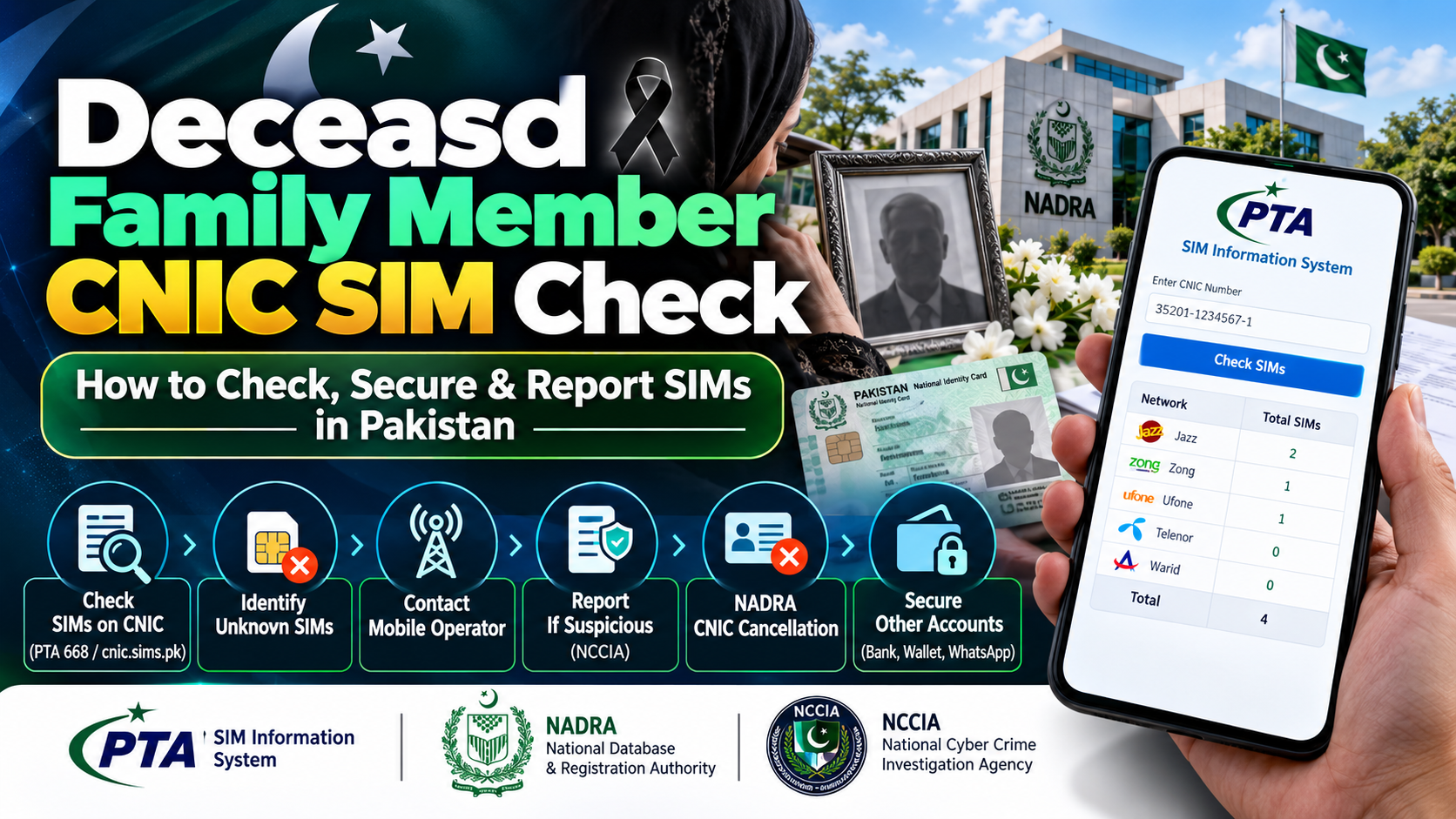
When a family member passes away, dealing with SIMs and mobile accounts may not be the first thing relatives think about. However, a deceased person’s CNIC may still be associated with mobile SIM registrations, old phone numbers, WhatsApp accounts, mobile wallets, banking services, email accounts and other digital services.
That does not mean every SIM appearing against the person’s CNIC is fraudulent. A family may simply need to identify which numbers were legitimately used, which ones are no longer required, and whether any unfamiliar registration needs further investigation.
A Deceased Family Member CNIC SIM Check can therefore be an important part of closing a person’s digital affairs responsibly.
Pakistan’s official PTA SIM Information System provides a way to check the number of SIMs registered against a CNIC. PTA’s own guidance also recommends periodically checking SIMs registered in your name and taking action if an illegally issued SIM is discovered.
For more educational information about SIM registration, SIM verification, CNIC-related checks and mobile identity protection in Pakistan, visit our SIM Owner Details guide.
This guide explains what families can realistically check, what an unknown SIM may mean, what steps to take next, how NADRA’s death-related identity-document cancellation fits into the process, and when a matter should be reported to NCCIA.
Why Should Families Check SIMs After a Family Member Dies?

A mobile number can remain connected to many important services long after a person stops using the physical SIM.
For example, a number may have been associated with:
- Banking alerts
- Mobile wallets
- Email recovery
- Social media accounts
- Business accounts
- Government services
- Utility accounts
- Online shopping accounts
- Authentication and verification services
If family members do not know which numbers were registered, they may have difficulty determining whether an old SIM is still active or whether an unfamiliar registration requires attention.
A SIM check can provide a useful starting point.
However, it is important to understand one key principle:
An unfamiliar SIM is a reason to investigate, not automatic proof of fraud.
A number could have been legitimately registered years earlier, used by the deceased, replaced, transferred, or simply forgotten by relatives.
The correct approach is therefore verify first, document the result, then take appropriate action.
Step 1: Check SIMs Registered Against the Deceased Person’s CNIC
The first practical step is to use the official PTA SIM Information System.
PTA provides an online facility where users can enter a CNIC and check the number of SIMs registered against it. The system also provides a Foreign ID option for applicable users.
The PTA result interface presents information by network, including a total count.
What should you record?
When checking the result, make a simple record of:
- Date of the check
- CNIC used
- Network names displayed
- Number of SIMs shown against each network
- Total SIM count
- Any information already known to the family
This record can become useful if an unexpected registration appears later.
Important limitation
The public PTA check should be treated as a registration/count verification tool.
Do not assume that the public result provides:
- complete historical ownership records
- complete call records
- live location
- private messages
- complete SIM activation history
- detailed biometric records
- internal operator investigation data
Those are separate matters.
Step 2: Compare the Result With What the Family Knows
Once the result is available, compare it with the deceased person’s known mobile numbers.
For example:
| Network | SIMs shown | Family knows | Difference |
|---|---|---|---|
| Jazz | 2 | 2 | None |
| Zong | 1 | 0 | Investigate |
| Ufone | 1 | 1 | None |
| Telenor | 0 | 0 | None |
This simple comparison can immediately identify where further checking may be useful.
But again, a difference does not automatically establish unauthorized activity.
There may be legitimate explanations.
What Does an Unknown SIM on a Deceased Person’s CNIC Mean?
An unknown SIM registration can have several possible explanations.
It could be:
- A number the deceased used but family members did not know about.
- An old number that relatives forgot.
- A SIM associated with an older phone.
- A registration that requires clarification from the operator.
- An incorrectly understood result.
- A potentially unauthorized registration.
The last possibility is important, but it should not be assumed without verification.
This is why the strongest approach is:
Check → Compare → Verify → Document → Report if necessary.
Step 3: Contact the Relevant Mobile Operator
If the family finds a SIM registration that cannot be explained, the next step is to contact the relevant mobile operator through its official customer-service or franchise channels.
The purpose is to determine what action is available regarding the registration.
Depending on the circumstances, the family may need to explain:
- The registered person’s death
- Their relationship to the deceased
- The relevant CNIC
- The network involved
- The unexpected SIM registration
- Any available supporting documentation
Do not rely on random social-media pages or unofficial agents claiming they can access private SIM records.
For sensitive identity matters, use official operator channels.
Step 4: Do Not Confuse SIM Cancellation With CNIC Cancellation
This is one of the most important distinctions in the entire topic.
There are two different matters:
SIM-related action
This concerns mobile registrations associated with a person’s identity.
Identity-document cancellation
This concerns the person’s CNIC/NADRA identity record after death.
They are related to the person’s identity, but they are not the same administrative process.
Families should not assume that cancelling a CNIC automatically means every historical SIM issue is instantly resolved.
Likewise, discovering a SIM does not mean the family’s NADRA record is automatically fraudulent.
Handle each matter through the relevant official channel.
Step 5: Understand NADRA’s Role After Death
NADRA provides procedures for cancellation of identity documents due to death.
Its official information explains that a Cancellation Certificate can certify cancellation of an identity document/registration due to death under the applicable NADRA framework.
NADRA – Cancellation of Identity Documents
This is an important part of properly closing a deceased person’s identity documentation.
However, families should avoid assuming that the cancellation process itself is a substitute for reviewing:
- SIM registrations
- bank accounts
- mobile wallets
- email accounts
- social media
- subscriptions
- other services
A responsible digital closure process may require attention to each category separately.
Step 6: What If the SIM Appears to Be Unauthorized?
Suppose the family checks the deceased person’s CNIC and discovers a SIM registration that nobody recognizes.
The safest approach is to preserve the information first.
Record:
- Date of discovery
- Network
- SIM count
- CNIC used for the check
- Screenshots or available result information
- Relevant family records
- Any communication with the operator
Then contact the operator through an official channel.
If there are indications of identity misuse, fraud, impersonation or another cybercrime issue, the matter may also warrant reporting to the National Cyber Crime Investigation Agency (NCCIA).
When Should You Contact NCCIA?
NCCIA is the current federal cybercrime investigation agency.
Its official complaint system provides a route for reporting cybercrime-related matters, while its official information also covers areas such as financial fraud and identity theft.
NCCIA Official Complaint Portal
A matter may deserve cybercrime reporting where there are reasonable indications of issues such as:
- Identity theft
- Digital impersonation
- Online financial fraud
- Unauthorized digital activity
- Account takeover
- Cyber harassment
- Fraudulent online transactions
- Misuse of personal identity information
NCCIA’s FAQ explains that complaints can be submitted through its complaint form and other official channels, and supporting material may be required.
Important legal point
A complaint is not the same thing as a conviction.
The family should report facts and evidence rather than publicly accusing a person or organization without proof.
What Evidence Should a Family Preserve?
If the situation looks suspicious, evidence can be more valuable than assumptions.
Keep copies of:
- PTA SIM-check results
- Screenshots
- SMS messages
- Emails
- WhatsApp messages
- Mobile-wallet notifications
- Bank alerts
- Operator correspondence
- Complaint numbers
- Relevant documents
- Phone numbers involved
- Transaction records
- Dates and times of suspicious activity
Do not edit screenshots to make them look stronger.
Preserve the original information wherever possible.
What If the Deceased Person Had a Mobile Wallet?
This is another area families should not overlook.
A SIM may have been connected to a mobile-wallet service.
Depending on the provider and account circumstances, the family may need to contact the relevant financial service separately.
The important point is:
Do not assume that resolving the SIM automatically resolves the wallet.
The family should identify which services were connected to the deceased person’s mobile number and follow the provider’s official process.
If there are suspicious transactions or suspected fraud, preserve transaction evidence and consider the appropriate complaint channel.
What About Bank Accounts and OTPs?
A deceased person’s mobile number may have been used for:
- OTPs
- transaction alerts
- password recovery
- account notifications
- authentication
Therefore, families handling an estate should consider whether important financial accounts were connected to the person’s old number.
However, relatives should not attempt to bypass banking security or access an account simply because they possess the deceased person’s phone.
The correct approach is to contact the relevant bank or financial institution and follow its official deceased-customer procedure.
What About WhatsApp on the Deceased Person’s Number?
WhatsApp deserves separate attention because phone-number control can affect account access.
If the family still has legitimate access to the deceased person’s phone and needs to manage the account, it should follow WhatsApp’s official account/security procedures rather than attempting unofficial recovery methods.
Families should also be careful about:
- OTP codes
- registration codes
- linked devices
- account recovery
- impersonation
Never share a WhatsApp registration code with another person.
If an account appears compromised or is being used for impersonation or fraud, preserve evidence and use the appropriate official reporting channels.
What If the Family Lives Outside Pakistan?

The process can become more complicated when the deceased person lived abroad.
The family may need to deal with:
- Pakistani identity documentation
- death documentation
- NADRA records
- SIM registrations
- mobile operators
- banks
- mobile wallets
- overseas estate matters
NCCIA’s FAQ also discusses arrangements relevant to overseas complainants, including the possibility of a focal person in Pakistan in applicable circumstances.
Because procedures can depend on the exact circumstances, families should use current official instructions rather than relying on an old blog or social-media post.
What If the Deceased Had an Old or Expired CNIC?
An expired identity document and a deceased person’s identity status are different situations.
Do not assume:
expired CNIC = deceased person’s record
or
deceased = every SIM automatically disappears immediately.
These are separate administrative questions.
If the person has died, the family should follow NADRA’s applicable death-related cancellation process and separately address any remaining SIM or account issues.
Should You Search for the Deceased Person’s SIM Details on Unofficial Websites?
No.
This is particularly important when dealing with deceased family members because their personal information may be sensitive.
Avoid websites or individuals claiming to provide:
- secret SIM owner databases
- complete private SIM records
- live location
- CDR
- private call history
- hidden CNIC databases
- WhatsApp access
- biometric records
A website claiming that it can reveal private telecom information does not automatically mean the information is legitimate or lawfully obtained.
For self-check purposes, start with official sources.
Can You Get Call History From the PTA SIM Check?
No.
The public PTA SIM Information System is not the same thing as a Call Detail Record system.
A SIM registration check can help establish the number/count of registrations associated with an identity.
It should not be presented as a tool for obtaining:
- complete call history
- SMS contents
- WhatsApp messages
- live GPS location
- private communications
This distinction is essential for maintaining accurate expectations.
What If You Find a SIM You Never Knew About?
Use this practical workflow:
1. Do not panic
An unfamiliar registration is not automatically proof of criminal activity.
2. Record the result
Save the date and available information.
3. Compare family records
Check old phones, documents, bills and known numbers.
4. Contact the relevant operator
Ask what official process applies.
5. Preserve evidence
Keep screenshots and correspondence.
6. Check for related financial activity
Review known bank and wallet notifications where appropriate.
7. Report suspected cybercrime
If there is evidence of identity misuse or online fraud, consider NCCIA.
8. Complete NADRA formalities
Handle the deceased person’s identity-document cancellation separately.
What Families Should NOT Do
There are several mistakes that can make an already sensitive situation worse.
Do not publicly post the deceased person’s CNIC
Avoid sharing complete identity information on Facebook groups, WhatsApp groups or public forums.
Do not publish unknown phone numbers
If you suspect misuse, do not publicly accuse the number holder.
Do not buy private databases
They may contain inaccurate, unlawfully obtained or outdated information.
Do not share OTPs
An OTP can provide access to important accounts.
Do not assume every unknown SIM is fraud
Investigate first.
Do not assume CNIC cancellation solves everything
SIMs and digital accounts may require separate action.
Do not use unofficial “SIM tracking” services
Use official channels for sensitive identity issues.
A Complete Deceased Family Member CNIC SIM Check Checklist
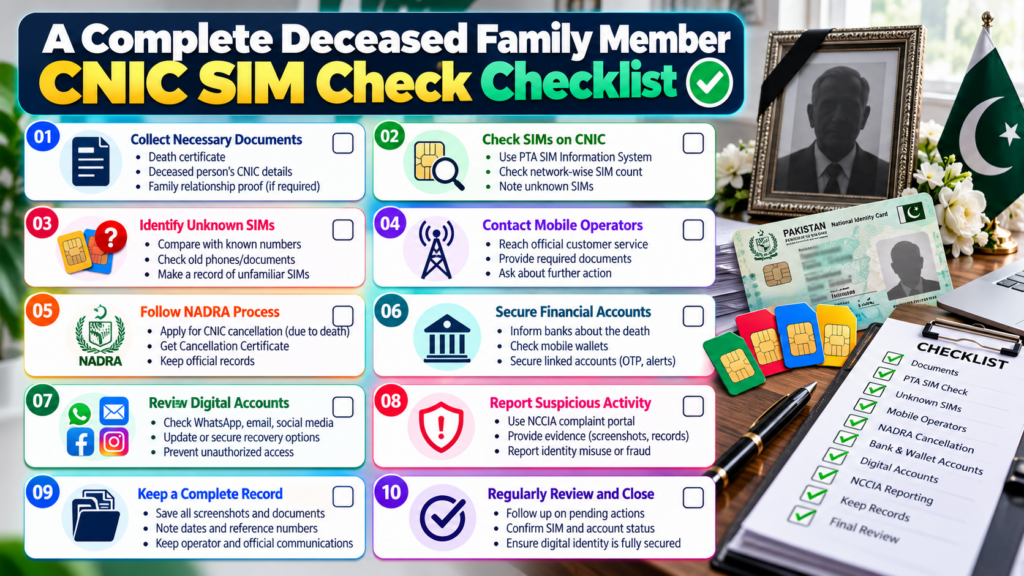
Use this checklist when handling a deceased relative’s digital records.
Identity
- Death documentation available
- CNIC information recorded
- NADRA cancellation process reviewed
SIMs
- PTA SIM Information System checked
- Network-wise counts recorded
- Known numbers identified
- Unknown registrations noted
- Relevant operator contacted if necessary
Financial services
- Banks identified
- Mobile wallets identified
- Suspicious transactions reviewed
- Relevant institutions contacted
Digital accounts
- WhatsApp considered
- Email accounts identified
- Social media accounts reviewed
- Recovery numbers identified where appropriate
Security
- Screenshots preserved
- Complaint/reference numbers saved
- Suspicious messages preserved
- Evidence backed up
Cybercrime
- NCCIA considered where applicable
- Complaint evidence organized
- No unsupported public accusations made
Official Resources for Families
For a Deceased Family Member CNIC SIM Check, use official sources whenever possible.
PTA SIM Information System
This is the primary starting point for checking SIM registrations associated with a CNIC.
NADRA
NADRA handles identity-document matters, including cancellation due to death.
NCCIA
NCCIA Complaint Portal
NCCIA’s official complaint information provides guidance on submitting cybercrime complaints and supporting evidence.
Frequently Asked Questions
Can I check SIMs registered against a deceased person’s CNIC?
The PTA SIM Information System provides CNIC-based SIM registration information. Families dealing with a deceased person’s identity should use the official system and then follow the appropriate operator/NADRA procedures for any issue that requires further action.
Does an unknown SIM automatically mean fraud?
No. It means the registration should be investigated. There may be a legitimate explanation.
Should I contact the mobile operator?
Yes, if a registration cannot be explained and requires clarification or action.
Does cancelling the CNIC automatically cancel every SIM?
Do not assume that. Identity-document cancellation and SIM-related actions are separate administrative matters.
Can I get the deceased person’s private call records from the PTA SIM check?
No. The public SIM Information System should not be treated as a tool for obtaining private communications or complete call history.
What if I suspect identity theft?
Preserve evidence, contact the relevant operator where appropriate, and consider reporting the suspected cybercrime to NCCIA.
Can I report online financial fraud to NCCIA?
NCCIA’s official information includes financial fraud among the cybercrime matters it handles and provides complaint channels.
What should I do if the deceased person’s number is still being used?
Do not immediately assume criminal activity. Document what you know, contact the relevant service provider and investigate whether the number was legitimately transferred, retained or otherwise used.
What if the deceased lived abroad?
The family may need to coordinate NADRA, telecom, banking and other procedures. NCCIA also provides information for overseas complainants in applicable cases.
Should I share the deceased person’s CNIC online to get help?
No. Avoid publishing sensitive identity information publicly.
Final Takeaway
A Deceased Family Member CNIC SIM Check is best treated as part of a broader digital and identity closure process.
The most reliable approach is not to search for private databases or assume that every unfamiliar SIM represents fraud. Instead:
Check the official PTA system → record the result → compare known numbers → contact the relevant operator → complete NADRA formalities → protect banking and digital accounts → preserve evidence → report genuine cybercrime concerns through NCCIA.
PTA provides the SIM-registration checking mechanism, NADRA handles identity-document matters including cancellation due to death, and NCCIA provides the current federal cybercrime complaint/investigation framework.
Most importantly, keep the process evidence-based. An unexpected SIM registration is a signal to verify, not by itself proof that someone committed fraud.
Important Disclaimer
This article is for general educational and self-check guidance. Procedures, operator requirements and government processes can change. Always verify the latest requirements through official PTA, NADRA, NCCIA, telecom operator or financial-institution channels. A complaint or investigation does not by itself establish criminal liability.
Is stronger version ka main advantage ye hai ke ye competitor se sirf “longer” nahi hai — ye uski unsupported claims ko remove karke zyada trustworthy, practical aur Google/E-E-A-T friendly banata hai.
Leave a Reply