SIM Owner Details Pakistan: What You Need to Know
A mobile SIM is no longer just a way to make calls or send messages. In Pakistan, a mobile number can be connected with banking services, digital accounts, mobile wallets, business communication, account recovery, and many other everyday services. Because of this, understanding SIM Owner Details, SIM registration, and subscriber verification has become an important part of responsible mobile usage.
When people search for SIM Owner Details Pakistan, they may be looking for different types of information. Some want to understand who a SIM is officially registered to, some want to check their own registered connections, while others are simply trying to understand how SIM registration works.
These are not all the same thing.
A telecom operator maintains subscriber information as part of its mobile service and registration systems. However, private subscriber information should not be confused with information that is publicly searchable on the internet. A mobile number by itself does not give an ordinary person unrestricted access to another subscriber’s confidential records.
This guide is being created to explain the subject clearly, responsibly, and in practical terms.
What Does SIM Owner Details Mean?
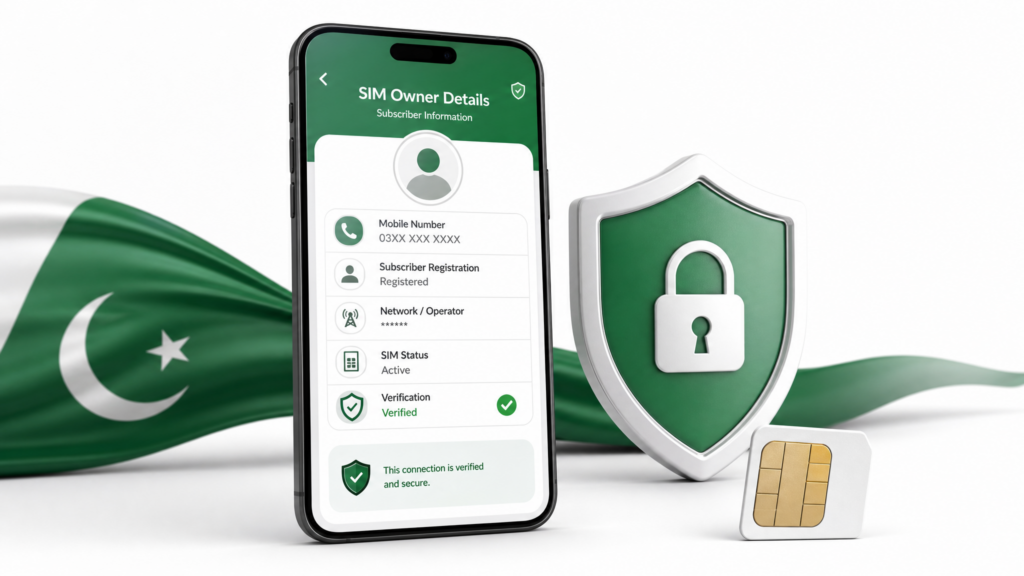
SIM Owner Details generally refers to information associated with the subscriber under whose identity a SIM connection has been registered.
When a person obtains a SIM through the required registration procedure, the mobile operator creates or maintains a subscriber record associated with that connection. The registration process is intended to establish a verified relationship between the mobile service and its subscriber.
Depending on the service and the operator, subscriber-related records can involve information such as:
- Mobile number
- Subscriber registration information
- Identity information used during registration
- Network/operator
- SIM or account status
- Other service-related records
The exact information available to a customer depends on the relevant operator and the official service being used.
SIM Owner and SIM User Are Not Always the Same
One of the most important concepts to understand is the difference between a registered subscriber and the person who happens to use the SIM.
For example, someone may purchase and register a SIM in their own name and later allow another family member to use the number. The person using the phone every day may therefore be different from the person recorded as the registered subscriber.
This distinction matters because simply possessing a SIM does not necessarily establish its official registration.
If you no longer control a number registered under your identity, it is better to deal with the connection through the appropriate official operator procedure rather than leaving it unmanaged.
Can You Check SIM Owner Details Online?
This depends entirely on whose information you are trying to verify and which service you are using.
If you want to manage or verify information relating to your own SIM or identity, the appropriate approach is to use an official telecom or regulatory channel.
However, websites that claim to let anyone enter a random mobile number and instantly obtain another person’s confidential subscriber information should be treated cautiously.
A legitimate account-verification service and an unofficial “SIM database” website are not the same thing.
Before entering your CNIC, phone number, OTP, or other personal information into any website, verify that the service is genuine and that you actually need to provide the requested information.
Why SIM Ownership Matters
Your mobile number can be connected to many important parts of your digital life.
For example, a number may be used for:
- Banking alerts
- Mobile wallets
- Account recovery
- Two-factor authentication
- Social-media accounts
- Email recovery
- Business communication
- Government-related services
If a SIM is lost, misused, or remains registered under your identity after you stop using it, it can create unnecessary security and account-management problems.
For this reason, users should know which mobile connections they control and should deal with unused or unfamiliar connections through official channels.
What This Guide Will Cover
This comprehensive guide will explain the subject of SIM Owner Details Pakistan from several different angles rather than focusing on one narrow search query.
You will learn about:
- SIM ownership and subscriber registration
- PTA’s role in telecom regulation
- SIM registration
- CNIC-based SIM verification
- SIM verification procedures
- SIM information and SIM details
- SIM owner details by number
- Mobile number information
- Pakistan’s major mobile networks
- Lost and stolen SIMs
- Incorrect registration
- Unrecognized SIM connections
- SIM security and privacy
- Common online scams
- Responsible use of telecom information
- Frequently asked questions
The purpose is to give readers enough context to understand the telecom system instead of simply providing a short answer to a single search query.
Important Privacy Notice
There is an important difference between learning about SIM ownership and attempting to obtain another person’s private information.
This guide does not provide unauthorized access to private subscriber databases, leaked records, confidential CNIC information, private call records, or real-time location information.
If you need information about your own connection, use the official service provided by the relevant telecom operator or applicable regulatory authority.
If you are dealing with another person’s number, respect their privacy and do not rely on questionable websites claiming to expose confidential subscriber information.
Quick Answer: What Are SIM Owner Details?
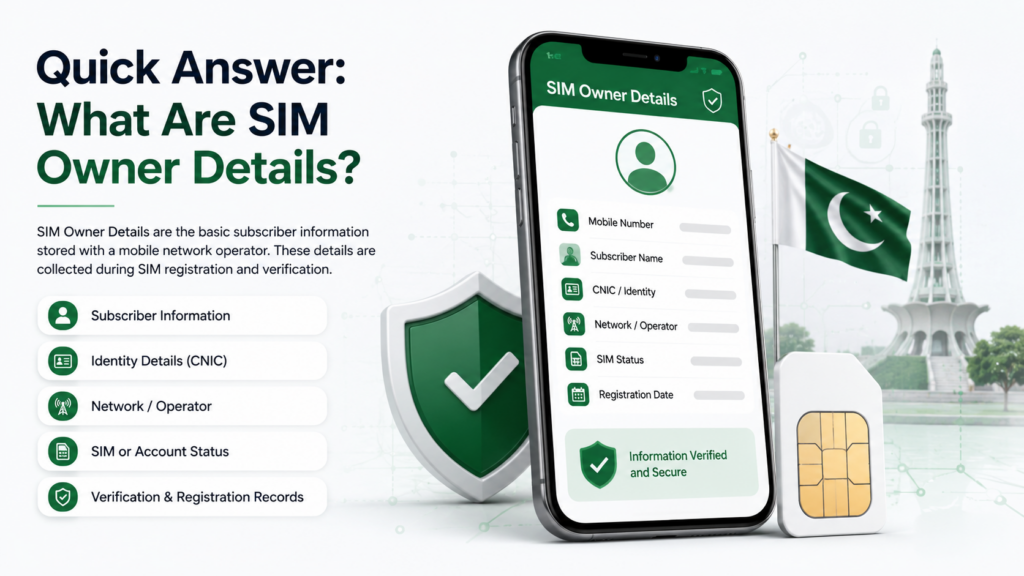
SIM Owner Details are the subscriber-related details associated with a mobile SIM registration. In Pakistan, a SIM is connected with a verified subscriber through the applicable registration and identity-verification process. Information about your own registered connections should be obtained through authorized telecom or regulatory channels rather than unofficial SIM databases.
Key Points to Remember
Before going deeper into the topic, keep these basic principles in mind:
- SIM ownership is connected to registration, not simply physical possession of a SIM.
- The registered subscriber and everyday user can be different people.
- Your own SIM information should be checked through official channels.
- A mobile number is not a public gateway to another person’s confidential identity information.
- Unofficial SIM databases may be inaccurate, outdated, or unsafe.
- Never share OTPs or sensitive identity information with unknown websites or callers.
- Lost, stolen, unused, or unfamiliar SIMs should be handled through the relevant operator.
Understanding these fundamentals will make the rest of the guide much easier to follow.
Why You Should Not Trust Every SIM Lookup Website
Search engines contain many pages targeting phrases such as SIM Owner Details Online, SIM Owner Details by Number, SIM Database, and Pak SIM Data.
The presence of a page in search results does not prove that it is an official telecom service.
A website may use professional design, telecom terminology, or claims such as “complete information” without demonstrating where its data came from.
Before using any such service, ask:
- Who operates the website?
- Is it an official telecom or government service?
- Why does it need my information?
- Does it request an OTP?
- Does it ask for a CNIC image?
- Is there an official alternative?
If something does not look right, do not submit sensitive information.
The Right Way to Approach SIM Information
The safest approach is to start with the purpose of your search.
If your goal is to check your own registered SIMs, use an authorized verification method.
If your goal is to manage your own mobile account, contact your operator.
If your goal is to identify a suspicious caller, use legitimate reporting, blocking, and identification methods rather than trying to access private subscriber databases.
And if your goal is simply to understand how SIM ownership works in Pakistan, use reliable educational information and current official resources.
This distinction keeps the process both useful and responsible.
SIM Registration in Pakistan
What Is SIM Registration?
SIM registration is the process through which a mobile connection is associated with a verified subscriber. When a person obtains a SIM through an authorized mobile operator, the required registration and identity-verification steps establish the subscriber record connected with that mobile service.
This process is important because a mobile connection is not simply a piece of plastic inserted into a phone. It represents an active telecom service that is associated with a customer account and registration record.
For anyone researching SIM Owner Details Pakistan, understanding registration is essential because the concept of ownership begins with the official subscriber record created during the registration process.
Why Is SIM Registration Important?
SIM registration serves several practical purposes.
It helps mobile operators:
- Maintain subscriber records
- Provide customer services
- Manage mobile connections
- Verify subscribers
- Handle SIM replacement requests
- Address registration-related problems
- Support telecom regulatory requirements
For users, proper registration provides a clear connection between their mobile service and their own identity.
This becomes particularly important when a mobile number is connected to banking, authentication, communication, or other digital services.
How Does SIM Registration Generally Work?
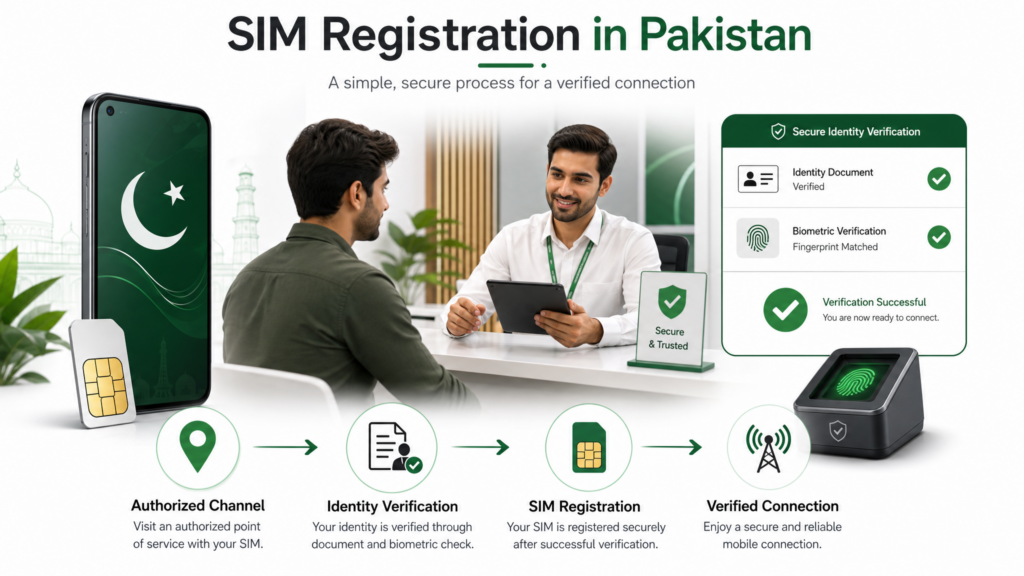
The exact procedure can vary depending on the operator and the service being requested, but the basic concept is straightforward.
1. Choose an Authorized Channel
A customer should obtain a SIM through an authorized mobile operator outlet or another officially supported channel.
Avoid purchasing mobile connections from unknown individuals simply because they promise a faster or cheaper process.
2. Provide Required Identification
The customer provides the identity information required for registration.
For an individual subscriber, this means using their own valid identity information rather than someone else’s.
3. Complete Verification
The operator performs the applicable identity-verification process.
Where biometric verification is required, the subscriber completes the required verification through the authorized process.
4. Registration Is Completed
After the required checks are successfully completed, the operator can activate and manage the mobile connection according to its procedures.
The resulting subscriber record is what establishes the registered relationship between the SIM and the customer.
What Is Biometric Verification?
Biometric verification is an identity-confirmation process that uses biometric information as part of verifying a person’s identity.
In SIM registration, biometric verification helps strengthen the connection between the person requesting the mobile service and the identity being used for registration.
This is important because simply entering an identity number into a form would not necessarily establish that the person requesting the SIM is actually the legitimate holder of that identity.
The verification process therefore adds another layer of identity assurance.
Is SIM Registration the Same as SIM Ownership?
They are closely related, but the terms are not exactly interchangeable.
SIM registration describes the process of establishing the subscriber record.
SIM ownership generally refers to the person associated with that registration.
For example:
A person completes the required registration process using their identity → the mobile connection is registered to that subscriber.
Simply possessing the physical SIM does not automatically mean that the person holding it is the registered subscriber.
Registered Owner vs Current User
This distinction deserves special attention.
Imagine that Ahmed registers a SIM under his own identity. Later, he gives the SIM to his brother for regular use.
The brother may become the everyday user, but that does not automatically mean the official subscriber record has changed.
This is why people searching for SIM Owner Details should understand that:
Using a SIM ≠ automatically being its registered subscriber.
If a mobile connection needs to be transferred, corrected, or otherwise changed, the appropriate official procedure should be followed.
Why You Should Register a SIM With Your Own Identity
Using your own identity for a mobile connection provides a clearer relationship between you and the service.
It can make it easier to manage matters such as:
- Customer support
- SIM replacement
- Lost SIM procedures
- Registration questions
- Account management
- Ownership-related requests
It also reduces the possibility of confusion about who is officially responsible for the connection.
What Happens If You Use a SIM Registered to Someone Else?
Using a SIM registered to another person can create problems.
For example, you may be the person making calls and receiving messages, but the official subscriber information may still belong to someone else.
This can become complicated if:
- The SIM is lost
- The number is blocked
- A replacement is needed
- Registration information needs correction
- The account becomes involved in a dispute
- The registered subscriber wants to close the connection
For long-term use, it is better to maintain mobile connections through the appropriate official registration process.
Can You Register a SIM Online?
The availability of online services depends on the operator and the specific service.
Some telecom activities may be supported through digital channels, while certain identity-verification or SIM-related procedures may require an authorized physical location.
Therefore, do not assume that every SIM registration service advertised online is legitimate.
Before providing personal information, verify that you are using the official website, application, or customer-service channel of the relevant operator.
Why Unofficial SIM Registration Services Are Risky
You may find websites or individuals offering to:
- Register a SIM instantly
- Change SIM ownership
- Activate a SIM without verification
- Provide SIM owner information
- Check private subscriber records
These claims should be treated cautiously.
A legitimate SIM registration process exists for a reason. If someone is offering to bypass the required verification process, that should be considered a major warning sign.
Never provide your identity documents or OTPs to an unknown person simply because they promise a shortcut.
What If Your Registration Information Is Wrong?
If you discover that your SIM has incorrect subscriber information, the appropriate solution is to contact the mobile operator associated with the connection.
Explain the problem and ask about the official correction or verification procedure.
Do not attempt to “fix” the information through an unofficial database or website.
The organization responsible for maintaining the subscriber record is the appropriate place to request a correction.
What If You No Longer Use a Registered SIM?
Old mobile connections can easily be forgotten.
A person may change numbers, switch networks, or stop using a particular SIM while the connection remains associated with their identity.
If you no longer need a mobile connection, contact the relevant operator and ask about the appropriate process for managing or closing it.
Keeping your mobile connections organized is a useful part of protecting your digital identity.
SIM Registration and Your Digital Accounts
SIM registration becomes even more important because mobile numbers are often connected with other services.
Your number may be used for:
- Login verification
- Password recovery
- Banking alerts
- Mobile wallets
- Social-media authentication
- Email recovery
- Business communication
This means losing control of a registered number can create consequences beyond ordinary telephone service.
Users should therefore keep their active SIMs secure and ensure that important accounts use mobile numbers they actually control.
Important Privacy Principle
SIM registration creates a subscriber record, but registration does not mean that the subscriber’s private information becomes publicly searchable.
This is a key distinction.
A telecom operator may maintain information for legitimate service and regulatory purposes, while access to sensitive information remains subject to appropriate authorization and privacy considerations.
Therefore:
SIM registration ≠ public SIM database.
Key Takeaway
SIM registration is the foundation of the subscriber relationship between a customer and a mobile operator.
A properly registered SIM should be associated with the correct subscriber through the required identity-verification process. The person physically using a SIM is not necessarily the person recorded as its registered subscriber.
For anyone researching SIM Owner Details Pakistan, the most important rule is simple:
Use authorized registration and verification channels, keep your own SIM connections under control, and never rely on unofficial services that promise shortcuts around the normal registration process.
PTA and SIM Registration in Pakistan
What Is PTA?
The Pakistan Telecommunication Authority (PTA) is Pakistan’s telecommunications regulator. It plays an important role in the regulation and oversight of telecommunications services, including matters related to mobile operators and SIM registration.
For people searching for SIM Owner Details Pakistan, understanding PTA’s role helps distinguish between an official telecom process and unofficial websites claiming to provide subscriber information.
PTA is not simply a public database where anyone can enter any mobile number and obtain another person’s private information. Instead, telecom regulation involves established procedures, operators, verification systems, and applicable rules.
What Is PTA’s Role in SIM Registration?
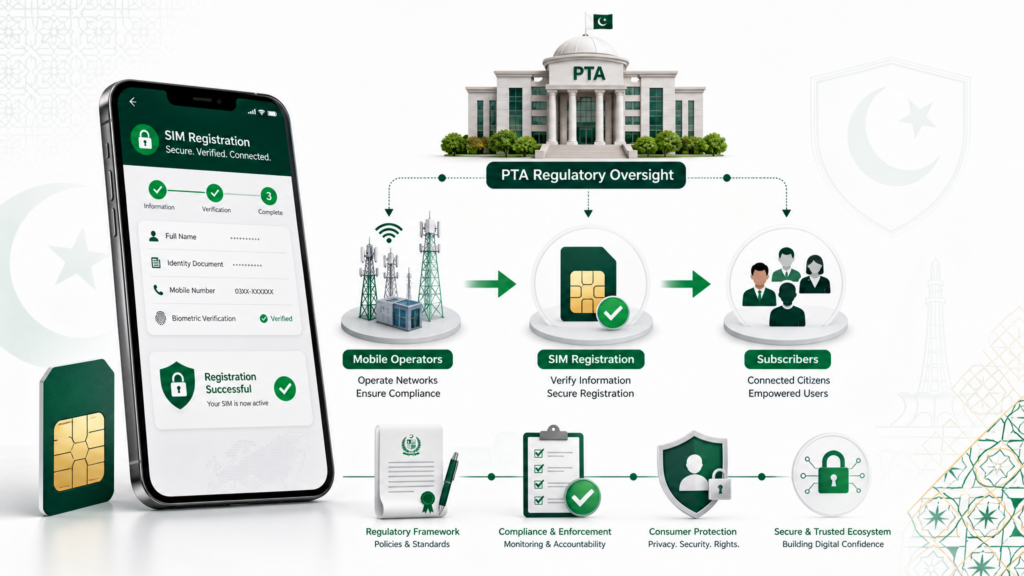
SIM registration involves mobile operators following the applicable regulatory requirements for subscriber identification and mobile connections.
PTA’s regulatory role can include areas such as:
- Telecom regulation
- Operator oversight
- Consumer-related telecom matters
- SIM-related regulatory requirements
- Industry compliance
- Public awareness
- Complaint and regulatory mechanisms
The actual customer account and SIM services are generally handled through the relevant mobile operator.
This distinction is important.
PTA regulates the telecom environment, while mobile operators provide the actual mobile service to subscribers.
PTA and Mobile Network Operators
Pakistan has several mobile network operators serving consumers.
When you purchase or manage a SIM, you normally deal with the relevant operator for services such as:
- SIM activation
- SIM replacement
- Account management
- Customer support
- Registration-related assistance
- Network services
PTA’s role is broader because it concerns telecommunications regulation and oversight.
Therefore, if you have a problem with a specific SIM, the mobile operator is usually the appropriate first point of contact.
Can PTA Provide Someone’s Private SIM Owner Details?
You should not assume that PTA provides a public service for retrieving another person’s confidential subscriber information.
A mobile number is not a public authorization mechanism for obtaining someone’s private identity information.
This means you should be cautious with websites claiming:
“Enter any number and get complete SIM owner details.”
The claim itself does not establish that the website is connected to PTA or an authorized telecom operator.
Always verify the source before trusting a SIM-related service.
Official SIM Information vs Unofficial Databases
There is a major difference between information obtained through an authorized telecom or regulatory process and information displayed by an unknown third-party website.
Official Information
Official systems are operated through established organizations and procedures.
They are intended to provide information or services according to applicable requirements.
Unofficial Database
An unofficial website may claim to have:
- Complete SIM records
- CNIC databases
- SIM owner names
- Mobile number details
- Pak SIM data
- Private subscriber information
But the origin, accuracy, freshness, and legality of such information may be impossible for an ordinary visitor to verify.
This is why users should never treat an unofficial database as equivalent to an official telecom record.
How PTA-Related SIM Searches Can Be Misleading
Search engines may display many pages targeting phrases such as:
- PTA SIM check
- SIM owner details
- SIM information
- SIM database Pakistan
- CNIC SIM check
- Pak SIM data
Some pages may provide useful educational information, while others may use these terms primarily to attract search traffic.
Before following instructions, check whether the page clearly identifies its source and directs users toward an appropriate official service.
A professional-looking website is not automatically an official website.
What Should You Do If You Want to Check Your Own SIMs?
If your goal is to understand which mobile connections are associated with your own identity, use the currently available official verification method rather than an unofficial database.
The safest process is:
Identify the official service → Verify your identity where required → Review your own information → Contact the relevant operator if something appears incorrect.
If you find a connection that you do not recognize, do not try to investigate the person using private databases.
Instead, contact the relevant operator and follow the appropriate complaint or resolution process.
What If You Find an Unknown SIM?
An unfamiliar SIM connection associated with your identity deserves attention.
Possible explanations can vary, so do not immediately assume that fraud has occurred.
First, verify the information through an official source.
Then:
- Identify the relevant mobile operator.
- Contact the operator through its official channel.
- Explain that you do not recognize the connection.
- Follow the operator’s verification process.
- Keep any complaint or reference information provided to you.
This is safer and more reliable than attempting to identify another person through an unofficial SIM owner details by number website.
PTA and Consumer Awareness
A major part of responsible telecom usage is knowing where to obtain reliable information.
Users should be especially careful when a website:
- Claims to be affiliated with PTA without clear evidence
- Uses official-looking logos without authorization
- Promises confidential information instantly
- Requests an OTP
- Requests a CNIC image unnecessarily
- Requires payment for questionable subscriber information
- Promises live phone tracking from a number
When in doubt, independently locate the official source instead of clicking through a suspicious advertisement or message.
Do Not Confuse SIM Verification With Phone Tracking
Another common misunderstanding involves SIM information and phone location.
A SIM registration system identifies a subscriber relationship with a mobile connection. It should not be confused with a public GPS tracking service.
Searching for terms such as:
- Mobile number location
- GPS location tracker
- Live tracking
- Phone number location tracker
- Track mobile location by mobile number
may produce websites making unrealistic claims.
A legitimate SIM verification process does not mean that an ordinary user can obtain another person’s real-time location.
What If a Website Claims to Be “PTA Verified”?
Do not rely on the wording alone.
If a website claims to be official or authorized, independently verify the claim through a trustworthy official source.
Look for:
- Correct official domain
- Clear organizational identity
- Consistent contact information
- Appropriate privacy information
- Secure and expected verification procedures
Do not enter your CNIC or OTP merely because a website uses the word PTA in its title.
PTA, SIM Owners and Privacy
SIM registration and privacy can exist together.
The purpose of subscriber registration is not to make every person’s identity publicly searchable.
Instead, mobile services require appropriate systems for identifying subscribers and managing telecom connections.
This is why a responsible SIM Owner Details Pakistan guide should explain both sides:
Users need legitimate ways to manage their own mobile connections.
Other people’s confidential information should not be exposed simply because someone knows their phone number.
What Is the Best Source for Current Procedures?
Telecom procedures can change.
Service methods, verification options, operator processes, and available online facilities may be updated over time.
Therefore, if you need to perform an actual SIM-related action, check the current information from the relevant official organization rather than relying on an old article, social-media post, or random lookup website.
This is especially important for instructions involving identity verification, SIM replacement, registration, or complaints.
Key Takeaway
PTA has an important regulatory role in Pakistan’s telecommunications sector, while mobile operators directly provide mobile connections and customer services.
For SIM Owner Details Pakistan, the most important distinction is:
PTA/regulatory information ≠ public access to private subscriber records.
If you need to verify or manage your own SIM, use the appropriate official channel. If you discover an unfamiliar connection, contact the relevant operator and follow the proper resolution process.
Never provide your CNIC, OTP, password, or other sensitive information to an unverified website simply because it claims to offer PTA or SIM verification.
How to Check SIMs Registered on Your CNIC in Pakistan
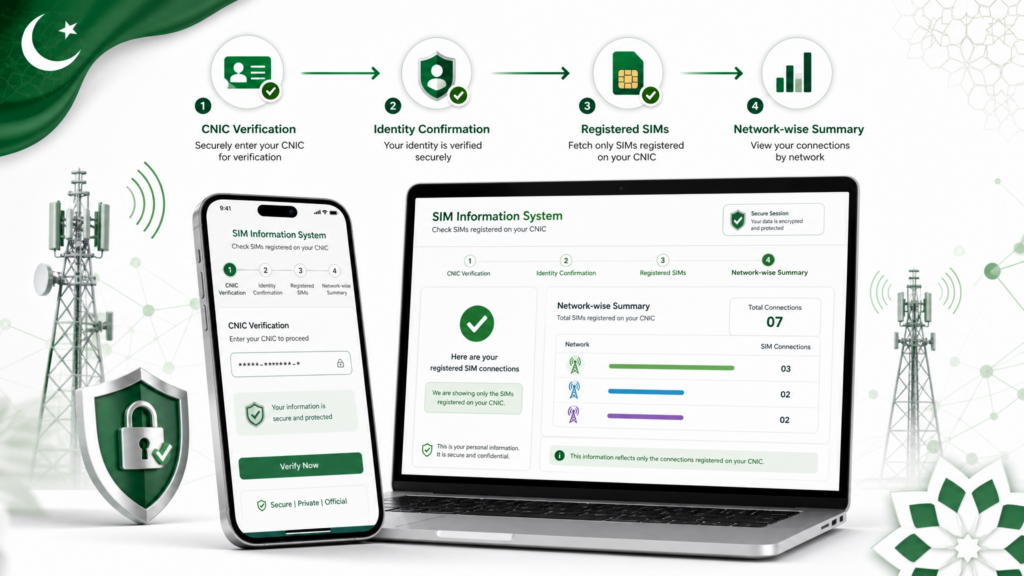
Checking Your Own Registered SIMs
One of the most useful reasons people search for SIM Owner Details Pakistan is to find out how many mobile connections are associated with their own CNIC.
This is different from trying to discover the private identity of another person.
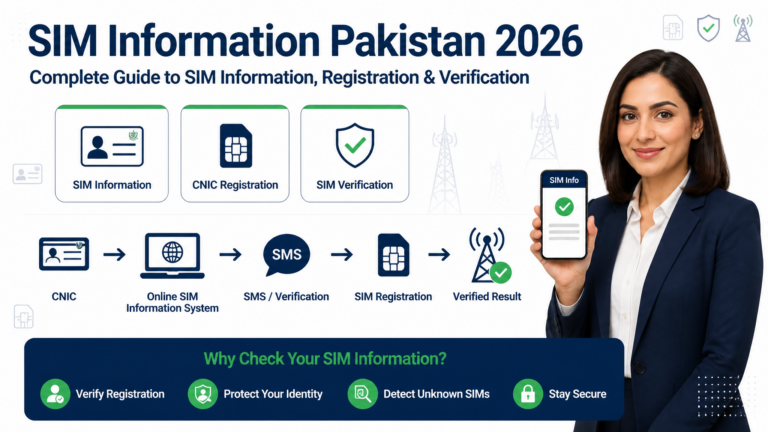
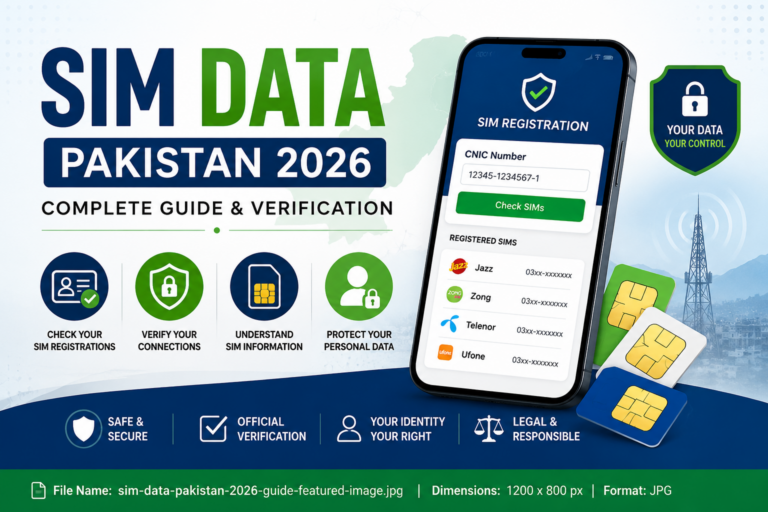
If you want to check your own registered connections, Pakistan has an official SIM Information System that allows users to check the number of SIMs associated with their identity information. The system displays the number of connections by network rather than functioning as a public database of private subscriber records.
The safest approach is therefore to use the official system rather than an unknown SIM database website.
What Information Can You See?
The SIM Information System provides a network-wise count of registered SIMs.
The displayed information can include categories such as:
- Jazz
- Telenor
- Ufone
- Zong
- Total SIMs
The system is designed to show the number of connections associated with the submitted identity information.
This is an important distinction:
A SIM count is not the same thing as a public list containing another person’s complete personal information.
How to Check SIMs Through the Online System
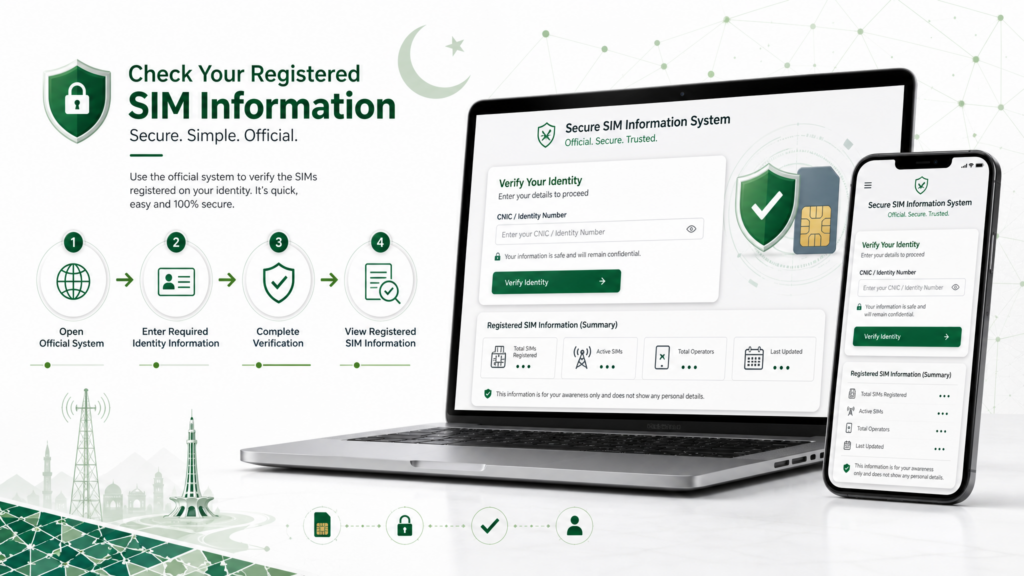
The general process is straightforward.
Step 1: Open the SIM Information System
Use the official SIM Information System rather than a random third-party lookup website.
The current system provides a CNIC/identity verification interface for checking registered SIM information.
Step 2: Select the Appropriate Identification Type
The system provides options for CNIC and, where applicable, foreign identification.
For Pakistani citizens, the relevant CNIC option can be used.
Step 3: Enter Your Own CNIC
Enter the required CNIC information carefully.
Do not enter somebody else’s identity information without authorization.
Step 4: Complete the Verification
Follow the verification step shown by the system.
Step 5: Review the Result
The result can show the number of registered SIMs by network and the overall total.
Why Checking Your CNIC Is Important
Checking your own registered SIM connections can help you identify connections that you no longer recognize.
For example, you may have:
- Old numbers you stopped using
- Connections you forgot about
- Numbers from previous network usage
- A connection you do not immediately recognize
An unexpected result does not automatically prove fraud.
It should, however, encourage you to investigate the matter through the relevant mobile operator.
What If the Number of SIMs Looks Wrong?
Suppose you check your own CNIC and the result shows more SIMs than you expected.
Do not try to identify the unknown subscriber through an unofficial website.
Instead:
- Note the network shown in the result.
- Contact the relevant mobile operator.
- Explain that you do not recognize the connection.
- Complete any verification requested by the operator.
- Ask about the appropriate blocking, correction, or resolution procedure.
This is the correct direction because the operator is responsible for managing the customer’s mobile service.
Checking SIMs Is Not the Same as Getting Owner Names
This is one of the most important points in the entire topic.
People often search for:
“SIM Owner Details by Number”
and expect a result showing the person’s complete name, CNIC information, address, and other personal details.
The official SIM Information System is not presented as a public tool for revealing another subscriber’s confidential identity information.
Instead, it is primarily useful for checking SIM registration information associated with your own identity.
Therefore, be careful when a third-party website claims that it can reveal complete private subscriber information simply from a phone number.
What About Checking the Network of a Mobile Number?
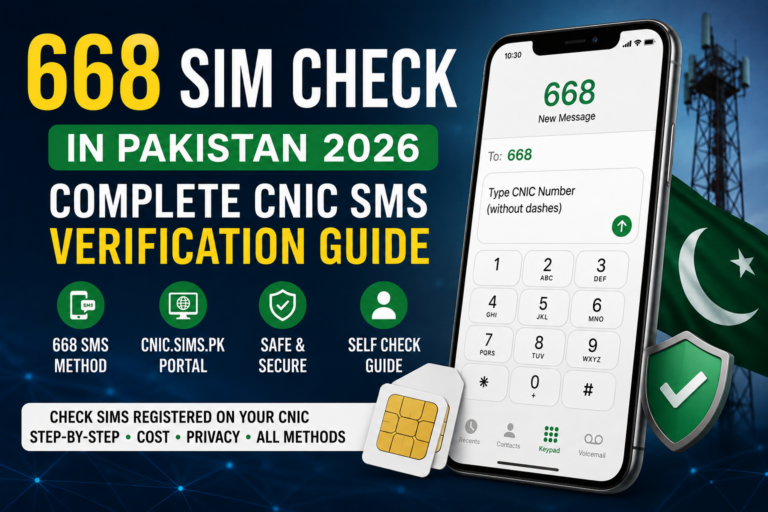
The SIM Information System also provides a separate network-checking facility.
Its current information states that users can check the network of a number by sending a message in the specified format to 76367, with the service carrying a stated charge of Rs. 2 plus applicable tax.
Because telecom procedures and charges can change, always verify the current instructions on the official service before relying on an old article or screenshot.
What If You Find an Unauthorized SIM?
If you believe a SIM has been registered using your identity without your authorization, take the matter seriously.
The appropriate response is not to search for the alleged owner through leaked databases.
Instead, contact the relevant operator and request assistance.
Pakistan’s telecom cybersecurity guidance also advises consumers to periodically check the number of SIMs issued in their name and to block illegally issued SIMs. It specifically warns about unauthorized SIM issuance and recommends obtaining SIMs through cellular franchises rather than questionable sales channels.
Why Official Channels Are Better
An official verification system has a major advantage: it provides information through an established telecom process.
With an unknown website, you may not know:
- Where its information came from
- Whether the information is current
- Whether the information is accurate
- Who operates the website
- How your submitted CNIC is stored
- Whether your information is being collected
This is why searching for Pak SIM Data or SIM Owner Details Online should always begin with the question:
“Is this an authorized source?”
Protect Your CNIC While Checking SIM Information
Your CNIC is sensitive information.
When checking your registered connections online:
- Use the official service.
- Check the website address carefully.
- Avoid suspicious advertisements.
- Do not give your OTP to another person.
- Do not upload your CNIC image to an unknown lookup website.
- Avoid websites promising private databases.
A genuine verification task should not require you to surrender unnecessary confidential information to an unrelated third party.
What If the Official System Does Not Solve Your Problem?
Some issues require direct assistance from the mobile operator.
For example:
- An unknown SIM appears against your identity.
- Your SIM is not working.
- You need a replacement.
- Registration information appears incorrect.
- You want to close an old connection.
- You suspect unauthorized SIM issuance.
In these situations, contact the relevant operator and follow its current procedure.
If a telecom complaint requires escalation, PTA also provides a Complaint Management System through which consumers can register and track telecom-related complaints.
A Simple Example
Imagine that a user checks their CNIC and sees:
| Network | Registered SIMs |
|---|---|
| Network A | 2 |
| Network B | 1 |
| Network C | 0 |
| Network D | 1 |
| Total | 4 |
The important information is the number of connections associated with the identity, not a public list of private subscriber records.
If the user expects only three connections but the system shows four, they should investigate the extra connection through the appropriate operator.
Common Mistake: Using a Random “SIM Database”
A common mistake is searching Google for:
“SIM database Pakistan”
then entering a CNIC or phone number into the first website that promises results.
This can create privacy and security risks.
The safer principle is:
Use the official system for your own registration information and the official operator for account-related problems.
Do not assume that a website offering a convenient lookup is authorized simply because it appears high in search results.
Key Takeaway
If your goal is to check how many SIMs are registered against your own CNIC, use the official SIM Information System.
The system provides network-wise SIM counts and is designed for checking registration information associated with your identity.
If the result contains a connection you do not recognize, contact the relevant mobile operator and follow the appropriate resolution process.
Do not confuse legitimate SIM verification with websites claiming to expose private SIM owner information.
SIM Owner Details by Number: What Can Actually Be Checked?
Can You Find SIM Owner Details by Mobile Number?
One of the most searched topics related to SIM Owner Details Pakistan is whether a person can enter a mobile number and instantly find the complete details of the SIM owner.
The answer requires an important distinction.
A mobile number can identify a particular telecom connection, but that does not mean every person has public access to the subscriber’s confidential identity information.
People often search for phrases such as:
- SIM Owner Details by Number
- SIM Owner Details Online
- SIM Card Owner Details Online
- Details of Mobile Number
- Mobile Number Details
- SIM Information With Number
- SIM Owner
- SIM Number Check
These searches can have different intentions. Someone may be trying to verify their own number, identify the network, understand SIM registration, or investigate an unfamiliar caller.
The correct method depends on the purpose.
What Does “SIM Owner by Number” Usually Mean?
When someone searches for SIM Owner Details by Number, they are often looking for information associated with a particular mobile number.
They may expect to see:
- Owner name
- CNIC information
- Mobile network
- Registration information
- SIM status
- Address
- Other personal details
However, these categories of information should not be treated as publicly available simply because a person knows a phone number.
A phone number is not a universal password for accessing someone’s private subscriber record.
Can a Mobile Number Reveal the Owner’s Name?
You should not assume that entering a random mobile number into an unofficial website will legitimately reveal the registered subscriber’s complete identity.
Some websites may advertise SIM owner details online or claim to provide a complete name and CNIC from a number.
Such claims need to be treated carefully.
The reliability of an unofficial result can be questionable because:
- The information may be outdated.
- The information may be incomplete.
- The source may be unknown.
- The information may have been obtained improperly.
- The website may simply generate misleading results.
- Your own information may be collected when you perform the search.
Therefore, a search result from an unknown database should never automatically be considered an official SIM ownership record.
What Can You Legitimately Check?
The information you can access depends on the service and your authorization.
For your own mobile connection, legitimate telecom services may allow you to manage or verify relevant account information.
You may also be able to determine basic network-related information through supported telecom services.
However, confidential subscriber information belonging to another person should not be treated as ordinary public search data.
This distinction is especially important when dealing with SIM owner details online.
Why a Phone Number Is Not Enough
Consider a simple example.
Suppose you receive a call from an unknown number.
You know:
Mobile number → 03XX-XXXXXXX
Knowing that number does not automatically give you legitimate access to:
CNIC → Address → Complete subscriber record → Private account information
These are different categories of information.
The fact that a number is visible to you does not mean that the confidential information associated with that number is publicly available.
What About SIM Owner Details Online Websites?
Search engines contain many websites targeting the keyword SIM Owner Details Online.
Some may provide general educational information. Others may claim to provide instant subscriber information.
Before using such a website, examine it carefully.
Ask:
Is it an official telecom service?
If not, be cautious about entering sensitive information.
Does it explain where its information comes from?
A legitimate-looking interface does not prove that its database is authorized.
Does it request your CNIC?
If so, understand why the information is needed before submitting it.
Does it ask for an OTP?
Never give an OTP to an unknown person or website simply to perform a lookup.
Does it promise confidential information about another person?
Treat that as a serious warning sign.
SIM Owner Details vs SIM Information
These terms are often used interchangeably online, but they can mean different things.
SIM Information
This can refer broadly to information about a SIM or mobile service, such as:
- Network
- Registration status
- Number of connections
- General telecom information
SIM Owner Details
This phrase generally implies information identifying the subscriber associated with the connection.
Because owner information can involve personal data, it should be handled more carefully.
This is why a good SIM Information guide should not imply that every type of subscriber information is freely searchable.
What If You Want to Verify Your Own Number?
If you are trying to verify a SIM that belongs to you, use the official services available through the relevant telecom operator or authorized verification system.
This is the safest route because you can establish your identity through the appropriate process.
If the information appears incorrect, contact the operator rather than trying to find your information through an unofficial database.
What If Someone Is Calling You From an Unknown Number?
An unknown caller does not automatically justify attempting to obtain their private identity information.
Instead, consider practical options such as:
- Ignore suspicious calls.
- Block unwanted numbers.
- Do not share personal information.
- Do not provide OTPs.
- Do not click suspicious links sent by the caller.
- Report genuine harassment or fraud through appropriate channels.
If the call involves threats, fraud, impersonation, or another serious issue, preserve relevant evidence and use the appropriate official reporting mechanism.
What About “SIM Owner Details by Number Free”?
The word free does not make a service trustworthy.
A website may advertise:
“SIM Owner Details by Number Free”
but still ask visitors to:
- Complete surveys
- Install applications
- Enter personal information
- Provide a phone number
- Submit an OTP
- Pay after an initial “free” search
Therefore, do not judge a service based only on whether it claims to be free.
Judge it based on who operates it, what it asks for, and whether the service is legitimate and authorized.
Why Some Online Results May Be Inaccurate
Even when a website displays a name or other information, you cannot automatically assume that the information is current.
Mobile numbers can change hands, subscribers can change services, and records can be updated.
An unofficial database may also contain old information.
This creates another important principle:
A name displayed by a third-party website is not automatically proof of current SIM ownership.
For actual registration matters, use the appropriate official telecom process.
Don’t Confuse SIM Owner Details With Phone Location
Another common misconception is that knowing the registered subscriber of a number allows someone to track the phone’s live location.
These are completely different concepts.
SIM registration concerns the subscriber relationship with a mobile service.
Location tracking concerns the location of a device and requires appropriate technical and legal mechanisms.
Therefore, websites claiming:
“Enter a phone number and see its live GPS location”
should be approached with extreme caution.
What Should You Do With an Unrecognized Number?
If you receive communication from a number you do not recognize, you do not need to search a questionable SIM database to respond.
A safer approach is:
- Do not share sensitive information.
- Do not provide OTPs.
- Avoid suspicious links.
- Block the number if appropriate.
- Keep screenshots or messages if the activity is suspicious.
- Use legitimate reporting channels if necessary.
This protects you without unnecessarily exposing another person’s private information.
The Safe Rule for SIM Owner Searches
Whenever you search for SIM Owner Details by Number, remember this rule:
Use official services for information about your own mobile connections, and do not assume that private subscriber information belonging to another person is publicly available.
This approach is more reliable, safer for your own information, and avoids the common mistake of treating unofficial databases as authoritative telecom records.
Key Takeaway
The phrase SIM Owner Details by Number is widely searched, but a mobile number should not be treated as a public key for accessing someone’s confidential subscriber information.
If you need to verify your own SIM, use an authorized telecom or regulatory service.
If you are dealing with an unknown number, focus on safe communication, blocking, reporting, and protecting your personal information rather than using questionable lookup websites.
CNIC SIM Check: How the Official System Works
What Is a CNIC SIM Check?
A CNIC SIM check is a way for a person to verify the number of SIM connections associated with their own identity record.
This is one of the most useful searches around SIM Owner Details Pakistan, because it focuses on checking your own registered connections rather than attempting to access another person’s private subscriber information.
The official SIM Information System currently provides an interface where users can enter their CNIC and check the total number of SIMs associated with it. The result is presented by network, including categories for voice/data and data-only SIMs.
What Does the CNIC SIM Check Show?
The official system is primarily designed to show SIM counts associated with the entered CNIC.
The result can show network-wise information such as:
| Network | SIM Count |
|---|---|
| Jazz | Number of registered SIMs |
| Telenor | Number of registered SIMs |
| Ufone | Number of registered SIMs |
| Zong | Number of registered SIMs |
| Other displayed categories | According to the system |
| Total | Total registered SIMs |
The exact result depends on the information associated with the CNIC being checked.
Importantly, this should not be confused with a public database containing every subscriber’s complete name, address, CNIC and other confidential information.
How to Perform a CNIC SIM Check
Step 1: Use the Official SIM Information System
Start with the official SIM Information System rather than an unknown third-party website.
Official SIM Information System
The current system specifically instructs users to enter their CNIC to find the total number of SIMs registered against it.
Step 2: Select CNIC
For Pakistani citizens, select the CNIC option provided by the system.
The system also provides a separate option for Foreign ID where applicable.
Step 3: Enter Your Own CNIC
Enter the required CNIC information carefully.
Use your own identity information when performing a personal SIM check.
Step 4: Complete Verification
Complete whatever verification step is displayed by the current system.
This helps prevent automated or unauthorized requests.
Step 5: Review the Result
After successful verification, review the number of SIMs displayed for each network and the total.
The current system displays network-level counts rather than presenting the service as a public name-search database.
Why Should You Check SIMs Registered to Your CNIC?
Checking your own SIM registration can help you maintain control over your identity-related mobile connections.
You may discover that you have:
- Old SIMs you no longer use
- Connections from previous network usage
- More active connections than expected
- A connection you do not immediately recognize
This does not automatically mean that your identity has been misused.
However, an unexpected registration is something worth investigating through the appropriate mobile operator.
What If You Find an Unknown SIM?
Suppose your CNIC check shows a connection that you do not recognize.
The safest response is not to search for the supposed owner using a random SIM database.
Instead:
- Note the relevant network.
- Contact that mobile operator through an official channel.
- Explain that you do not recognize the connection.
- Complete the required identity verification.
- Ask what procedure is available for blocking, correcting, or resolving the registration.
Official cybersecurity guidance from PTA also advises consumers to periodically check the number of SIMs issued in their name and to take action regarding illegally issued SIMs.
CNIC SIM Check vs SIM Owner Details by Number
These two searches are often mixed together, but they represent different purposes.
CNIC SIM Check
You are checking:
“How many SIMs are registered against my identity?”
SIM Owner Details by Number
People may be asking:
“Who is the subscriber associated with this mobile number?”
The first is a legitimate self-verification task supported by the SIM Information System.
The second can involve another person’s private subscriber information and should not be treated as a freely accessible public database.
This distinction is extremely important for anyone searching for SIM Owner Details Online.
Can the CNIC SIM Check Show the Complete Owner Profile?
The official system should not be interpreted as a tool for obtaining another person’s complete personal profile.
Its purpose is to provide registration-related SIM information associated with the identity being checked.
If you need detailed assistance concerning a particular connection, use the appropriate operator’s official customer-service process.
Do not assume that a third-party website showing additional information is more accurate simply because it displays more fields.
More information does not automatically mean better information.
What If Your CNIC Is Entered Incorrectly?
The CNIC must be entered correctly for the system to process the request.
If the system reports an error, check the information you entered and follow the verification instructions shown on the official page.
The current system specifically identifies the CNIC field and provides verification before displaying the SIM information.
CNIC Validity and SIM Results
The SIM Information System currently notes that the displayed SIM information does not itself reflect CNIC validity.
That means users should not interpret a SIM count as confirmation that every aspect of their identity document is currently valid.
If you have an identity-document issue, deal with the appropriate identity authority rather than assuming that the SIM result answers every CNIC-related question.
Can You Check a Mobile Number’s Network?
The official SIM Information System also provides a separate network-checking facility.
Its current instructions state that users can check the network of a number by sending:
N 03xx3456789
to 76367.
The system currently states a charge of Rs. 2 + tax for this service.
Because telecom services and charges can change, users should verify the current instructions on the official service before relying on older guides.
What Is the Difference Between CNIC Check and Network Check?
They answer different questions.
| Search | Main Purpose |
|---|---|
| CNIC SIM Check | Check SIM counts associated with your CNIC |
| Network Check | Identify the network associated with a mobile number |
| SIM Owner Details | Refers broadly to subscriber information |
| SIM Database | Usually refers to a database of SIM-related records |
| Mobile Number Details | A broad and often ambiguous search term |
Understanding these differences prevents users from expecting an official service to provide information it was not designed to display.
Why You Should Avoid Unofficial CNIC Lookup Websites
A website asking for your CNIC may appear convenient, but you should always consider what happens to the information after you submit it.
An unknown service may not clearly explain:
- Who operates it
- Why it needs your CNIC
- How your information is stored
- Whether information is shared
- Whether the displayed results are current
- Whether the database is authorized
Telecom cybersecurity guidance emphasizes protecting subscriber information and preventing unauthorized disclosure of telecom data.
Therefore, when checking your own SIMs, the official route should be your first choice.
CNIC SIM Check and Privacy
A responsible SIM verification system needs to balance two things:
Verification for the legitimate subscriber
and
Protection of confidential subscriber information.
If every mobile number automatically exposed its registered person’s identity, it could create serious privacy and security problems.
That is why users should understand that checking your own registered SIMs is fundamentally different from trying to discover another person’s private identity.
What If You Suspect Illegal SIM Issuance?
If you believe a SIM has been issued using your identity without authorization, treat it as a security issue.
PTA’s cybersecurity guidance specifically warns about illegal SIM issuance and recommends obtaining SIMs through authorized cellular franchises rather than questionable sales channels. It also recommends periodically checking SIMs issued in your name.
Do not attempt to solve the issue through leaked databases.
Instead, contact the relevant operator and follow the official complaint or blocking procedure.
Keep Your CNIC Information Private
When performing a CNIC SIM Check, remember that your CNIC is sensitive personal information.
Avoid entering it into:
- Random lookup websites
- Suspicious advertisements
- Unknown forms
- Unverified mobile applications
- Websites promising leaked SIM databases
If a service is genuinely necessary, first establish that it is the appropriate official service.
Quick CNIC SIM Check Checklist
Before performing the check:
- Use the official SIM Information System.
- Enter your own CNIC.
- Complete the displayed verification.
- Review network-wise SIM counts.
- Investigate unfamiliar connections through the relevant operator.
- Never provide OTPs to unknown persons.
- Avoid unofficial SIM databases.
- Keep screenshots or reference information if you need to report an issue.
Key Takeaway
A CNIC SIM Check is primarily useful for checking how many SIM connections are associated with your own identity.
The official SIM Information System currently provides network-wise SIM counts after CNIC verification.
If the result does not match your expectations, contact the relevant mobile operator rather than trying to identify an unknown subscriber through an unofficial SIM Owner Details by Number website.
Your CNIC should be used for legitimate verification—not submitted to every website promising SIM information.
SIM Verification in Pakistan: Process, Importance & Common Issues
What Is SIM Verification?
SIM verification is the process of confirming that a mobile connection is associated with the correct subscriber information.
It is an important part of the overall SIM registration system because a mobile connection should be linked to a properly verified subscriber rather than being issued or maintained under inaccurate identity information.
For users searching for SIM Information, SIM Details, or SIM Owner Details, understanding verification is important because registration and verification work together to establish the subscriber relationship.
Why Is SIM Verification Important?
A verified mobile connection helps create a clearer relationship between the subscriber and the telecom operator.
SIM verification can support:
- Accurate subscriber records
- Safer SIM registration
- Customer account management
- SIM replacement procedures
- Protection against unauthorized registrations
- Telecom regulatory compliance
- Better control over mobile connections
It is particularly important today because a mobile number can be connected to financial services, online accounts, and authentication systems.
How Does SIM Verification Generally Work?
The exact procedure can depend on the operator and the service being requested, but the overall concept normally involves several stages.
Step 1: Provide Subscriber Information
The customer provides the required identity information when registering or managing the mobile connection.
The information should belong to the actual subscriber.
Step 2: Complete Identity Verification
The operator verifies the subscriber using the applicable verification method.
Where biometric verification is required, the customer completes the required process through an authorized channel.
Step 3: Confirmation
After successful verification, the operator can proceed with the requested SIM or account service.
Step 4: Subscriber Record
The relevant subscriber information remains associated with the mobile connection according to the operator’s systems and applicable requirements.
What Is Biometric SIM Verification?
Biometric verification uses biometric information as part of confirming a person’s identity.
In the context of SIM services, it helps establish that the person requesting the connection or service corresponds with the identity being used during registration.
This is important because identity information written on a form alone may not be sufficient to establish that the person making the request is genuinely the holder of that identity.
Biometric verification therefore provides an additional layer of identity assurance within the authorized registration process.
Where Should SIM Verification Be Done?
SIM-related verification should be completed through an authorized mobile operator channel or another officially designated service.
Depending on the service, this may involve:
- An authorized franchise
- An operator service center
- An official customer-service channel
- An official digital service
- Another approved verification facility
Do not allow an unknown individual to perform identity verification on your behalf simply because they promise a faster process.
What If SIM Verification Fails?
Verification may occasionally fail for legitimate reasons.
For example, there could be:
- Identity-record mismatches
- Technical problems
- Verification-system issues
- Problems with documentation
- Difficulty completing biometric verification
If verification fails, do not immediately search for an alternative website that promises to bypass the process.
Instead, contact the relevant mobile operator and ask what procedure applies to your specific situation.
Incorrect Subscriber Information
Sometimes a customer may discover that information associated with a mobile connection is incorrect.
If this happens, contact the relevant operator and explain the issue.
The operator can tell you what documentation or verification is required to investigate or correct the record.
Do not attempt to modify subscriber information through a third-party SIM database.
The organization responsible for the account record is the appropriate place to request a correction.
What If Your SIM Is Registered Under Someone Else’s Identity?
This can create problems, particularly if you have been using the number for a long time.
For example, a person may be using a SIM that was originally registered by a relative or another individual.
The everyday user and the official subscriber can therefore be different.
If the connection needs to be changed or transferred, ask the relevant operator about the current official procedure rather than assuming that physical possession automatically changes registration.
SIM Verification and Digital Security
Your mobile number may be connected to important online accounts.
For example:
- Email accounts
- Banking services
- Mobile wallets
- Social media
- Business accounts
- Two-factor authentication
- Account recovery
If your SIM is incorrectly registered, lost, stolen, or controlled by another person, the problem can extend beyond ordinary phone service.
For this reason, SIM verification should be viewed as part of broader digital security.
Never Share an OTP for SIM Verification
One of the most important security rules is simple:
Never give your OTP to an unknown person.
Someone may call and claim:
“I’m calling from the mobile network. I need your OTP to verify your SIM.”
Do not provide the code.
If you believe a legitimate verification process is taking place, independently contact the operator using its official customer-service channel.
An OTP is an authentication credential, not a routine piece of information that should be shared with strangers.
SIM Verification vs SIM Owner Details
These terms are related but have different meanings.
| SIM Verification | SIM Owner Details |
|---|---|
| Confirms subscriber identity or registration | Refers to information associated with the registered subscriber |
| Used during certain registration/service processes | May include sensitive subscriber information |
| Helps maintain accurate records | Does not mean private data is publicly searchable |
| Performed through authorized procedures | Should be accessed according to applicable authorization |
This distinction is especially useful when researching SIM Owner Details Online.
Can SIM Verification Reveal Another Person’s Private Information?
A legitimate verification service should not be interpreted as permission to access another person’s confidential subscriber information.
For example, verifying your own SIM does not mean you can use the same process to retrieve another subscriber’s:
- CNIC
- Private address
- Account information
- Call history
- Authentication credentials
- Real-time location
These are separate categories of information.
What If Someone Uses Your Identity to Register a SIM?
If you discover an unfamiliar SIM associated with your identity, first verify the information through an official source.
Then:
- Identify the relevant mobile operator.
- Contact the operator.
- Explain that you do not recognize the connection.
- Follow the operator’s verification process.
- Ask about the appropriate resolution.
- Keep any complaint/reference information provided.
If the issue cannot be resolved through normal channels, use the applicable regulatory complaint mechanism.
Do not try to identify the other person through an unofficial database.
SIM Verification and Lost Connections
If your SIM is lost or stolen, contact your operator promptly.
The operator can explain the appropriate process for:
- Blocking the connection
- Replacing the SIM
- Maintaining the mobile number
- Re-verifying the subscriber
- Securing the account
This becomes especially important if the number is connected to financial or authentication services.
Common SIM Verification Myths
Myth 1: A phone number automatically reveals its owner’s CNIC
False. A mobile number is not a public method for retrieving another person’s confidential identity information.
Myth 2: Every SIM database website is official
False. A website’s terminology or design does not prove authorization.
Myth 3: SIM verification is the same as phone tracking
False. Subscriber verification and device location are different concepts.
Myth 4: An OTP can be shared with a telecom representative
Not as a general rule. Treat OTPs as confidential authentication information and independently verify unexpected requests.
SIM Verification Best Practices
For safer SIM management:
- Use authorized operator channels.
- Register connections using your own identity.
- Protect your CNIC information.
- Never share OTPs.
- Report lost SIMs promptly.
- Investigate unfamiliar registrations.
- Avoid unofficial SIM databases.
- Confirm current procedures before following old online instructions.
Key Takeaway
SIM verification helps establish that a mobile connection is associated with the appropriate subscriber. It supports accurate registration, account management, and telecom security.
If verification fails or your registration information appears incorrect, contact the relevant mobile operator rather than using an unofficial service.
Most importantly, remember:
Your own SIM information should be verified through authorized channels, while another person’s private subscriber information should be treated as confidential.
SIM Information & SIM Details in Pakistan
What Is SIM Information?
SIM information is a broad term used for information connected with a mobile SIM and its subscriber account.
When people search for SIM Information, SIM Details, or SIM Information With Number, they may be looking for completely different things. Someone might want to check their own mobile connection, understand the network associated with a number, confirm registration information, or learn what information is actually connected with a SIM.
That is why it is important to understand what SIM information means before using any online lookup service.
What Are SIM Details?
The phrase SIM Details can refer to different types of information associated with a mobile connection.
Depending on the service and the user’s authorization, relevant information may include:
- Mobile number
- Network operator
- Registration status
- Subscriber account information
- SIM status
- Service information
- SIM replacement or management information
Not every type of information is available through every service.
More importantly, information belonging to another subscriber should not automatically be considered publicly accessible.
SIM Information Does Not Mean a Public Subscriber Database
This is one of the biggest misunderstandings surrounding SIM-related searches.
A telecom operator can maintain subscriber information as part of providing mobile services. That does not mean the entire database is available for anyone to search online.
There is a significant difference between:
Official telecom records
and
A random website claiming to have a SIM database.
The first belongs to an established service environment. The second may have an unknown source, uncertain accuracy, and privacy concerns.
What Information Is Associated With a SIM?
A SIM connection can have several categories of information associated with it.
Mobile Number
This is the telephone number used for calls, messages, and other mobile services.
Network Operator
The connection is provided through a particular mobile operator.
Subscriber Registration
The SIM is associated with a subscriber record created through the applicable registration process.
Connection Status
Depending on the operator’s system, a connection can have a particular service or account status.
Account Services
A subscriber may have additional services or features associated with the mobile account.
These categories should not be confused with private information that is not intended for public access.
What Is “SIM Information With Number”?
The phrase SIM Information With Number is often used by people who want to learn more about a particular mobile number.
However, a phone number alone does not automatically authorize access to confidential subscriber information.
If the number belongs to you, use the relevant operator’s official services to manage or verify your connection.
If the number belongs to another person, do not assume that an unofficial lookup service can legitimately reveal their private identity information.
Can You Check Your Own SIM Information?
Yes, users can manage and verify information relating to their own mobile connections through appropriate telecom channels.
Depending on the operator and service, this may include:
- Customer support
- Official mobile applications
- Authorized service centers
- Account-management services
- SIM replacement services
- Registration assistance
Because procedures can change, users should check the current instructions from their own mobile operator.
Why Official Sources Are Important
Telecom information can change over time.
An old article may contain:
- An outdated service code
- An old customer-care number
- An old verification method
- An obsolete application
- Incorrect instructions
This is why a strong SIM information guide should explain the underlying process but encourage readers to verify current procedures through official sources.
Can SIM Information Reveal the Owner’s CNIC?
A mobile number should not be treated as a public method for obtaining another person’s confidential CNIC information.
The identity information used during SIM registration is sensitive.
If you need to verify information associated with your own identity, use the appropriate official verification process.
Avoid websites claiming that you can enter any number and instantly retrieve another person’s CNIC.
Can SIM Information Reveal a Home Address?
Private residential information should not be assumed to be publicly available from a mobile number.
A business may publicly publish its office address alongside a telephone number. That is voluntarily published information.
It is completely different from obtaining a private subscriber’s address from a telecom record.
Therefore, websites promising:
“Enter a number and get the owner’s complete address”
should be approached with caution.
Can SIM Information Show Call History?
Private call records should not be treated as ordinary public SIM information.
A website claiming to provide another person’s complete call history simply by entering their number should be considered suspicious.
Do not provide your:
- OTP
- Password
- Banking PIN
- Authentication code
- Account credentials
to such services.
If you need information about your own account or billing history, contact your mobile operator.
SIM Information and Mobile Location
Another common misunderstanding is that SIM information can automatically reveal the live location of a phone.
It cannot be treated that way.
SIM registration information and device location are different concepts.
A mobile number is not a public GPS tracking tool.
If you need to locate your own lost device, use the legitimate device-location features provided by your device platform or manufacturer.
Why Unofficial SIM Information Websites Can Be Risky
Some websites use attractive phrases such as:
- Complete SIM information
- SIM owner details online
- SIM database
- Pak SIM data
- Mobile number details
- SIM owner details by number
But the wording alone does not prove that the service is authorized.
An unofficial service may potentially provide:
Outdated Information
Old records may no longer represent the current subscriber.
Inaccurate Information
Results may be incomplete or simply incorrect.
Misleading Results
Some services may display information designed to encourage users to continue interacting with the website.
Privacy Risks
The information entered by users may itself be collected or stored.
For these reasons, use official services whenever you need to manage or verify your own mobile information.
What If Your SIM Information Is Incorrect?
If information relating to your own SIM appears to be incorrect, contact the relevant mobile operator.
Explain the issue and ask what process is available for:
- Verification
- Correction
- Replacement
- Blocking
- Account management
The operator is the appropriate organization to address the official subscriber record.
Do not attempt to correct the information through an unofficial database.
What If You Have Multiple SIMs?
Having multiple mobile connections can make account management more complicated.
You may have:
- A personal SIM
- A business SIM
- An old number
- A second network
- A data-only connection
- A replacement connection
It is therefore useful to keep track of which numbers you actually use.
If you no longer need a connection, ask the relevant operator about the appropriate process for managing or closing it.
SIM Information and Digital Accounts
Your SIM information can matter beyond telecommunications.
A mobile number can be connected with:
- Email accounts
- Banking services
- Mobile wallets
- Social-media accounts
- Business platforms
- Two-factor authentication
- Password recovery
This makes it important to maintain control over your mobile number.
If you lose your SIM or suspect unauthorized use, contact the operator and secure important accounts associated with that number.
Common SIM Information Searches
“SIM Details”
Usually a broad search for information about a mobile connection.
“SIM Information With Number”
Often used when someone wants information associated with a particular number.
“SIM Owner Details”
Usually refers to the subscriber associated with a registered SIM.
“Pak SIM Data”
A broad term for SIM-related information in Pakistan.
“Mobile Number Details”
Can refer to network, public contact information, or subscriber-related information depending on the searcher’s intent.
Understanding the search intent behind these terms is important because not every query has the same legitimate answer.
What Should You Do Before Entering Your Number Online?
Before submitting a mobile number to a website, consider:
- Is this an official service?
- Why does it need my number?
- Does it request additional personal information?
- Does it ask for an OTP?
- Is there an official alternative?
- Do I actually need the service?
If the website appears suspicious, do not continue.
Quick SIM Information Safety Checklist
- Use official telecom services.
- Protect your CNIC.
- Never share OTPs.
- Avoid leaked SIM databases.
- Do not trust claims of “100% complete” private information.
- Keep your own SIMs under control.
- Report lost SIMs promptly.
- Verify outdated instructions before following them.
Key Takeaway
SIM Information and SIM Details are broad terms that can cover many aspects of a mobile connection. They should not automatically be interpreted as access to a person’s confidential subscriber profile.
For your own SIM, use the relevant operator’s official services and authorized verification channels.
For another person’s number, do not rely on unofficial databases claiming to reveal private identity information.
The safest approach is simple:
Use official sources, protect your personal information, and never trade privacy for the convenience of an instant lookup.
SIM Database Pakistan: What It Means and What You Should Know
What Is a SIM Database?
The term SIM database is commonly used to describe records associated with mobile SIM registrations and subscriber accounts.
In Pakistan, mobile operators maintain customer and subscription records as part of providing telecom services. These records can support activities such as SIM registration, account management, customer support, and regulatory compliance.
However, an important distinction must be understood:
An official telecom database is not the same as a publicly searchable internet database.
The fact that telecom operators maintain subscriber records does not mean that anyone can legally access the complete private information of other subscribers.
What Information Can Be Associated With a SIM Record?
A mobile connection can have different types of information associated with it.
Depending on the service and authorization, records may relate to:
- Mobile number
- Subscriber registration
- Identity information used during registration
- Network/operator
- SIM status
- Customer account
- Service-related information
The exact information available to a subscriber depends on the relevant operator and the official service being used.
This is why the phrase SIM Database Pakistan should not automatically be interpreted as meaning that every detail about every subscriber is publicly searchable.
Does Pakistan Have an Official SIM Database?
Telecom operators maintain subscriber records, while Pakistan’s telecom regulatory framework governs the broader environment in which mobile services operate.
For users, the important point is that official SIM-related information should be accessed through the appropriate authorized system or operator channel.
An unknown website claiming to have a “complete Pakistan SIM database” is not automatically an official source.
Before trusting such a website, determine:
- Who operates it?
- Is it clearly an official organization?
- Is the service authorized?
- Where does its information come from?
- Is the information current?
- Why does it require your personal information?
If these questions cannot be answered clearly, avoid submitting sensitive information.
What Is Pak SIM Data?
Pak SIM Data is another broad search term used by people looking for information about Pakistani mobile connections.
Different users may mean different things when they search this phrase.
They may want to:
- Check their own registered SIMs
- Understand SIM registration
- Identify a mobile network
- Learn about SIM verification
- Find information about their own number
- Understand telecom security
These legitimate questions should be answered through reliable information and authorized services.
The phrase itself does not prove that a particular website has access to official subscriber records.
Is an Online SIM Database Always Accurate?
No.
An unofficial database may contain information that is:
- Outdated
- Incomplete
- Incorrect
- Duplicated
- Difficult to verify
Mobile subscribers can change numbers, replace SIMs, close connections, switch services, or update their registration information.
As a result, an old dataset may no longer represent the current situation.
This is one of the biggest reasons not to treat an unofficial SIM database as definitive proof of current ownership.
Why Are People Searching for SIM Databases?
The popularity of SIM-related searches has increased because mobile numbers are now connected with many areas of daily life.
People may want to know:
Which SIMs Are Registered to Them?
This is a legitimate personal-security concern.
Which Network Does a Number Use?
This can be useful for general telecom information.
Is an Old SIM Still Associated With Their Identity?
This can help users manage unused connections.
Is an Unknown Connection Registered to Them?
This may require follow-up with the relevant operator.
These needs are different from trying to access another person’s confidential subscriber profile.
SIM Database vs Official SIM Information System
An official SIM verification system and an unofficial database should not be treated as equivalent.
| Official SIM Service | Unofficial SIM Database |
|---|---|
| Provided through an established organization | Operator may be unknown |
| Has a defined purpose | Purpose may be unclear |
| Uses an established verification process | May ask for unnecessary information |
| Information has an identifiable source | Data source may be impossible to verify |
| Intended for legitimate services | May make broad or unverifiable claims |
When checking your own SIM registration, always prioritize the official route.
Can a SIM Database Reveal the Owner’s Name?
A third-party website may display a name beside a number, but that does not automatically prove that the information represents the current official subscriber.
The information could be:
- Old
- Publicly sourced
- User-submitted
- Incorrect
- Associated with a previous user
- Unverified
Therefore, do not treat a result from an unofficial database as definitive evidence of SIM ownership.
For legitimate registration questions, use the relevant operator or authorized verification system.
Can a SIM Database Reveal CNIC Information?
Private identity information should not be treated as publicly searchable simply because someone knows a mobile number.
A website claiming to provide:
Mobile Number → Name → CNIC → Address
should be approached with particular caution.
Never assume that the presence of such information on a website means that it was legitimately obtained or is currently accurate.
If you need to verify information associated with your own identity, use an official process.
Can a SIM Database Show Call History?
Private call records are a separate category of information from basic SIM registration.
A website claiming that you can enter any mobile number and download someone’s complete call history should be treated as highly suspicious.
Do not provide:
- OTPs
- Passwords
- Banking PINs
- Authentication codes
- Account credentials
to such services.
If you need information about your own telecom account, contact the relevant operator.
Can a SIM Database Track a Phone?
A SIM database should not be confused with a live phone-location system.
Searches such as:
- Mobile number location
- Phone number location tracker
- GPS location tracker
- Live tracking
- Track mobile location by mobile number
can produce websites making unrealistic promises.
A mobile number does not automatically give an ordinary user access to another person’s real-time GPS location.
If you need to locate your own lost phone, use the legitimate device-location tools provided by your device platform.
Why “Free SIM Database” Websites Need Caution
Some websites use the word free to attract visitors.
A “free” lookup may still have risks.
The website could potentially:
- Collect your number
- Collect your CNIC
- Ask for an OTP
- Redirect you to unrelated pages
- Display misleading information
- Encourage you to download unknown software
Never assume that free means safe.
The more important questions are:
Who operates the service?
Is it authorized?
What information does it request?
Why does it need that information?
What If Your Information Appears in an Unofficial Database?
If you believe your personal information has appeared online without authorization, do not respond by publishing someone else’s information in return.
Instead:
- Document what you found.
- Avoid spreading the information further.
- Contact the relevant telecom operator if a SIM record is involved.
- Secure important accounts connected to your number.
- Use appropriate official reporting channels if necessary.
Your objective should be to protect your information rather than create another privacy problem.
How to Protect Yourself From SIM Database Scams
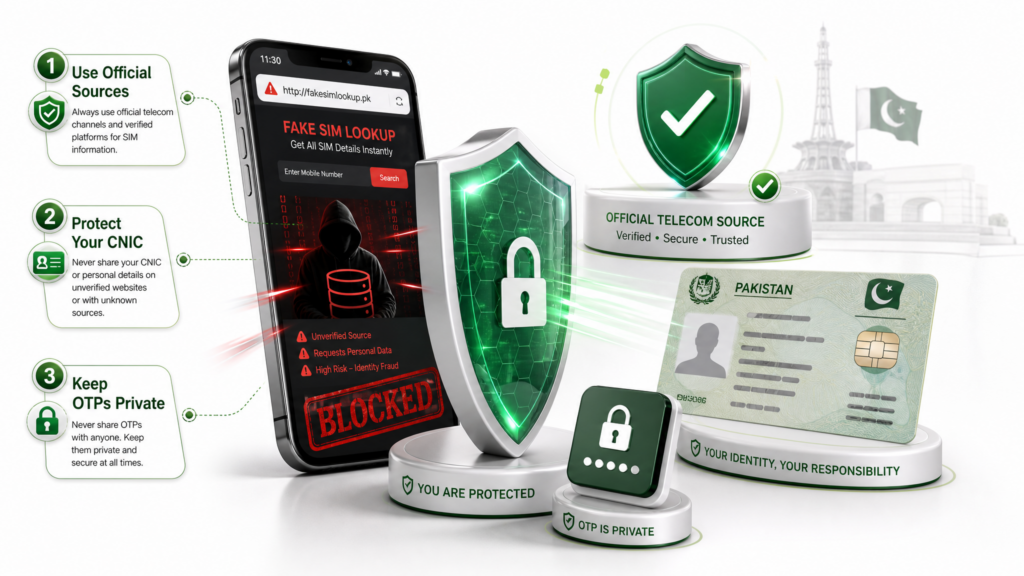
Follow these basic rules:
Use Official Sources
Start with your mobile operator or an applicable official telecom service.
Protect Your CNIC
Do not upload identity documents to unknown lookup websites.
Keep OTPs Private
Never share authentication codes with strangers.
Check Website Identity
Do not assume that a website using telecom logos is officially affiliated with a telecom organization.
Avoid Leaked Databases
Do not purchase, download, or redistribute supposedly leaked subscriber information.
Be Careful With “100% Accurate” Claims
Accuracy claims do not prove that a database is legitimate.
What Should You Do If You Need Your Own SIM Data?
If you are looking for information about your own connections, follow this sequence:
1. Identify what you need.
Do you need a SIM count, network information, account information, or a registration correction?
2. Find the appropriate official service.
Use the relevant operator or authorized telecom system.
3. Complete the required verification.
Provide only the information genuinely required for the service.
4. Contact the operator if something is wrong.
Especially if you find an unfamiliar connection.
This is much safer than using an unknown “SIM database.”
SIM Database and Search Engine Results
A common mistake is assuming that the first result on Google must be the most authoritative.
Search engines rank pages for many different reasons. A page appearing prominently in search results does not necessarily mean that it is an official telecom service.
When dealing with sensitive information such as CNIC and SIM registration, source verification matters more than search position.
Key Takeaway
The term SIM Database Pakistan can refer broadly to telecom subscriber records, but users should not assume that private SIM information is freely available to the public.
If you need to check your own SIM registration, use an authorized service.
If you encounter a website claiming to provide complete private subscriber information, verify its legitimacy before entering any personal information.
A database containing more information is not necessarily more accurate, more official, or safer.
Your priority should always be:
Accuracy → Authorization → Privacy → Security.
SIM Ownership: Registered Owner vs Actual User
What Is SIM Ownership?
SIM ownership refers to the subscriber associated with a mobile connection through the official registration process.
When a SIM is registered, the relevant mobile operator maintains a subscriber record connected with that service. The person recorded in that registration is generally the registered subscriber, while the person physically using the SIM may sometimes be different.
This distinction is important when researching SIM Owner Details Pakistan, because simply holding a SIM card does not necessarily establish who the connection is officially registered to.
Registered Owner and SIM User Can Be Different
Consider a simple example.
A person purchases a SIM and completes registration using their own identity. Later, they give that SIM to a family member for regular use.
The family member may become the everyday user, but the official subscriber record may still remain associated with the person who originally registered the connection.
This can create complications when the number needs:
- Replacement
- Blocking
- Account support
- Registration correction
- Ownership-related management
Therefore, long-term use of a SIM should be handled through the appropriate official procedure rather than informal transfer alone.
Why Should a SIM Be Registered Correctly?
Correct registration creates a clearer relationship between the subscriber and the mobile operator.
It can make it easier for the registered subscriber to manage legitimate account matters, including:
- Customer support
- SIM replacement
- Lost-SIM reporting
- Account-related requests
- Registration issues
- Service management
It also reduces uncertainty about who is officially associated with the connection.
Is Physical Possession Proof of Ownership?
No.
Possessing a SIM card does not necessarily mean that you are the registered subscriber.
For example, someone could have:
- Found another person’s SIM
- Borrowed a family member’s SIM
- Purchased a used connection informally
- Received a SIM from an employee or friend
None of these situations automatically establishes official registration.
For actual ownership or registration questions, the relevant telecom record and authorized verification process are more important than physical possession.
What If You Are Using Someone Else’s SIM?
If you are temporarily using another person’s SIM, that does not automatically make you the registered subscriber.
For short-term situations this may simply be a practical arrangement, but long-term use can create problems if you need to manage the account yourself.
For example, the registered subscriber may be the person who must deal with certain account or replacement requests.
If the number is intended to become your long-term connection, ask the operator about the appropriate official procedure rather than assuming that possession changes the registration.
What If Someone Else Is Using Your Registered SIM?
If a SIM registered under your identity is being permanently used by another person, consider resolving the situation through the relevant mobile operator.
This is particularly important if the number is connected with:
- Banking
- Mobile wallets
- Email recovery
- Social-media accounts
- Business services
- Two-factor authentication
You should know which mobile connections remain associated with your identity and maintain appropriate control over them.
What If You No Longer Use a SIM?
People frequently stop using old numbers without taking further action.
You may have:
- Changed your primary number
- Switched networks
- Purchased a new SIM
- Stopped using a secondary number
- Replaced a lost SIM
If you no longer need an old connection, contact the relevant operator and ask about the current procedure for managing or closing it.
Keeping old connections under your identity without a reason can make your mobile records harder to manage.
What If a SIM Is Lost?
A lost SIM should be reported to the relevant operator as soon as reasonably possible.
This is especially important if the number is connected with important accounts.
The operator can explain the appropriate procedure for:
- Blocking the lost SIM
- Replacing the SIM
- Maintaining the number
- Completing required verification
- Securing the connection
Do not wait for a suspicious website or unknown caller to offer a “SIM recovery” service.
What If Your Phone Is Stolen?
A stolen phone can create both device and SIM-security concerns.
If your phone is stolen:
- Contact your mobile operator regarding the SIM.
- Follow the official blocking or replacement procedure.
- Secure accounts connected to the mobile number.
- Use legitimate device-security features where available.
- Review important accounts for unusual activity.
Do not give your OTP or account credentials to someone claiming they can recover the phone or SIM.
Can SIM Ownership Be Changed?
If a mobile connection needs to move from one subscriber to another, the correct approach is to ask the relevant operator about its current official ownership or transfer procedure.
Do not assume that:
Giving someone the SIM = changing ownership
These are two different things.
The physical SIM can change hands while the official subscriber record remains unchanged.
What If a SIM Is Registered Under Your Name Without Your Permission?
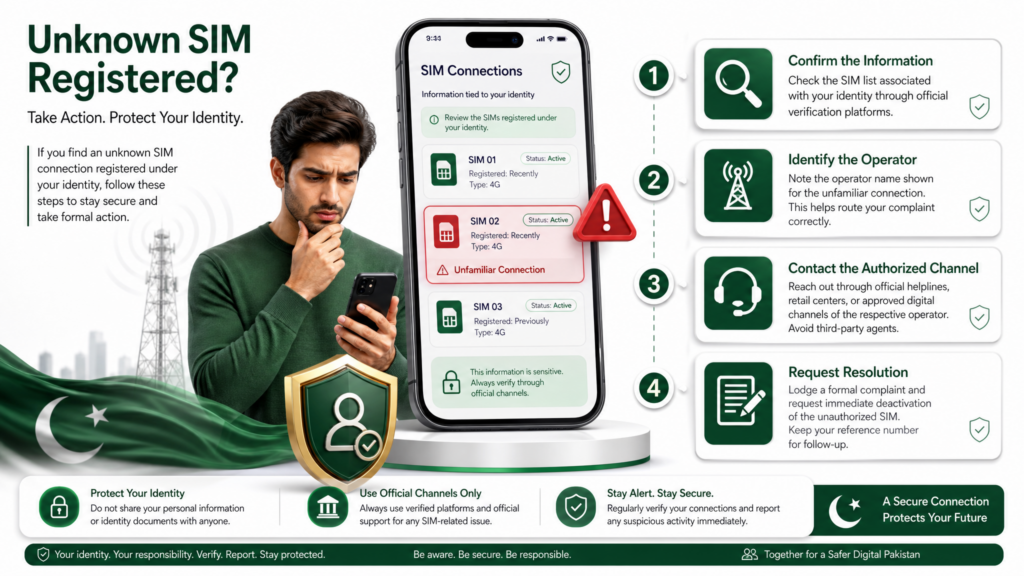
This is a situation that should be taken seriously.
If an official SIM check indicates that a connection is associated with your identity and you do not recognize it:
Step 1: Confirm the Information
Make sure the result came from an authorized source.
Step 2: Identify the Operator
Determine which network is associated with the connection.
Step 3: Contact the Operator
Explain that you do not recognize the registration.
Step 4: Follow Verification
The operator can explain the appropriate procedure for investigating the issue.
Step 5: Resolve the Connection
Depending on the circumstances, you may need to request blocking, closure, correction, or another appropriate action.
Do not try to discover the alleged user’s identity through an unofficial SIM database.
SIM Ownership and Digital Identity
SIM ownership has become increasingly important because mobile numbers are connected to digital services.
A number may be used for:
- Account recovery
- Login verification
- Banking alerts
- Mobile wallets
- Business communication
- Two-factor authentication
- Password recovery
Therefore, losing control of a number can potentially affect several other services.
This is why maintaining accurate and secure SIM registration is part of good digital-security practice.
How to Protect Your SIM Ownership
Follow these simple habits:
Keep Your Registered SIM Under Your Control
Avoid giving permanent control of your registered number to another person.
Use Authorized Services
Obtain and manage SIMs through legitimate operator channels.
Protect Your CNIC
Do not provide identity documents to unknown websites or individuals.
Keep OTPs Private
An OTP should never be shared with another person.
Report Lost SIMs
Contact the operator promptly if a SIM is lost or stolen.
Manage Old Connections
If you no longer need a number, ask the operator about the correct closure or management process.
Common SIM Ownership Mistakes
Mistake 1: Assuming Possession Equals Ownership
Holding a SIM does not automatically establish the registered subscriber.
Mistake 2: Permanently Giving Away a Registered SIM
The original subscriber may remain associated with the connection.
Mistake 3: Ignoring Old Connections
Unused numbers can remain part of your mobile records.
Mistake 4: Buying SIMs From Unknown Sources
Use authorized channels instead.
Mistake 5: Sharing OTPs
Authentication codes should remain private.
SIM Ownership and Privacy
SIM ownership information can involve personal data.
This is why a person’s subscriber information should not be treated as something that anyone can freely obtain simply by knowing a mobile number.
Responsible SIM management means protecting both:
Your own information
and
Other people’s information.
A useful rule is:
Verify what you are authorized to verify, and do not attempt to access information that belongs to someone else.
Key Takeaway
SIM ownership is determined by the official subscriber registration, not simply by possession or everyday use of the SIM.
If you are using a number registered to someone else, or someone else is permanently using a number registered to you, the safest approach is to contact the relevant operator and ask about the appropriate official procedure.
Keep your own SIM connections under control, protect your identity information, and investigate unfamiliar registrations through authorized channels rather than unofficial databases.
SIM Owner Details Online: Safe & Responsible Ways to Search
What Does SIM Owner Details Online Mean?
The phrase SIM Owner Details Online is commonly searched by people who want information about a mobile number or SIM registration.
However, this search can represent several different intentions. A user may want to check their own SIM, understand registration, identify a network, or investigate an unfamiliar number.
The important point is that online availability does not automatically mean public availability.
Telecom operators maintain subscriber records, but confidential subscriber information should not be assumed to be freely searchable by anyone on the internet.
Can You Check SIM Owner Details Online?
If you are trying to check information about your own SIM or registered connections, online verification may be available through an authorized telecom or regulatory service.
This is the safest approach because the service can use an appropriate verification process.
However, if a website claims:
“Enter any Pakistani mobile number and get complete owner details.”
you should not automatically trust the claim.
A legitimate service should have a clear purpose, identifiable operator, and appropriate verification process.
What Can Be Available Online?
Depending on the source, you may find different types of mobile-number information.
For example, a business may publicly publish its telephone number on its website.
Publicly available information can sometimes include:
- Business name
- Public contact number
- Office information
- Customer-service details
- Public social-media information
This is very different from private telecom subscriber information.
Public Information vs Private Information
Consider this example:
A restaurant publishes its customer-service number on its official website.
You can legitimately find:
Restaurant → Published phone number
But this does not mean you can use that number to retrieve:
Subscriber → CNIC → Home address → Private account records
The second category can contain sensitive personal information and should not be treated as a public lookup result.
Why Search Results Can Be Misleading
Search engines may display pages that target phrases such as:
- SIM Owner Details Online
- SIM Owner Details by Number
- SIM Information
- Mobile Number Details
- SIM Database
- Pak SIM Data
A page ranking for a keyword does not automatically mean it is an official service.
This is particularly important when a page asks users to submit sensitive information.
Before entering anything, check:
- Who owns the website?
- Is it an official organization?
- Is the domain genuine?
- Why is the information required?
- Does the service explain its verification process?
- Is there an official alternative?
Never Share Your OTP for an Online SIM Check
An OTP should be treated as confidential authentication information.
If a website or person says:
“Enter the OTP you just received so we can show you the SIM owner.”
stop and verify the service independently.
Do not share OTPs with:
- Unknown callers
- Random websites
- Unverified agents
- Social-media accounts
- People claiming to provide SIM verification
If an official service genuinely requires authentication, complete it directly through the official platform rather than giving your code to another person.
Be Careful With CNIC Requests
Your CNIC is sensitive personal information.
A website offering SIM Owner Details Online may ask you to enter a CNIC number or upload an identity document.
Before doing so, ask whether:
You are checking your own information?
The service is officially authorized?
The information is genuinely necessary?
If the answer is unclear, do not submit the document.
Can You Find SIM Owner Details by Mobile Number?
A mobile number can be associated with a subscriber record, but that does not mean the private subscriber record is publicly accessible.
If you need to verify your own registration, use the appropriate official SIM verification system or mobile operator.
If you are investigating another person’s number, do not rely on an unofficial database to obtain confidential identity information.
What About “Free SIM Owner Details Online”?
The word free should not influence your judgment about whether a service is trustworthy.
A free website may still:
- Collect your personal data
- Display inaccurate information
- Redirect you to advertisements
- Request unnecessary permissions
- Ask for an OTP
- Encourage downloads
- Make unsupported claims
Always evaluate the source rather than the price.
SIM Owner Details and Unknown Callers
If you receive a call from an unknown number, you may simply want to know whether the caller is legitimate.
In that situation, you do not necessarily need private subscriber information.
Instead:
- Do not share personal information.
- Do not provide OTPs.
- Avoid clicking links sent by the caller.
- Search for publicly available business information if relevant.
- Block suspicious numbers.
- Report serious fraud or harassment through appropriate official channels.
This approach protects you without attempting to expose private information.
What If a Number Belongs to a Business?
Business contact information is often intentionally public.
For example, a company may publish a phone number for:
- Customer support
- Sales
- Orders
- Complaints
- General inquiries
If you are trying to verify a business number, prioritize the company’s official website and verified business profiles.
This is generally more reliable than an unofficial SIM database.
Don’t Confuse Online Lookup With Official Verification
An online result may tell you something about a number, but that does not necessarily make it an official verification.
There is a difference between:
Finding information
and
Verifying information.
For example, a random webpage might associate a name with a number. That association may be outdated or incorrect.
An official telecom process is designed for actual subscriber and account verification.
What If You Find Incorrect Information Online?
If a website displays incorrect information about you or your mobile number, avoid responding by publishing someone else’s private information.
Instead:
- Document the page.
- Avoid sharing the information further.
- Contact the relevant service provider if appropriate.
- Secure your accounts.
- Use an applicable reporting or removal process if necessary.
Your goal should be to protect your privacy rather than create another privacy issue.
How to Perform a Safer SIM Search
Use this simple process:
1. Define Your Purpose
Are you checking your own SIM, a network, or a public business number?
2. Choose the Correct Source
Use an official operator or authorized telecom service for private account matters.
3. Minimize Information Sharing
Provide only what is genuinely required.
4. Protect Authentication Codes
Never share OTPs.
5. Verify Unexpected Results
If information appears incorrect, contact the relevant operator.
6. Avoid “Leaked Database” Services
Do not treat leaked or supposedly leaked records as reliable or legitimate.
Quick Safety Checklist
Before using an online SIM service:
- ✅ Verify the website.
- ✅ Confirm that it is an appropriate source.
- ✅ Check whether you are accessing your own information.
- ✅ Read what information the service requests.
- ❌ Do not share OTPs.
- ❌ Do not upload CNIC documents to unknown websites.
- ❌ Do not trust “100% complete database” claims automatically.
- ❌ Do not assume a search result proves current SIM ownership.
Key Takeaway
SIM Owner Details Online is a broad search term, but not every website targeting it is an authorized source.
For your own SIM and registration information, use official telecom and regulatory channels. For an unknown mobile number, rely on legitimate public information and safe reporting methods rather than attempting to access confidential subscriber records.
The safest rule is:
Use official sources for verification, protect your personal information, and never assume that a phone number gives public access to a person’s private identity.
Final Checklist: SIM Owner Details Pakistan
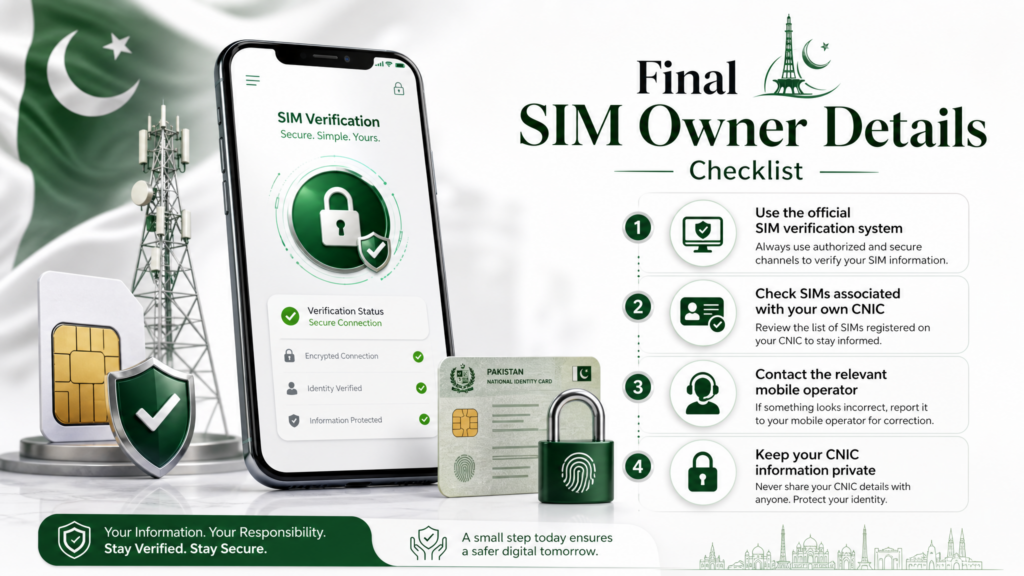
Final SIM Owner Details Checklist
If you are researching SIM Owner Details Pakistan, the most important thing is to use the right method for the right purpose.
For your own SIM connections:
- Use the official SIM verification system.
- Check the SIMs associated with your own CNIC.
- Contact the relevant mobile operator if something looks incorrect.
- Keep your CNIC information private.
- Never share OTPs with unknown people.
- Report lost or stolen SIMs promptly.
- Manage old or unused connections through the proper operator procedure.
For an unknown mobile number, remember that a phone number does not automatically provide public access to another person’s private subscriber information.
Avoid websites claiming to offer:
- Complete SIM owner databases
- Private CNIC information
- Private addresses
- Call-history records
- Guaranteed live GPS tracking
- “100% accurate” subscriber information
Instead, rely on authorized telecom services and legitimate public information.
Final Takeaway
SIM Owner Details Pakistan is a broad topic covering SIM registration, verification, ownership, CNIC SIM checks, SIM information, telecom networks, and digital-security awareness.
The safest approach is simple:
Check your own information through official channels, protect your personal data, and respect the privacy of other subscribers.
A reliable SIM guide should help you understand what can be checked, where it can be checked, and what information should never be trusted from an unofficial source.