If you are searching for Jazz SIM Owner Details, the first thing to understand is what “owner details” actually means. A Jazz mobile number is connected to a subscriber registration, but that does not mean every private detail associated with the subscriber is publicly available through a simple number search.
For your own Jazz SIM, verification is mainly about confirming the registration, managing the connection, and making sure the number is being used under the correct identity. Jazz’s SIM terms explain that a cellular connection is issued against valid identification and that biometric verification is part of the activation process.
For someone searching for another person’s information, the situation is different. A mobile number should not be treated as a public key for obtaining confidential CNIC information, residential details, biometric records, or other protected subscriber data. Therefore, this guide focuses on legitimate Jazz SIM verification, ownership-related situations, registration, security, official support, and the limits of online lookup claims.
For official identity verification and CNIC-related services, readers should rely on the National Database and Registration Authority (NADRA) rather than unofficial websites claiming to provide private subscriber information. This helps ensure that identity-related information is handled through an authorized source.
What Does Jazz SIM Owner Details Mean?
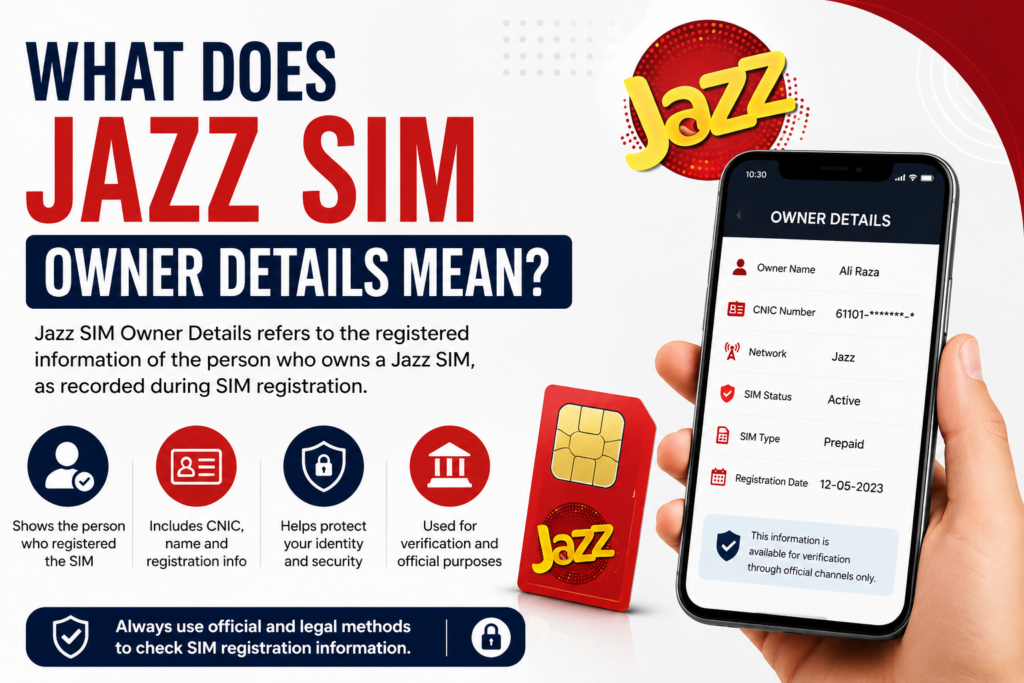
The phrase Jazz SIM Owner Details can describe several different user needs.
Someone may want to:
- Verify their own Jazz SIM registration
- Understand how Jazz SIM ownership is established
- Check whether a connection is correctly registered
- Resolve an ownership or registration problem
- Replace or block a SIM
- Identify the correct official support channel
- Understand what information can and cannot be obtained from a Jazz number
These are separate situations and should not be mixed together.
Jazz’s published SIM terms state that customers must provide valid identification for obtaining a cellular connection. The documented activation process includes checking eligibility, selecting a mobile number, capturing a customer’s thumb or finger through a designated biometric scanner, and sending the required information for verification.
This gives us an important foundation: SIM ownership is connected with an official subscriber-registration process rather than simply with possession of a mobile number.
Why Your Own SIM Registration Matters
If you are using a Jazz number yourself, knowing how its registration is handled can help you deal with problems more effectively. An incorrectly registered, unauthorized, lost, or compromised SIM can create both service and security concerns.
Jazz currently provides several official customer-management options. Its SIMOSA platform offers account-management and customer-support functions, while Jazz also lists customer-care numbers and a contact form for queries and complaints.
The important principle is simple: when the issue concerns your own Jazz connection, start with an authorized Jazz channel rather than an unofficial “SIM owner database.”
This approach also protects you from websites that may display questionable information or request unnecessary personal details.
How Jazz SIM Registration Works in Pakistan
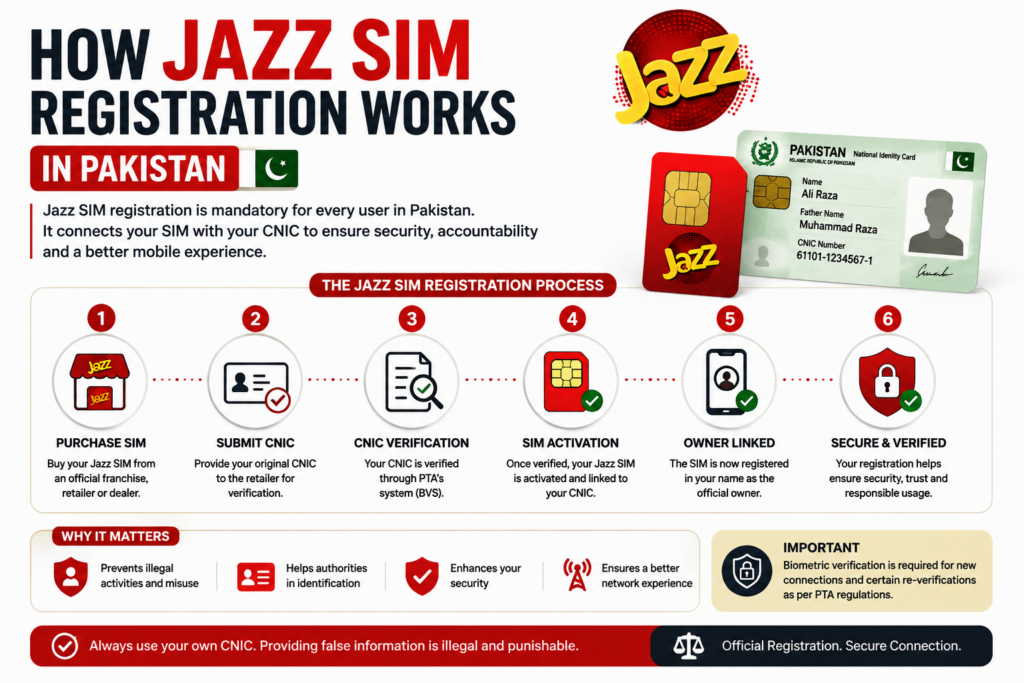
Jazz SIM ownership is established through a formal subscriber-registration process. This is important because simply possessing a Jazz SIM or having a mobile number does not by itself prove who the registered subscriber is.
Subscriber Identity and SIM Registration
When a Jazz connection is obtained, the customer provides valid identification as part of the registration process. Jazz’s published SIM terms explain that the customer information is verified before the cellular connection is activated. The process includes selecting a mobile number, capturing the customer’s thumb or finger through a designated biometric scanner, and submitting the required information for verification.
This means that Jazz SIM Owner Details are connected with the subscriber information collected during the authorized registration process.
Why Biometric Verification Matters
Biometric verification helps establish that the person requesting the SIM is the legitimate individual associated with the identification document being presented.
It also creates an important distinction between:
SIM possession — who physically has the SIM, and
SIM registration — whose identity the connection is officially registered against.
These two situations can sometimes be different. A person may be using a number that was registered earlier, while the official subscriber record remains connected with the individual who completed the registration process.
Registration Is Not a Public Directory
The existence of a formal registration system does not mean that subscriber records become publicly searchable.
If someone enters a Jazz number into an unknown website and receives a supposed name, CNIC, address, or other personal information, that result should not automatically be considered an official Jazz record.
For privacy and security reasons, users should distinguish between legitimate verification and third-party claims about Jazz SIM Owner Details.
What This Means for Your Own Jazz SIM
If you personally use a Jazz SIM, understanding the registration process helps you identify the correct next step when something appears wrong.
For example, if you suspect that:
- Your SIM is registered incorrectly
- An unauthorized connection exists
- Your SIM has been lost
- Your connection needs replacement
- You have an ownership-related issue
you should use Jazz’s official customer-support channels instead of relying on an online owner-lookup service.
Jazz provides customer-management and support facilities through its official channels, including SIMOSA and customer-care services.
The key point is that Jazz SIM ownership is established through subscriber verification and registration—not merely by knowing or possessing the mobile number.
How to Verify Your Jazz SIM Registration
If you want to check Jazz SIM Owner Details for a number that you personally use, the safest approach is to verify the registration through recognized channels rather than depending on an unverified online lookup. The purpose of verification is to establish whether the connection is correctly associated with your own identity and to identify any registration issue that may require attention.
Start With Your Own Identity
A SIM registration check should begin with the identity under which the connection was obtained. In Pakistan, SIM registration is linked with subscriber identification and verification, while Jazz’s published terms describe biometric verification as part of the SIM activation process.
If you are checking your own Jazz connection, keep your identification information private and use an authorized service when the verification process requires it.
Use Jazz’s Official Support Channels
For a Jazz-specific registration or account question, Jazz’s own customer-support channels are the appropriate starting point.
Jazz provides SIMOSA for account management and customer support, alongside its listed customer-care facilities.
This is particularly useful when your question involves an individual Jazz connection rather than a general explanation of SIM registration.
Check Your Overall SIM Registration
If your concern is broader—for example, you want to know whether additional SIMs have been registered against your own CNIC—the relevant nationwide SIM-verification facility should be used.
This type of check is different from asking Jazz to resolve a particular account issue. One process helps you understand your overall registration position, while the operator can assist with matters involving its own service.
What If the Details Appear Incorrect?
If your verification suggests that a Jazz connection is not registered as you expected, do not immediately rely on a third-party website claiming to reveal the “real owner.”
Instead:
- Confirm the issue through an appropriate official channel.
- Contact Jazz if the connection is related to its network.
- Explain the registration problem clearly.
- Follow the operator’s current verification or correction procedure.
- Keep relevant confirmation or complaint information for your records.
Why This Approach Is Safer
A genuine Jazz SIM Owner Details check should answer a specific question about registration, service, or ownership. It should not require you to expose unnecessary personal information to an unknown website.
For your own Jazz SIM, verify the registration through authorized channels, and use Jazz customer support when the issue concerns the connection itself.
Jazz SIM Owner Name: What Can Actually Be Verified?
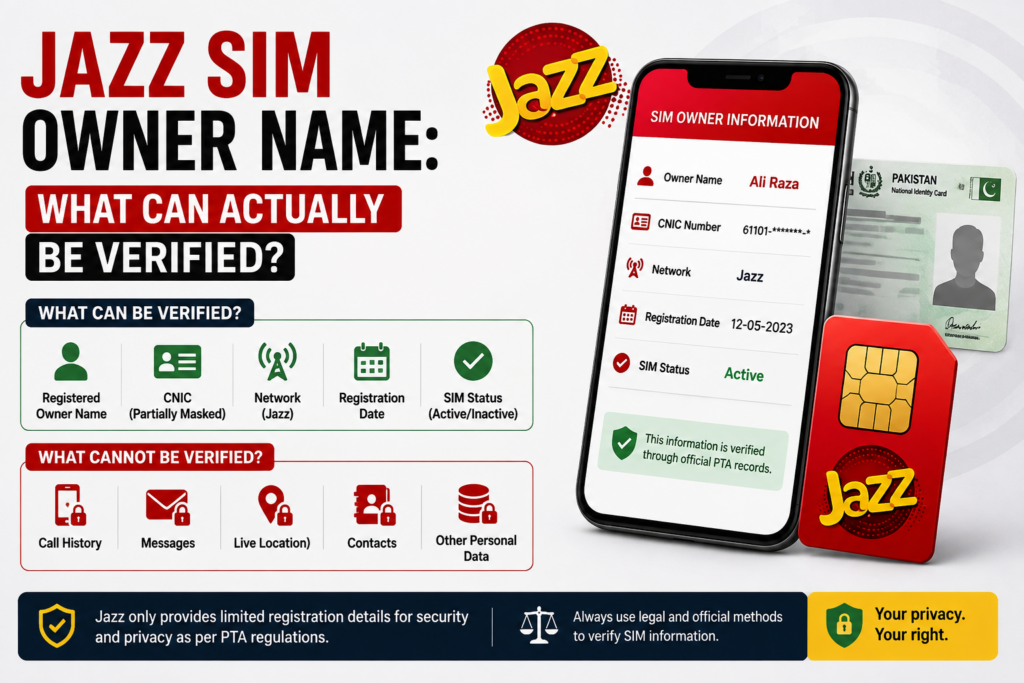
When people search for Jazz SIM Owner Details, they often specifically want to know whether the registered owner’s name can be discovered from a Jazz mobile number. This is where it is important to distinguish between verifying your own registration and attempting to obtain another subscriber’s private information.
Your Own Jazz SIM
If the Jazz number belongs to you, the relevant question is whether the connection is correctly registered under your identity.
Jazz’s published SIM terms describe a registration process involving valid identification and biometric verification before activation.
For account-specific questions, Jazz provides official customer-support options, including SIMOSA and its customer-care facilities.
These channels are more appropriate than relying on an unknown website that promises an instant owner-name result.
Another Person’s Jazz Number
If you have someone else’s Jazz number, simply knowing the number should not be treated as authorization to obtain their confidential subscriber record.
A mobile number can identify a telecom connection, but that does not mean that a person’s complete identity information, CNIC, residential address, biometric data, or private account information should be publicly accessible.
This distinction is particularly important when evaluating websites advertising Jazz SIM Owner Details by Number.
Why Online Results Need Caution
Some third-party websites may display a name after a number is entered. However, the appearance of a result does not establish that the information is:
- Officially provided by Jazz
- Current
- Accurate
- Authorized for public disclosure
- Taken from a legitimate telecom source
A responsible verification process should therefore focus on information you are entitled to access.
What You Should Do Instead
If your objective is to verify your own Jazz registration, use an authorized Jazz channel or the applicable official SIM-registration checking system.
If you are dealing with an unknown number, first determine why you need to investigate it. For an ordinary unknown call, protecting yourself from spam or fraud may be more useful than trying to uncover private subscriber information.
If the number is connected with suspected fraud, harassment, or another serious issue, preserve relevant evidence and use the appropriate complaint or reporting channel.
The important distinction is that verifying your own Jazz registration is a legitimate account-management task, while obtaining another subscriber’s private identity information requires appropriate authorization.
What Information Can You Get From a Jazz SIM Number?
A Jazz mobile number can be a useful starting point for certain telecom checks, but it should not be treated as a direct key to a subscriber’s complete personal profile. When searching for Jazz SIM Owner Details, it is important to separate general number-related information from private registration records.
Mobile Network Information
One of the most basic things associated with a mobile number is its network. If you need to determine which telecom operator is associated with a number, an applicable official network-checking method can help you identify the relevant provider.
This information can be useful when you need to contact the correct operator about a SIM-related issue. However, identifying the network does not establish that you have obtained the subscriber’s complete ownership information.
Your Own SIM Registration
If the Jazz number belongs to you, the more important question may be whether the connection is correctly registered under your identity.
Jazz’s published SIM terms describe a registration process involving valid identification and biometric verification before activation. This means the official subscriber relationship is established through a formal verification process rather than simply through possession of the SIM card.
If you have concerns about your own Jazz connection, use an authorized Jazz support channel to clarify the registration or account issue.
Account-Specific Information
Some information is connected specifically with the subscriber’s own account and may require direct interaction with the operator.
Examples can include:
- SIM replacement
- SIM blocking
- Registration assistance
- Account-related support
- Ownership-related requests
- Service management
Jazz provides SIMOSA as one of its official customer-management and support platforms.
Using an official channel is preferable when you need assistance with information connected to your own Jazz account.
Private Subscriber Information
A mobile number should not be considered a public shortcut to another person’s confidential identity.
Information such as a subscriber’s CNIC number, residential address, biometric records, or private account information should not be assumed to be publicly available simply because someone knows the person’s mobile number.
This distinction is particularly important when evaluating websites advertising Jazz SIM Owner Details by Number.
Be Careful With Online Lookup Results
Some third-party websites may display a person’s name or other information after a Jazz number is entered. However, seeing a result on a webpage does not prove that the information comes directly from Jazz or that it is accurate, current, or authorized for public disclosure.
Before trusting such information, consider where it came from and whether the service has a legitimate basis for providing it.
For your own Jazz SIM, the safer approach is to use recognized verification and customer-support channels.
A Jazz mobile number can help begin a legitimate verification process, but it should never be treated as an automatic gateway to another subscriber’s complete private information.
How Many Jazz SIMs Can Be Registered on Your CNIC?
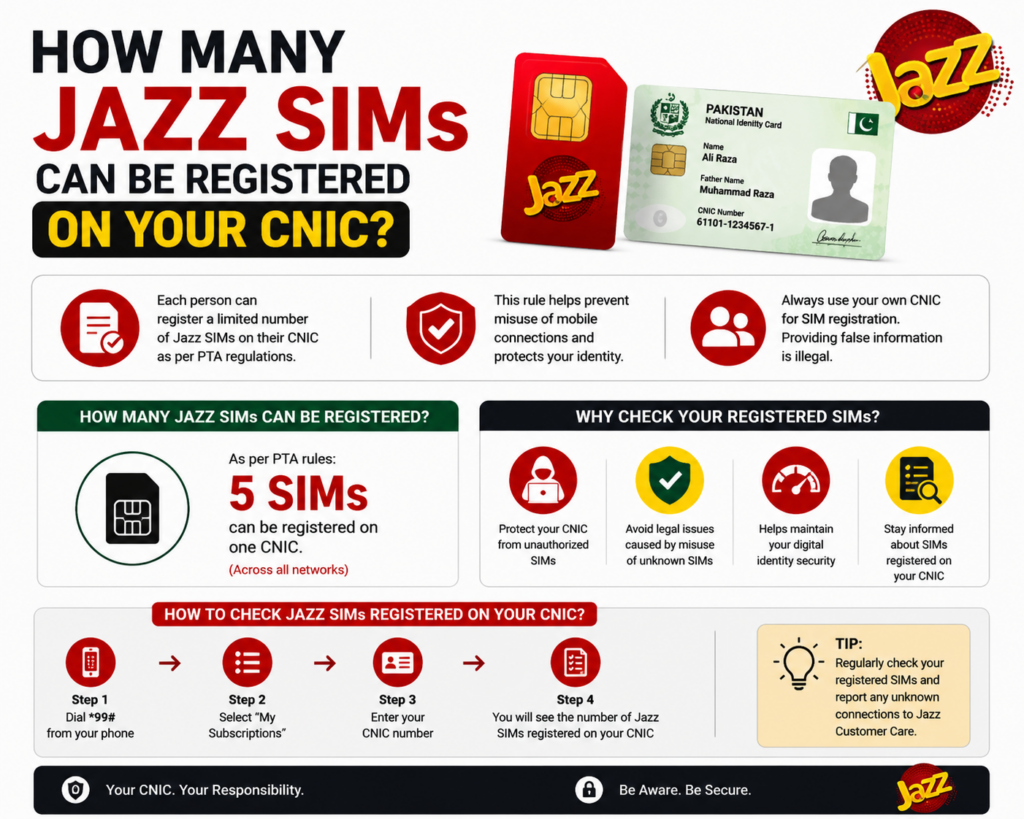
If you are checking Jazz SIM Owner Details, one of the most useful questions is not necessarily the name associated with a particular number. It may be more important to know whether the Jazz connections registered against your own CNIC are accurate and whether any unfamiliar SIM appears in your registration record.
Check Your Own SIM Registration
Pakistan’s official SIM Information System provides a CNIC-based facility that allows users to check the number of SIMs registered against their identity. The result is organized according to mobile networks, making it useful for identifying whether connections exist under your CNIC that you do not recognize.
This type of verification is different from entering a Jazz mobile number into an online owner-lookup website. A CNIC-based check focuses on your own registration record rather than attempting to expose another subscriber’s private information.
Why Checking Your CNIC Matters
Keeping track of your registered SIM connections can help you identify unexpected registrations.
For example, you may discover a connection that:
- You no longer use
- You do not remember obtaining
- Was registered without your knowledge
- Requires clarification from the relevant operator
An unfamiliar SIM should not immediately be treated as proof of fraud. First confirm the information through an appropriate official channel and then determine what action is required.
What to Do About an Unrecognized Jazz SIM
If your CNIC-linked SIM information shows an unfamiliar Jazz connection, the next step is to contact Jazz through an authorized support channel.
Explain that the connection is not recognized by you and ask about the applicable procedure for verification, blocking, disowning, or correcting the registration.
Jazz provides customer-management and support facilities through its official channels, including SIMOSA.
Keep any relevant confirmation, reference number, or communication for your records.
Do Not Use an Unofficial Database
An unfamiliar registration does not mean you should search for the supposed user’s name, CNIC, address, or other private details through an unofficial Jazz SIM Owner Details website.
The safer approach is to resolve the registration issue through the operator responsible for the connection.
Keep Your CNIC Information Private
When checking your own SIM registrations, protect your CNIC information and other sensitive credentials. Do not share OTPs, passwords, biometric information, or unnecessary identity documents with unknown websites or individuals.
The objective of checking your registered SIMs is to protect your own identity and maintain accurate registration—not to obtain unrestricted information about other subscribers.
Regularly reviewing the SIMs registered against your own CNIC can help you identify unfamiliar connections early and gives you an opportunity to address registration issues through the proper Jazz support channel.
Jazz SIM Ownership Transfer and Change of Registration
A Jazz SIM may need an ownership-related change when a connection is being transferred to another person, when registration information needs correction, or when the current user and registered subscriber are no longer the same. For anyone researching Jazz SIM Owner Details, understanding this distinction is important because physical possession of a SIM does not automatically change the official subscriber record.
Using a SIM Does Not Automatically Change Its Registration
A person may use a Jazz number for a long period while the registration remains associated with the individual who originally obtained the connection.
Therefore, if the current user needs the SIM to be officially registered under their own identity, they should not assume that continued use is enough. An ownership-related request should be handled through Jazz’s authorized process.
When an Ownership Change May Be Relevant
Situations can include:
- A SIM is being transferred to a new user
- The registered subscriber and actual user are different
- Registration information needs correction
- A family member is no longer using the connection
- A business-related number needs an appropriate subscriber arrangement
- The current registration needs to be reviewed with the operator
The exact requirements can depend on the type of request and Jazz’s current procedures.
Identity Verification Is Important
Jazz’s published SIM terms describe subscriber identification and biometric verification as part of the SIM activation process.
This is why an ownership-related request should be completed through an authorized Jazz channel rather than through an online service claiming to change or reveal Jazz SIM Owner Details.
Identity verification helps ensure that the requested change is being handled for the appropriate subscriber.
Contact Jazz Before Making a Change
If you believe your Jazz SIM should be transferred, corrected, or reviewed, contact Jazz through its official customer-support channels and ask for the current procedure.
Jazz provides customer-management and support facilities through SIMOSA, along with other customer-care options.
Before submitting documents or personal information, confirm that you are dealing with an official Jazz channel.
Do Not Confuse Ownership With Number Possession
This is one of the most important points in understanding SIM ownership.
Having the SIM → physical possession
Using the number → everyday access
Official registration → subscriber identity recorded through the authorized process
These can describe different circumstances.
If your own Jazz connection does not reflect your current situation, resolving the registration through the operator is more appropriate than attempting to discover private information through a third-party database.
A genuine Jazz ownership change should be handled through the operator’s authorized verification process so that the subscriber record remains accurate and properly protected.
Jazz SIM Replacement and Duplicate SIM
A replacement SIM becomes relevant when a Jazz connection is lost, damaged, blocked, or otherwise cannot be used normally. For people researching Jazz SIM Owner Details, it is important to understand that replacing a SIM is a service-management process, not a method for discovering private information about a subscriber.
When You May Need a Replacement
Common situations include:
- Your phone or SIM has been lost
- The physical SIM is damaged
- The SIM no longer works properly
- You need to move an existing connection to a replacement SIM
- A security concern requires the existing SIM to be blocked
The appropriate procedure depends on the specific situation and should be confirmed through Jazz’s current official support channels.
Identity Verification Matters
A replacement request concerns an existing subscriber connection, so the operator may require appropriate identity verification before processing it.
Jazz’s published SIM terms describe customer identification and biometric verification within its SIM registration and activation procedures.
This is an important security measure because a replacement SIM can restore access to a mobile number that may also be connected to important accounts and services.
What If Your SIM Is Lost?
If your Jazz SIM is lost, do not wait unnecessarily before taking action. Contact Jazz through an authorized support channel and ask about blocking the missing SIM and obtaining a replacement.
The goal is to prevent unauthorized use of the lost connection while preserving legitimate access for the registered subscriber.
Jazz provides customer-support facilities through its official channels, including SIMOSA, where customers can manage services and seek assistance.
Replacement Does Not Mean New Ownership
A replacement SIM should not be confused with transferring a connection to a different person.
Replacement → restoring access to an existing connection
Ownership change → changing the registered subscriber relationship
These are separate processes and may involve different verification requirements.
Avoid Unofficial SIM Replacement Offers
Be cautious if someone offers to replace your Jazz SIM through an unofficial website, social-media account, or unknown agent while asking for your OTP, password, or unnecessary personal information.
A legitimate request should be handled through an authorized Jazz channel.
If your SIM was lost and you are concerned about account security, also review important services that use your mobile number for authentication or recovery.
For a lost, damaged, or compromised Jazz SIM, use the operator’s authorized replacement process and complete the required identity verification rather than relying on unofficial services claiming to manage Jazz SIM Owner Details.
How to Block a Jazz SIM Safely
If a Jazz SIM is lost, stolen, misused, or suspected to be compromised, blocking the connection should be treated as a security step rather than simply a routine service request. For users researching Jazz SIM Owner Details, this is particularly important because the mobile number may be connected to personal accounts, verification messages, and other services.
When Should You Consider Blocking a SIM?
A Jazz SIM may need to be blocked when:
- The SIM has been lost or stolen
- Someone else may have access to the SIM
- The number is being used without your permission
- You suspect unauthorized activity
- Your phone suddenly loses service and you suspect a SIM-related security problem
The exact blocking procedure can depend on the circumstances, so the safest approach is to contact Jazz through an authorized customer-support channel.
Why Quick Action Matters
A mobile number can be used for receiving calls and SMS messages and may also be associated with online accounts. If a lost SIM remains active, an unauthorized person who obtains it could potentially receive communications intended for the legitimate subscriber.
For this reason, delaying action after losing a SIM is unnecessary risk.
If you still have access to your Jazz account, review the available security and account-management options. Jazz provides customer-management and support facilities through SIMOSA and its other official customer-care channels.
What About Your SIM Registration?
Blocking a SIM does not mean that the underlying subscriber information should be treated as publicly searchable.
If you are concerned about Jazz SIM Owner Details, keep the focus on your own registration and account security. Jazz’s published SIM terms describe subscriber identification and biometric verification as part of the registration and activation process.
If the registration itself appears incorrect, discuss the issue with Jazz rather than attempting to resolve it through an unofficial lookup service.
If Your Phone Suddenly Loses Service
Unexpected loss of mobile service can have several causes, but it can also be a warning sign of SIM-swap activity. PTA’s SIM-swapping guidance recommends contacting the wireless provider immediately if calls or text messages unexpectedly stop without an obvious reason.
After contacting the operator, review important accounts that depend on your number for authentication or recovery.
Keep Your Information Private
Never give your OTP, password, or unnecessary personal information to someone claiming they can block or recover your Jazz SIM.
Use an authorized Jazz channel, explain the situation, and follow the current identity-verification requirements.
If your Jazz SIM is lost, stolen, or potentially compromised, prompt operator contact and proper verification are safer than relying on an unofficial service claiming to manage Jazz SIM Owner Details.
Jazz SIM Replacement vs. Ownership Change
A replacement request and an ownership change may sound similar, but they solve two different problems. Understanding the difference is important when researching Jazz SIM Owner Details, especially if you are trying to maintain access to your own number or correct its registration.
What Does SIM Replacement Mean?
SIM replacement generally concerns the same mobile connection when the physical SIM can no longer be used.
For example, replacement may become relevant when:
- The SIM is lost
- The SIM is damaged
- The SIM stops functioning
- A security incident requires the existing SIM to be replaced
The objective is to restore or maintain access to the existing connection through an authorized process.
What Does Ownership Change Mean?
An ownership change concerns the registered subscriber relationship itself.
This can become relevant when the person currently using a number is different from the person under whose identity the connection is registered, or when the registration needs to be formally changed.
These situations should not be confused with simply obtaining a replacement SIM.
The basic difference
SIM replacement → replaces access to an existing connection.
Ownership change → concerns the subscriber registration associated with that connection.
The exact requirements for either request should be confirmed directly with Jazz because procedures can depend on the circumstances.
Why Identity Verification Matters
Jazz’s published SIM terms describe customer identification and biometric verification as part of the SIM activation process. This helps establish the subscriber relationship associated with the cellular connection.
Therefore, an ownership-related request should be handled through an authorized Jazz process rather than an unofficial website claiming that it can change or reveal Jazz SIM Owner Details.
What If You Are Using Someone Else’s SIM?
If you regularly use a Jazz number that is registered under another person’s identity, do not assume that possession of the SIM automatically makes you the registered subscriber.
The appropriate solution depends on the circumstances and should be discussed with Jazz through an official support channel.
Jazz provides customer-management and support services through SIMOSA and its other official customer-care options.
Why the Distinction Is Useful
Knowing whether you need a replacement or an ownership-related service prevents you from choosing the wrong process.
If your SIM is damaged or lost, you are dealing primarily with access to the existing connection.
If the registration itself does not reflect the correct subscriber relationship, you are dealing with an ownership or registration matter.
In either situation, avoid sharing OTPs, passwords, or unnecessary personal information with unofficial services.
A replacement restores access to a connection, while an ownership change concerns who is officially registered for that connection; both should be handled through the appropriate Jazz verification process.
Jazz SIM Ownership and Registration Problems
A problem with Jazz SIM Owner Details does not always mean that the SIM itself is defective. Sometimes the concern is related to registration, identity information, unauthorized use, or a connection that the subscriber no longer recognizes. Identifying the exact problem first can make the resolution process much easier.
When Registration Does Not Match Your Situation
If you are using a Jazz number but believe its registration does not reflect the correct subscriber, do not assume that continued use automatically changes the official record.
SIM registration is connected with subscriber identification and verification. Jazz’s published terms describe valid identification and biometric verification as part of the process used when obtaining a cellular connection.
If the registration needs to be reviewed or corrected, contact Jazz through an authorized channel and ask which procedure currently applies to your circumstances.
When You Find an Unexpected SIM
If a SIM associated with your identity is unfamiliar, first confirm the information through an appropriate official SIM-registration checking method.
An unexpected connection should not immediately lead you to an unofficial website searching for the supposed user’s name or CNIC. The more appropriate approach is to identify the relevant network and contact the operator responsible for the connection.
If the connection is associated with Jazz, use Jazz’s official customer-support facilities to explain the issue.
When the SIM Is Being Used Without Permission
If you believe someone has obtained unauthorized access to your number, treat the situation as a security concern.
Depending on what happened, you may need to:
- Contact Jazz promptly
- Request appropriate SIM or account protection
- Review important accounts linked to your number
- Change relevant passwords
- Preserve suspicious messages or notifications
- Follow the operator’s recommended security procedure
Do not share an OTP with someone claiming to be able to “verify” or recover your Jazz SIM Owner Details.
When You Need Further Assistance
Jazz provides customer-management and support facilities through SIMOSA, along with its other customer-care channels.
Use these official channels for account-specific questions rather than relying on third-party services that claim to have access to private subscriber databases.
Keep the Problem Clearly Defined
There is a major difference between:
Registration issue → your subscriber record may need review.
Lost SIM → your existing connection needs protection or replacement.
Unauthorized SIM → an unfamiliar connection may be associated with your identity.
Account security problem → someone may be attempting to gain control of your number.
Identifying which situation applies helps you choose the right response.
When Jazz SIM registration or ownership information appears incorrect, verify your own record, contact Jazz through an authorized channel, and protect your personal information throughout the process.
Jazz SIM Owner Details: How Biometric Verification Protects Registration
Biometric verification is an important part of understanding Jazz SIM Owner Details because it helps connect a cellular connection with the identity of the person requesting the SIM. It also creates an important security layer between simply possessing a number and being recognized as its registered subscriber.
What Is Biometric Verification?
Biometric verification uses a person’s physical identifying characteristics to help confirm their identity during an authorized SIM registration process.
Jazz’s published SIM terms explain that, during the activation process, the customer’s thumb or finger is captured through a designated biometric scanner and the required information is sent for verification.
This means SIM registration involves more than selecting a mobile number and receiving a SIM card.
Why It Matters for SIM Ownership
A person can physically possess or use a SIM without that fact alone establishing the official registration record.
Biometric verification helps the operator authenticate the person requesting the connection and associate the registration process with the appropriate identity information.
This distinction is useful when researching Jazz SIM Owner Details, because “who uses the number” and “who is officially registered for the connection” can describe different situations.
Protection Against Improper Registration
Proper subscriber verification can help reduce the risk of connections being activated without the required identity checks.
Jazz’s published terms state that customer information and biometric verification are used as part of the SIM activation process.
For this reason, users should be cautious about anyone offering SIM activation or ownership services outside recognized channels.
What Biometric Verification Does Not Mean
Biometric verification does not mean that a subscriber’s biometric information becomes publicly searchable.
A mobile number should not be treated as a way to obtain another person’s fingerprints, CNIC information, or other confidential records.
If a website claims to provide complete Jazz SIM Owner Details simply by entering a number, the claim should be evaluated carefully rather than assumed to be an official Jazz service.
If You Have a Registration Concern
If you believe your Jazz SIM registration is incorrect, contact Jazz through its authorized customer-support channels.
Jazz provides customer-management and support facilities through SIMOSA, alongside its other customer-care options.
Explain the registration issue and follow the current identity-verification procedure provided by the operator.
Biometric verification helps establish the subscriber relationship during SIM registration, but it does not make private biometric or identity information publicly available through a mobile-number search.
Official vs Unofficial Methods for Jazz SIM Owner Details
When searching for Jazz SIM Owner Details online, you may come across two very different types of services. One category consists of official channels designed for subscriber support and verification, while the other includes third-party websites making claims about accessing private SIM information.
Understanding the difference can help you avoid unreliable results and protect your personal information.
Official Jazz Verification Channels
If the issue concerns your own Jazz connection, the safest starting point is Jazz itself.
Jazz provides customer-management and support facilities through SIMOSA, along with other customer-care channels. These services are intended for legitimate account and connectivity matters rather than unrestricted searches of other subscribers.
Jazz’s published SIM terms also describe subscriber identification and biometric verification as part of the SIM activation process.
This gives official verification a defined purpose: helping an authorized subscriber manage or resolve an issue involving their connection.
Nationwide SIM Verification
For questions involving SIMs registered against your own identity, a nationwide SIM-registration checking facility can be more appropriate than a Jazz-specific account service.
This type of check is useful when you want to determine whether additional connections are associated with your own CNIC.
It is important to remember that this is an identity-based registration check, not a public directory containing complete information about every Jazz subscriber.
Unofficial Lookup Websites
Third-party websites may advertise services using phrases such as:
- Jazz SIM owner check
- Jazz number owner details
- Live SIM database
- SIM owner name lookup
- Complete CNIC information
The wording used by a website does not prove that it has authorized access to Jazz subscriber records.
A displayed result may be outdated, inaccurate, incomplete, or obtained from an unknown source. Users should therefore avoid treating an online result as an official Jazz record simply because the website produces an answer.
Never Submit Unnecessary Sensitive Information
Be especially careful if an unknown website asks for your:
- CNIC number
- OTP
- Password
- Banking information
- Biometric information
- Account credentials
A legitimate need to understand Jazz SIM Owner Details does not automatically justify giving sensitive information to an unfamiliar service.
How to Judge a Verification Method
Before using any SIM-related service, ask four questions:
Who operates the service?
What information is it actually authorized to provide?
Why is my personal information being requested?
Can the same task be completed through Jazz, PTA, or another recognized official channel?
If the answers are unclear, do not provide sensitive information.
The safest approach is to use official Jazz or regulatory channels for legitimate verification and treat third-party claims about private Jazz subscriber information with caution.
Jazz SIM Owner Details and Privacy Protection
When checking Jazz SIM Owner Details, privacy should remain a central part of the process. A mobile number may be connected to important accounts and personal records, so careless handling of SIM information can create unnecessary security risks.
Keep Your CNIC Private
Your CNIC is sensitive identity information. If you are checking your own SIM registration, use an appropriate official channel and avoid entering your CNIC into random websites that promise instant Jazz owner details.
A search form alone does not prove that a website has authorized access to telecom records.
Never Share an OTP
An OTP should remain private, even if someone claims to be a Jazz representative or verification agent.
If an unfamiliar person asks for an OTP while offering to check Jazz SIM Owner Details, stop and verify the request through an official Jazz channel instead.
An OTP can be used as part of an authentication process, so giving it away can create a much bigger security problem than the original SIM query.
Be Careful With Suspicious Links
SIM-related scams may use messages, social-media posts, emails, or websites that appear to offer quick verification.
Before opening a link or submitting information, check whether it belongs to a recognized official service. Avoid downloading unknown applications or entering account credentials simply to obtain a supposed owner lookup.
Protect Your Mobile Account
Your phone number may be used for account recovery, verification messages, and security notifications. If you suddenly lose access to calls or SMS without an obvious reason, contact your mobile operator promptly.
PTA’s SIM-swapping guidance recommends contacting the wireless provider immediately when calls or text messages unexpectedly stop, as this can be a warning sign of SIM-swap activity.
Keep Verification Results Private
If you check your own SIM registration and save screenshots or other records, store them securely.
Do not publish complete CNIC numbers, mobile numbers, OTPs, or account information on public websites or social-media platforms. If evidence needs to be shared with an operator or complaint authority, disclose only what is necessary.
Use Authorized Support
For Jazz-specific account concerns, Jazz provides official customer-management and support facilities through SIMOSA and its other customer-care channels.
If you suspect unauthorized SIM activity, explain the issue through the appropriate official channel and follow the operator’s current security procedure.
The goal of Jazz SIM Owner Details verification should be to protect and correctly manage your own connection—not to expose sensitive information or hand your identity details to an unknown third party.
Good SIM security starts with one simple rule: verify through trusted channels, share only necessary information, and keep your identity credentials private.
Jazz SIM Owner Details and Unknown Numbers
An unfamiliar Jazz number does not automatically mean that you need to discover the subscriber’s private identity. In many situations, the useful objective is simply to understand whether the call or message presents a genuine concern and what safe action should be taken.
Start by Identifying the Reason for the Check
Before searching for Jazz SIM Owner Details, ask why the number needs to be investigated.
You may have received:
- An unexpected phone call
- A suspicious SMS
- A promotional message
- A possible fraud attempt
- Repeated unwanted communication
- A message connected with an account or transaction you do not recognize
The appropriate response can be different in each situation.
Do Not Treat an Online Name Result as Proof
Some websites claim that entering a Jazz number will reveal the subscriber’s name or complete registration information. A result displayed by such a service does not automatically prove that the information is official, accurate, or current.
This is especially important if the website describes itself as a “live database” but does not clearly establish its relationship with Jazz or an authorized telecom service.
A number should therefore be investigated through legitimate channels rather than through questionable private-data lookup services.
Protect Yourself From Suspicious Calls
If an unknown caller asks for your CNIC, OTP, password, banking information, or other sensitive details, do not provide them simply because the caller claims to be conducting a SIM verification.
Instead, end the conversation and contact the relevant service provider through a recognized channel if you believe the request may be genuine.
Preserve Evidence When Necessary
If an unknown Jazz number appears to be involved in fraud, harassment, or another serious incident, keep useful evidence.
This can include:
- Screenshots of messages
- Call details
- Relevant dates and times
- Transaction information
- Suspicious links
- Other communications connected with the incident
Keep this material private and share it only through appropriate reporting or support channels.
When Your Own SIM Is Involved
If the unfamiliar number is actually connected with a SIM registered under your own identity, the situation becomes a registration issue rather than an ordinary unknown-caller problem.
In that case, verify your own SIM registrations through the appropriate official method and contact Jazz if the connection is associated with its network.
Jazz provides customer-management and support facilities through SIMOSA and other official customer-care channels.
The Safer Approach
The purpose of checking an unknown number should be clear before you begin.
Unknown caller → protect yourself.
Suspicious message → preserve evidence.
Own SIM registration concern → verify your identity-linked registrations.
Jazz account problem → contact Jazz.
Serious telecom or cybercrime issue → use the appropriate official reporting channel.
This approach keeps Jazz SIM Owner Details searches practical while avoiding unnecessary attempts to access another person’s confidential information.
An unfamiliar Jazz number should be handled according to the actual risk involved, not simply treated as an invitation to search for private subscriber details online.
Jazz SIM Owner Details and Fraud Prevention
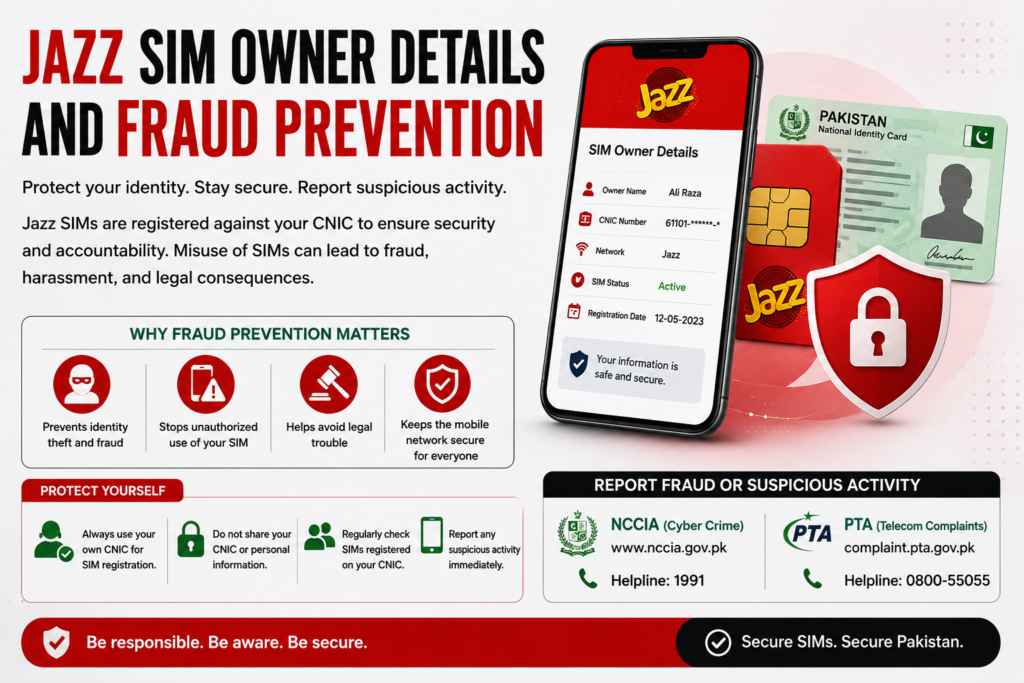
Understanding Jazz SIM Owner Details is also useful from a security perspective. A SIM is more than a plastic card inside a phone; the connected mobile number can be used for calls, SMS verification, account recovery, and other important communications. If control of the number is lost, the consequences can extend beyond ordinary mobile service.
Recognize Suspicious SIM Activity
Pay attention to unusual changes involving your Jazz connection. For example, an unexpected loss of calls or SMS messages may deserve immediate attention, particularly when there is no obvious network or device problem.
PTA’s SIM-swapping guidance recommends contacting your wireless provider promptly when calls or text messages unexpectedly stop, because this can be a warning sign of SIM-swap activity.
The earlier you investigate an unexplained change, the easier it may be to protect accounts connected with the number.
Protect Your Identity Information
Fraudsters may attempt to collect personal information by pretending to offer SIM verification or account assistance.
Do not casually provide:
- CNIC details
- OTP codes
- Account passwords
- Banking credentials
- Biometric information
- Recovery codes
A genuine concern about Jazz SIM Owner Details does not require you to surrender sensitive credentials to an unknown person or website.
Be Careful With Verification Websites
Some websites use attractive search forms and promises such as “instant owner details” or “live SIM records.” Their appearance does not establish that they are connected with Jazz or another authorized telecom system.
Before using any service, consider whether the same task can be completed through an official Jazz or regulatory channel.
If a service asks for more personal information than the task reasonably requires, that should be treated as a warning sign.
Secure Accounts Connected to Your Number
Your mobile number may be connected to email, social-media, financial, or other online accounts. Review the security settings of important accounts and make sure recovery information is current.
Where available, consider using stronger authentication options rather than relying exclusively on SMS-based verification.
Report Suspicious Activity
If you believe your Jazz SIM has been compromised, contact Jazz through an authorized support channel as soon as possible.
Jazz provides customer-management and support facilities through SIMOSA and its other official customer-care options.
If the matter involves suspected fraud, identity misuse, harassment, or another serious cyber-related incident, preserve relevant evidence and use the appropriate official reporting channel.
Prevention Is Better Than Recovery
Regularly checking your own SIM registrations, keeping identity documents private, avoiding suspicious links, and responding quickly to unexplained service changes can reduce unnecessary exposure.
The goal is not simply to understand who a SIM is registered to, but also to ensure that your own mobile identity remains under your control.
Good SIM security combines accurate registration, careful handling of personal information, prompt action when something changes, and communication through authorized support channels.
Jazz SIM Owner Details: What to Do After a Security Concern
A security concern involving a Jazz number should be handled according to the type of problem rather than through random Jazz SIM Owner Details lookup services. Whether the issue involves an unauthorized registration, lost SIM, suspicious account activity, or possible fraud, taking the correct sequence of steps can reduce further risk.
Confirm What Has Changed
First, identify the actual problem.
Ask yourself whether:
- The SIM has physically been lost
- Your mobile service has unexpectedly stopped
- An unfamiliar SIM appears in your own registration record
- You received suspicious messages
- Someone requested your OTP or identity information
- An online account connected with your number shows unusual activity
A clear understanding of the problem prevents you from taking unnecessary action.
Contact Jazz for Your Own Connection
If the problem involves your Jazz account or SIM, use an authorized Jazz support channel.
Jazz provides customer-management and support facilities through SIMOSA, together with other customer-care options.
Explain exactly what happened and follow the current procedure provided by the operator. Depending on the circumstances, the appropriate solution may involve account verification, SIM blocking, replacement, or another security measure.
Protect Accounts Connected to the Number
If your Jazz number is used for account recovery or authentication, review those accounts after a serious SIM-related incident.
Change passwords where appropriate and check for unusual login activity, recovery changes, or security notifications.
Do not wait until an account is actually compromised before reviewing its security.
Preserve Relevant Evidence
If the problem involves suspected fraud or harassment, save useful evidence before deleting messages or conversations.
Useful records may include:
- Suspicious SMS messages
- Screenshots
- Call information
- Transaction details
- Unusual account notifications
- Relevant dates and times
- Communications with the operator
Keep these records private and provide them only through appropriate support or reporting channels.
Do Not Try to Investigate Through Private Databases
If you suspect another person is involved, avoid using an unofficial website to obtain their supposed name, CNIC, address, or other confidential information.
A third-party result is not automatically an official Jazz subscriber record. Attempting to investigate through questionable databases can also expose your own personal information.
Escalate When Necessary
If the issue is a telecom complaint that cannot be resolved through the operator, use the appropriate regulatory complaint mechanism.
For suspected cybercrime or identity misuse, preserve evidence and use the relevant official reporting channel rather than attempting to resolve the matter through an unofficial SIM Owner Details service.
The safest response to a Jazz SIM security concern is to identify the problem, protect your accounts, contact the operator through an authorized channel, preserve useful evidence, and escalate through the appropriate official route when necessary.
How to Report a Jazz SIM-Related Problem
When a problem involving Jazz SIM Owner Details goes beyond a simple verification question, knowing where to report it becomes important. The correct reporting route depends on whether the issue concerns your Jazz account, an unauthorized SIM registration, suspected fraud, or another telecom-related problem.
Start With Jazz Customer Support
For an issue involving your own Jazz connection, the mobile operator should generally be the first point of contact.
Jazz provides customer-management and support facilities through SIMOSA, along with other customer-care options. These channels can be used to seek assistance with account and SIM-related concerns.
When contacting Jazz, explain the issue clearly rather than simply requesting “owner details.” For example, tell the operator if you believe a connection is registered incorrectly, your SIM has been lost, or you suspect unauthorized activity.
If an Unknown SIM Is Registered to You
If your own SIM-registration check reveals an unfamiliar Jazz connection, keep a record of the result and contact the relevant operator.
Do not attempt to identify the person allegedly using that connection through an unofficial database. The purpose of the verification is to protect and correct your own registration record.
Ask Jazz what procedure applies to an unauthorized or unrecognized registration and follow its current identity-verification requirements.
If You Suspect Fraud
A SIM-related incident can sometimes involve phishing, identity misuse, account compromise, or other fraudulent activity.
In such cases, preserve relevant evidence before deleting messages or other records. Keep screenshots, suspicious phone numbers, SMS messages, transaction information, and important dates where applicable.
If your mobile service unexpectedly stops, PTA’s SIM-swapping guidance recommends contacting your wireless provider immediately because sudden loss of calls or texts can be a warning sign of SIM-swap activity.
Escalating a Telecom Complaint
If you have already approached the relevant operator and the telecom issue remains unresolved, an appropriate regulatory complaint channel may be necessary.
PTA’s Complaint Management System provides consumers with a mechanism for registering and tracking telecommunications complaints.
Keep any complaint reference numbers or communications received from the operator so that you can provide an accurate account of the issue if escalation becomes necessary.
Use the Correct Reporting Route
The basic sequence is straightforward:
Jazz account issue → contact Jazz
Unrecognized Jazz registration → verify and contact Jazz
Suspected SIM-swap → contact Jazz immediately
Unresolved telecom complaint → appropriate PTA complaint channel
Suspected cybercrime → preserve evidence and use the relevant official reporting authority
This approach keeps Jazz SIM Owner Details verification focused on legitimate subscriber protection instead of turning a telecom problem into an unsafe private-information search.
When a Jazz SIM issue requires action, start with the responsible operator, document the problem carefully, and use the appropriate official escalation route when necessary.
Jazz SIM Owner Details: Common Mistakes to Avoid
Many people searching for Jazz SIM Owner Details make the same basic mistakes: they confuse different types of verification, trust unverified online results, or share sensitive information with services that do not need it. Understanding these errors can make SIM verification much safer and more effective.
Mistake 1: Assuming a Number Reveals Everything
Knowing a Jazz mobile number does not automatically provide access to every detail connected with its subscriber.
A number can be relevant to network identification or a legitimate investigation involving your own connection, but private identity information should not be treated as freely available through a public lookup.
Mistake 2: Confusing Network With Ownership
Identifying the network associated with a number does not establish the complete identity of the subscriber.
The operator tells you which telecom service is involved; it does not mean that a network result is equivalent to a complete Jazz SIM Owner Details record.
Keeping these concepts separate prevents incorrect conclusions.
Mistake 3: Trusting Every Online Lookup
Some websites advertise instant Jazz owner-name searches, live SIM databases, or complete subscriber records.
A search result alone does not prove that the information comes from Jazz or an authorized source. It may be inaccurate, outdated, incomplete, or presented without a legitimate basis.
Always consider the source before trusting an online result.
Mistake 4: Sharing Your CNIC With Unknown Websites
A person trying to verify their own SIM registration may be tempted to enter their CNIC into any website that promises quick results.
That can create unnecessary privacy risks.
Use recognized official services when identity information is genuinely required, and avoid submitting your CNIC merely to test an unverified owner-lookup tool.
Mistake 5: Giving Away an OTP
Never share an OTP with someone who claims they need it to check Jazz SIM Owner Details, activate a service, block a SIM, or resolve an account issue.
An OTP is an authentication credential and should remain private.
Mistake 6: Ignoring an Unexpected SIM
If you discover a connection that you do not recognize under your own identity, do not simply ignore it.
Verify the information through an appropriate official channel and contact the relevant operator if the registration needs investigation or correction.
Mistake 7: Waiting After a SIM Security Warning
A sudden loss of calls or SMS can sometimes indicate a SIM-related security problem. PTA guidance recommends contacting your wireless provider immediately when calls or texts unexpectedly stop.
Prompt action can help protect accounts connected with your number.
Mistake 8: Using the Wrong Reporting Channel
A SIM account problem should normally begin with the mobile operator. An unresolved telecom complaint may require regulatory escalation, while suspected cybercrime may require a different reporting route.
Choosing the correct channel saves time and keeps the complaint focused.
The safest Jazz SIM verification process avoids assumptions, protects sensitive information, uses authorized channels, and treats online owner-lookup claims with appropriate caution.
Jazz SIM Owner Verification: A Practical Checklist
Before considering a Jazz SIM Owner Details check complete, it helps to follow a simple verification sequence. This reduces confusion between subscriber registration, network information, account support, and private data.
1. Identify What You Need
Start by defining the exact purpose of your search.
You may want to verify your own SIM registration, investigate an unfamiliar connection associated with your identity, resolve a lost or damaged SIM, or understand which official channel can help with a Jazz-related issue.
A clear purpose prevents you from using an inappropriate third-party lookup service.
2. Verify Your Own Registration
If your concern is about SIMs connected with your identity, use an appropriate official SIM-registration checking method.
The purpose is to establish whether the connections associated with your own CNIC are accurate. If an unfamiliar Jazz connection appears, treat it as a registration issue that may require operator assistance.
Do not attempt to solve the matter by searching for another person’s private information.
3. Confirm the Relevant Network
If you are working with a mobile number and need network information, use the applicable official network-checking facility.
Knowing the network can help you identify which operator should handle a service or registration concern. It does not, however, provide unrestricted access to the subscriber’s private identity record.
4. Contact Jazz for Jazz-Specific Issues
When the concern involves your Jazz connection, use Jazz’s authorized support channels.
Jazz provides customer-management and support facilities through SIMOSA, as well as other customer-care options.
Explain the actual issue—such as registration, replacement, blocking, or account assistance—rather than relying on an online service that claims to reveal complete Jazz SIM Owner Details.
5. Protect Your Credentials
During verification, keep your CNIC information, OTPs, passwords, biometric information, and account credentials private.
An unknown website does not become trustworthy simply because it displays a professional-looking SIM search form.
If a service requests information that is unnecessary for the task, stop and verify its legitimacy first.
6. Document an Unauthorized Registration
If you discover an unfamiliar SIM under your own identity, keep useful evidence such as screenshots, dates, SMS notifications, and operator communications.
This information can help you explain the problem accurately when requesting assistance.
7. Escalate When Required
If a genuine telecom problem remains unresolved after contacting the operator, use the appropriate regulatory complaint mechanism.
For suspected fraud, identity misuse, harassment, or another cyber-related incident, preserve relevant evidence and use the appropriate official reporting channel rather than attempting to investigate through an unofficial database.
Quick Decision Guide
Own SIM registration → verify through the appropriate official system.
Network information → use the designated network-checking method.
Jazz account problem → contact Jazz.
Unauthorized registration → document it and contact the operator.
Unresolved telecom complaint → consider the appropriate PTA channel.
Private-data lookup claim → verify the source before trusting it.
A good Jazz SIM Owner Details check is not about finding the largest amount of information; it is about verifying the right information through the right channel while keeping personal data protected.
Jazz SIM Owner Details: Official Sources You Can Trust
Finding reliable information is one of the most important parts of researching Jazz SIM Owner Details. Search engines can display many pages offering SIM checks, number searches, and ownership information, but not every result comes from an authorized telecom source. A strong verification process therefore begins by identifying which organization is responsible for the information you need.
Jazz as the Primary Operator
If your question concerns a Jazz connection specifically, Jazz should be your first source for account-related assistance. The operator provides official customer-management and support facilities, including SIMOSA, where customers can access service-related support.
This is especially relevant when you need help with your own SIM, such as registration concerns, replacement, blocking, or other account matters.
PTA for Telecom Regulation
The Pakistan Telecommunication Authority (PTA) is the country’s telecom regulator and provides official information and consumer-related services.
PTA resources are useful when you need regulatory guidance, information about telecom security, or an appropriate route for escalating a telecom complaint.
If a website claims to provide complete Jazz SIM Owner Details, comparing its claims with information available through official regulatory channels can help you recognize misleading promises.
Official SIM Information System
Pakistan’s official SIM Information System is another important source for SIM-registration verification.
Its facilities are designed for specific purposes, including checking SIMs associated with your own CNIC and obtaining applicable network information for a mobile number.
These functions should not be confused with a public database containing unrestricted subscriber profiles.
Why Official Sources Are Better
Using recognized sources provides several advantages:
- Information is more likely to reflect the intended verification process
- You know which organization is responsible for the service
- Personal information can be handled through established channels
- Account-specific problems can be directed to the relevant operator
- Complaints can be escalated through appropriate authorities
By contrast, an unknown website may not explain where its information originates or whether it is authorized to provide subscriber information.
Check the Purpose Before Sharing Information
Even when using a genuine service, only provide information that is necessary for the specific task.
Never share an OTP, password, or sensitive account credential with someone simply because they claim to offer Jazz SIM Owner Details.
For your own SIM, the safest strategy is to begin with Jazz or the applicable official SIM-verification system, use PTA resources when regulatory guidance is needed, and avoid unsupported third-party claims.
Reliable Jazz SIM verification depends on using the source that is responsible for the information or service you actually need, rather than choosing a website simply because it promises more data.
Jazz SIM Owner Details: What to Do If You Find an Unauthorized SIM
If a SIM appears under your identity that you do not recognize, the issue should be treated as a registration and security concern rather than as a simple Jazz SIM Owner Details search. The objective is to protect your identity, confirm the registration accurately, and use the proper channel to resolve the connection.
Confirm the Registration First
Before assuming that an unfamiliar connection was fraudulently registered, verify your own SIM registration through an appropriate official checking method.
A registration result should be reviewed carefully because the important question is whether a connection is actually associated with your identity. Do not rely on a third-party website claiming to identify the person supposedly using the number.
Identify the Relevant Network
Once an unfamiliar connection is confirmed, determine which network it belongs to. If the connection is associated with Jazz, the next step is to approach Jazz through an authorized customer-support channel.
This is more appropriate than attempting to obtain the other user’s private identity information.
Contact Jazz
Jazz provides official customer-management and support facilities through SIMOSA, along with its other customer-care options.
When contacting support, clearly explain that the connection is unfamiliar and appears to be associated with your identity. Ask what procedure is currently available for investigating or correcting the registration.
Depending on the circumstances, the operator may guide you through the appropriate verification, blocking, disowning, or correction process.
Keep Evidence
If you discover an unauthorized connection, keep useful records of what you found.
You may want to preserve:
- The date you discovered the issue
- Relevant verification results
- SMS notifications
- Screenshots
- Operator communications
- Complaint or reference numbers
Store this information privately and avoid posting complete CNIC details or other sensitive information publicly.
Protect Your Other Accounts
If you suspect that your identity or mobile number has been misused, review important accounts connected with the number.
Pay attention to unexpected login alerts, password-reset messages, verification codes, or other activity that you did not initiate.
Never provide an OTP to someone claiming they need it to investigate your Jazz SIM Owner Details.
Escalate a Genuine Complaint
If the operator does not resolve a legitimate telecom registration problem, an appropriate regulatory complaint route may be available.
For suspected identity misuse, fraud, or cybercrime, preserve relevant evidence and use the appropriate official reporting authority rather than attempting to identify or confront the person privately.
If an unfamiliar Jazz SIM is associated with your identity, verify the registration, contact Jazz through an authorized channel, protect your connected accounts, and document the issue until it is properly resolved.
Jazz SIM Owner Details: Ownership, Usage, and Registration Explained
Understanding the difference between ownership, usage, and registration can prevent many misunderstandings when dealing with Jazz SIM information. A person may use a mobile number every day, but the official subscriber record is determined through the registration process rather than simply by who currently has the SIM in their phone.
SIM Registration
SIM registration refers to the formal process through which a cellular connection is associated with subscriber identification.
Jazz’s published SIM terms describe valid identification and biometric verification as part of the activation process. This establishes an official relationship between the connection and the subscriber information provided during registration.
This is the foundation behind legitimate Jazz SIM Owner Details verification.
SIM Usage
Usage simply refers to who is currently using the mobile connection.
For example, a family member may regularly use a SIM that was originally obtained and registered by another person. Similarly, an employee might use a company-provided number.
In such circumstances, the person holding the phone is not automatically the same as the person appearing in the official subscriber registration.
Physical Possession
Having the physical SIM card is another separate concept.
If someone finds, borrows, receives, or otherwise obtains a SIM, possession alone does not establish that they are the registered subscriber.
This is why a mobile number or SIM card should not be treated as proof of ownership without considering the underlying registration.
Why the Difference Matters
These three concepts can be summarized as:
Registration → identifies the official subscriber relationship.
Usage → describes who is currently using the number.
Possession → describes who physically has the SIM.
They may all refer to the same person, but they do not have to.
This distinction is particularly useful when evaluating online services claiming to provide Jazz SIM Owner Details by Number. A website may claim to identify a person from a number, but that does not establish that its information represents the current official subscriber record.
What to Do If the Situation Does Not Match
If you are using a Jazz SIM and believe its registration does not reflect the correct subscriber relationship, contact Jazz through an authorized support channel.
Jazz provides customer-management and support facilities through SIMOSA, along with other customer-care options.
Explain the situation and follow the operator’s current procedure for reviewing the connection.
Avoid attempting to correct an ownership problem through an unofficial website or by sharing sensitive identity information with unknown individuals.
A Better Way to Understand Owner Details
The phrase Jazz SIM Owner Details should therefore be understood in the context of legitimate subscriber verification. It is not simply a question of who answers the phone or who currently possesses the SIM.
Official registration determines the subscriber relationship, while usage and possession describe how the connection is being used at a particular time.
Jazz SIM Owner Details: Business and Workplace Number Verification
Jazz numbers are not used only for personal communication. Businesses, organizations, and workplaces may also issue mobile connections to employees or teams. This creates situations where the person using a Jazz number may differ from the individual or organization associated with its formal registration.
Business Numbers Can Have Different Users
A company may provide a Jazz connection to an employee for customer communication, field operations, sales, support, or management.
In such a case, the employee may be the everyday user, while the registration arrangement can involve the organization or another authorized subscriber.
This is why Jazz SIM Owner Details should not be interpreted simply as “the name of the person currently answering the phone.”
Verify Before Making Business Decisions
If a business receives a call or message from an unfamiliar Jazz number, it should avoid making important decisions solely from an online owner-lookup result.
Instead, verify the person’s identity through established business channels.
For example, if someone claims to represent a company, you can independently contact that organization using its official website or publicly listed contact information rather than relying entirely on the number that contacted you.
Keep Customer Information Private
Businesses should also avoid collecting or exposing unnecessary personal information while investigating a mobile number.
Customer phone numbers, identity documents, account credentials, and other sensitive information should be handled carefully.
If a company needs to document a suspicious call, it can retain relevant call details or screenshots without publicly publishing confidential subscriber information.
When the Number Is Your Company’s Connection
If your organization manages Jazz connections, account and registration questions should be directed to the appropriate Jazz support channel.
Jazz provides customer-management and support facilities through SIMOSA, along with other official customer-care options.
The relevant account holder or authorized representative can ask about the available procedure for service management or registration-related concerns.
Avoid Unverified Owner Databases
An online service claiming to reveal the “business owner” or personal identity behind a Jazz number should not automatically be considered reliable.
A number may be used by an employee, representative, family member, or another authorized user, meaning the person answering the call may not necessarily correspond to the formal subscriber record.
A Better Verification Approach
For business-related number verification, focus on the purpose of the communication and independent confirmation rather than attempting to obtain private subscriber information.
If the communication concerns a payment, account change, contract, or sensitive request, independently verify it before taking action.
For business and workplace numbers, responsible verification means confirming the person or organization through trusted channels rather than assuming that a mobile number alone proves the user’s official identity.
Jazz SIM Owner Details for Personal Safety and Unknown Callers
A mobile number can sometimes become a source of concern when you receive repeated calls, unexpected messages, or suspicious requests. In such situations, searching for Jazz SIM Owner Details may seem like the obvious first step, but identifying the safest response is often more useful than trying to uncover private subscriber information.
Start With the Nature of the Contact
Before taking action, consider what the unknown caller or sender is actually asking for.
A communication may involve:
- A routine promotional offer
- A wrong number
- Repeated unwanted calls
- A suspicious financial request
- A phishing attempt
- Harassment or threatening communication
The seriousness of the situation determines what you should do next.
Never Share Sensitive Information
If an unknown caller claims to represent Jazz, a bank, a government organization, or another company, do not automatically trust the claim.
Never provide an OTP, password, banking credentials, CNIC information, or other sensitive details simply because the caller says they need them for verification.
If the request appears legitimate, independently contact the organization through its official website, app, or recognized customer-support channel.
Do Not Rely on Unverified Owner Results
A third-party website may claim to identify the person behind a Jazz number. However, an online result is not automatically proof of the official subscriber record.
Information displayed by an unofficial service may be inaccurate, outdated, incomplete, or sourced without clear authorization.
Therefore, Jazz SIM Owner Details by Number should not be used as the sole basis for accusing someone, making a financial decision, or sharing personal information.
Preserve Evidence When the Contact Is Suspicious
If you believe a number is involved in fraud, harassment, or another serious incident, preserve relevant evidence.
Useful material can include screenshots, messages, call records, dates, transaction details, suspicious links, and other information that explains what happened.
Do not edit the original evidence unnecessarily, and avoid publishing sensitive material publicly.
When the Situation Involves Your Own SIM
If you discover that the suspicious activity is connected with your own Jazz number, contact Jazz through an authorized support channel.
Jazz provides customer-management and support facilities through SIMOSA and other customer-care options.
If your mobile service unexpectedly stops, PTA’s SIM-swapping guidance recommends contacting your wireless provider immediately because sudden loss of calls or text messages can be a warning sign.
Focus on Safety Rather Than Identification
In many cases, you do not need to know the private identity of an unknown caller to protect yourself.
Block unwanted communication where appropriate, secure your accounts, preserve evidence when necessary, and report serious incidents through the correct official channel.
When an unknown Jazz number creates a safety concern, responsible verification means protecting yourself, preserving evidence, and using authorized reporting or support channels instead of relying on an unverified private-data lookup.
Jazz SIM Owner Details for Fraud and Scam Awareness
Fraud prevention is another important reason to understand Jazz SIM Owner Details correctly. A mobile number can be involved in phishing, impersonation, fake prize messages, financial scams, or attempts to obtain sensitive information. However, discovering the private identity behind a number is not always necessary to protect yourself.
Recognize Common Warning Signs
Be cautious when a caller or message asks you to take urgent action, especially when the request involves money or confidential information.
Warning signs may include:
- Requests for an OTP
- Demands for banking information
- Unusual payment instructions
- Claims that your SIM will immediately be blocked
- Fake verification requests
- Suspicious links
- Promises of prizes or rewards
- Pressure to make a quick decision
A professional-looking message does not necessarily make the request genuine.
Verify the Organization Independently
If someone claims to represent Jazz, a bank, a government department, or another organization, do not rely solely on the contact information provided in the message.
Instead, find the organization’s official website or recognized support channel independently and contact it yourself.
This prevents scammers from controlling both sides of the conversation.
Do Not Share Your OTP
An OTP is designed to confirm an authentication or verification action. Treat it as confidential.
If someone says they need your OTP to check Jazz SIM Owner Details, verify the request independently before doing anything. An unknown person should never receive your authentication code simply because they claim to be helping with a SIM issue.
Keep Evidence of Suspicious Activity
If a Jazz number appears to be involved in a scam, preserve useful evidence before blocking or deleting the communication.
Depending on the situation, this may include:
- Screenshots
- SMS messages
- Call details
- Phone numbers
- Payment information
- Transaction records
- Website addresses
- Dates and times
Keep this information secure and provide it only to an appropriate support or reporting authority.
Protect Your Own Jazz Number
Fraud prevention also means protecting the number registered to you.
If your mobile service suddenly stops working without a clear reason, contact your operator promptly. PTA’s SIM-swapping guidance specifically recommends contacting the wireless provider when calls or text messages unexpectedly stop, as this can indicate possible SIM-swap activity.
You should also review important online accounts that rely on your mobile number for recovery or authentication.
Do Not Confront a Suspected Scammer
If you receive suspicious communication, avoid attempting to identify or confront the person using an unofficial Jazz SIM Owner Details database.
The safer approach is to document the incident, secure your own accounts, block the communication where appropriate, and use the correct official reporting channel if the matter is serious.
Effective scam prevention is less about uncovering a stranger’s private identity and more about recognizing warning signs, protecting your credentials, preserving evidence, and responding through trusted channels.
Jazz SIM Owner Details: Legal and Responsible Verification
Searching for Jazz SIM Owner Details should always be approached with a clear distinction between legitimate verification and attempts to access someone else’s private information. A mobile number can be relevant to a telecom inquiry, but the purpose of the inquiry determines what information should reasonably be requested and which channel should be used.
Verify Information You Are Authorized to Access
The safest starting point is your own SIM registration. If you want to confirm whether a Jazz connection is associated with your identity, use an appropriate official verification method or contact Jazz directly for account-specific assistance.
Jazz’s published SIM terms describe subscriber identification and biometric verification as part of the SIM activation process.
This means legitimate ownership verification is connected with an established registration process rather than simply entering a mobile number into an unknown website.
Do Not Treat Private Data as Public Information
A person’s CNIC number, address, biometric information, and confidential telecom records should not be treated as information that anyone can obtain merely by knowing a Jazz number.
This is particularly important when a website claims to provide complete Jazz SIM Owner Details without explaining a legitimate source or authorization for the information.
Even when an online result appears convincing, it should not automatically be considered an official subscriber record.
Use the Correct Channel
Different problems require different solutions.
If the issue concerns your own Jazz account, contact Jazz through an authorized customer-support channel. Jazz provides customer-management and support facilities through SIMOSA, along with other customer-care options.
If you discover an unfamiliar SIM associated with your own identity, use the appropriate SIM-registration checking process and contact the relevant operator.
If the matter involves suspected fraud, identity misuse, harassment, or another cyber-related incident, preserve the relevant evidence and use the appropriate official reporting route.
Avoid Misleading Claims
Search results may contain pages promising “100% accurate” owner names, complete CNIC records, or instant subscriber information.
Such claims should be evaluated critically.
A responsible verification service should have a clear purpose, identify its source, and avoid requesting unnecessary sensitive credentials. If a website demands your OTP, password, banking information, or biometric data simply to perform a supposed number lookup, do not provide it.
Responsible Verification Protects Everyone
The purpose of legitimate Jazz SIM Owner Details verification is to help users manage their own connections, resolve registration concerns, and respond appropriately to security problems.
It should not become a method for exposing another subscriber’s private identity.
Legal and responsible verification means using authorized channels, accessing only information you are entitled to obtain, protecting sensitive credentials, and reporting genuine problems through the appropriate authorities.
Jazz SIM Owner Details: What to Do With an Unfamiliar Number
If you receive a call or message from an unfamiliar Jazz number, the safest response is to evaluate the communication itself rather than immediately trying to uncover the subscriber’s private identity. A number can be useful for documenting an incident or identifying the relevant telecom network, but it should not automatically be treated as a gateway to confidential Jazz SIM Owner Details.
First Determine Whether the Contact Is Suspicious
Not every unknown number represents a threat. It could belong to a business, delivery service, acquaintance, customer, or another legitimate caller.
Look at the context before taking action. A request for money, an unexpected verification code, a suspicious link, or pressure to provide personal information deserves more caution than an ordinary missed call.
Do Not Share Personal Credentials
If the caller claims that your Jazz SIM needs verification, do not provide sensitive information simply because the caller knows your phone number.
Keep the following private:
- CNIC information
- OTP codes
- Passwords
- Banking credentials
- Recovery codes
- Biometric information
If the caller claims to represent Jazz or another organization, independently contact that organization through its recognized official channel.
Be Careful With Owner-Lookup Websites
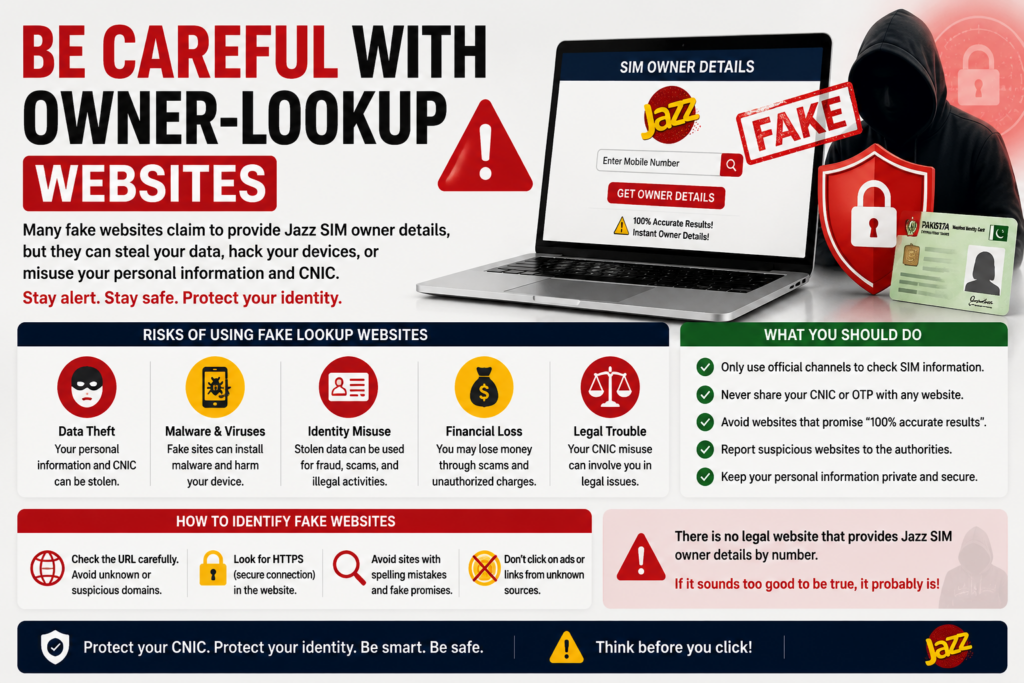
An unfamiliar Jazz number may tempt users to search for the owner’s name online. Some websites advertise instant Jazz SIM Owner Details by Number, but the existence of a search result does not establish that the information is an official subscriber record.
The information may be outdated, inaccurate, incomplete, or obtained from an unclear source.
For that reason, avoid entering your own sensitive information into an unknown website simply because it promises detailed results.
Preserve Evidence for Serious Incidents
If the number is involved in suspected fraud, harassment, threats, or another serious incident, preserve relevant evidence.
Useful records can include:
- Screenshots of messages
- Call history
- The complete phone number
- Dates and times
- Suspicious links
- Payment or transaction records
- Other relevant communications
Keep the evidence private and provide it through an appropriate reporting or support channel.
Protect Your Own Jazz Connection
If the unfamiliar communication is accompanied by unexpected loss of mobile service, take the situation more seriously.
PTA’s SIM-swapping guidance recommends contacting your wireless provider immediately when calls or text messages unexpectedly stop, as this can be a warning sign of SIM-swap activity.
If your own Jazz connection is affected, contact Jazz through an authorized support channel and follow its current security procedure.
Use Identification Only When It Is Appropriate
In ordinary situations, you do not need to know the private identity of an unknown caller to protect yourself. You can block unwanted communication, avoid sharing sensitive information, preserve evidence when necessary, and report serious incidents through the correct channels.
When dealing with an unfamiliar Jazz number, focus on verifying the situation and protecting yourself rather than relying on unofficial services to uncover private subscriber information.
Final Remaining Section — Jazz SIM Owner Details: Complete Practical Guide
Understanding Jazz SIM ownership becomes even more useful when you look beyond a simple owner-name search and consider the situations in which people actually need subscriber verification. A mobile number may be connected with personal communication, business activities, online accounts, customer support, financial notifications, or security services, so the correct approach depends on the reason behind the check. If you are trying to verify a Jazz connection that belongs to you, the most important objective is to establish whether the SIM is properly associated with your identity and whether the connection is being managed through an authorized channel. If you are dealing with an unfamiliar number belonging to someone else, the priority should normally be safety, fraud awareness, evidence preservation, and appropriate reporting rather than attempting to uncover private subscriber information. This distinction makes the subject of Jazz SIM Owner Details much clearer because it separates legitimate account management from unsupported online claims about personal data. A useful verification process begins by asking what information is actually needed. If the question is whether a number belongs to your own registered connection, use the appropriate Jazz support or SIM-registration verification route. If the purpose is to identify the network associated with a number, use the relevant network-checking facility. If you have discovered an unfamiliar connection under your own identity, treat it as a registration concern and contact the appropriate operator. If a number has been used in a suspected scam or harassment incident, preserve the available evidence and use the relevant complaint or reporting mechanism. These situations may involve the same mobile number, but they require completely different responses. Another important consideration is the difference between a subscriber record and everyday usage. A Jazz number can remain registered under one subscriber while being used by another individual in a family, workplace, or other arrangement. Possession of a SIM card therefore should not automatically be interpreted as proof of formal registration. Jazz’s published SIM terms describe identification and biometric verification as part of the process used to establish a cellular connection, which demonstrates why registration is more than simply having a SIM in a handset. If the registered relationship no longer reflects the legitimate circumstances surrounding a connection, the correct solution is to discuss the matter with Jazz and follow its current procedure rather than assuming that continued usage has automatically changed the registration. This is particularly relevant for numbers that have moved between family members, employees, business users, or other authorized users. In a business environment, for example, a company may provide a Jazz number to an employee for sales, customer service, field work, or administrative communication. The employee may answer every call, yet that does not necessarily mean the employee is the formal subscriber recorded in the registration system. Businesses should therefore verify important communications independently instead of assuming that an online owner-name result proves the identity of the person representing an organization. The same principle applies to personal transactions. If an unknown caller claims to be from a bank, government department, telecom company, delivery service, or another organization, the safest method is to independently locate that organization’s official contact information and verify the request. A phone number appearing familiar or producing a name on an unofficial website should never be the sole reason for trusting a sensitive request. Privacy is another major part of responsible Jazz SIM verification. People sometimes search for owner details because they want to know who called them, but an unknown caller does not automatically create a right to obtain that person’s confidential identity information. A subscriber’s CNIC, residential address, biometric information, account records, and other personal information should not be treated as ordinary public search data. This is why websites advertising complete Jazz SIM Owner Details by Number deserve careful evaluation. A webpage can display a name, address, CNIC-like information, or other details without proving that the information is official, accurate, current, or lawfully obtained. Users should never assume that a database is genuine merely because it has a search box, a professional interface, or a large collection of claimed records. In fact, the more sensitive information a website promises to reveal, the more important it becomes to question its source and legitimacy. Another common mistake is entering personal information into a third-party website in order to obtain a supposed owner result. If a service asks for your CNIC, OTP, password, banking credentials, biometric information, or account recovery code merely to perform a mobile-number lookup, stop and reconsider the request. A genuine need to understand your own Jazz SIM registration does not automatically justify giving an unknown service access to authentication information. OTPs in particular should remain confidential because they may be used to confirm account actions. Someone who already knows your phone number may attempt to use social engineering to obtain additional credentials, so a verification request should always be independently confirmed before sensitive information is shared. SIM security also extends beyond the physical card. Your mobile number may receive login codes, password-reset messages, transaction notifications, and other security communications. This makes unexpected changes in service worth taking seriously. If calls or SMS messages suddenly stop without an obvious reason, contact the mobile operator promptly. PTA’s SIM-swapping guidance recommends immediate contact with the wireless provider when calls or text messages unexpectedly stop because such a change can be a warning sign of SIM-swap activity. A user experiencing such an event should not wait for a third-party website to identify an alleged SIM owner. The first objective should be to protect the number and the accounts connected to it. Review important online accounts, watch for unusual security notifications, and follow the operator’s instructions for securing the connection. If the SIM itself has been lost or stolen, the situation is different from an ownership dispute but still requires prompt action. The legitimate subscriber should contact Jazz through an authorized channel and ask about blocking the missing connection and obtaining a replacement. A replacement SIM is intended to restore access to an existing connection; it should not be confused with transferring registration to a different person. This distinction is useful because people often use the terms “SIM ownership,” “SIM replacement,” and “SIM registration” as though they describe the same service. They do not. Replacement concerns continued access to a connection, while an ownership-related request concerns the subscriber relationship associated with that connection. The exact procedure can depend on the circumstances, so customers should confirm the current requirements directly with Jazz. Jazz provides customer-management and support facilities through SIMOSA and other official customer-care channels. If an ownership or registration concern cannot be resolved through ordinary support, the customer should keep relevant records of the interaction and use the appropriate escalation mechanism. Documentation can be especially valuable when a user believes an unauthorized connection has been associated with their identity. Useful records may include the date of discovery, verification results, SMS notifications, screenshots, customer-support communications, and complaint reference numbers. These records should be stored privately rather than posted publicly. Publishing a complete CNIC, phone number, OTP, or account screenshot can create a second privacy problem while attempting to solve the first one. If the problem involves suspected fraud, identity misuse, harassment, threats, or another serious cyber-related incident, preserve the relevant evidence and use the appropriate official reporting authority. Do not attempt to confront the suspected individual based solely on an online database result. An incorrect identity match can cause serious consequences for an innocent person, while an actual fraudster may deliberately use another person’s number or identity information. This is another reason why Jazz SIM Owner Details should be treated as a verification topic rather than a shortcut for identifying or accusing people. For unknown numbers, context is usually more valuable than an unverified owner-name result. If the number simply made a missed call, there may be no reason to investigate further. If the caller requested money, an OTP, a password, or personal information, the communication should be treated with caution. If the caller claimed to represent a company, independently verify the claim. If the communication involved harassment or threats, preserve the evidence and report it through the relevant channel. If the number appears connected to a financial scam, keep transaction records and screenshots and contact the relevant financial institution if necessary. Each scenario has its own response, and none requires blindly trusting an unofficial SIM database. The same principle applies to business verification. If a customer receives an order, payment request, account-change request, or other sensitive instruction from a mobile number, the business should confirm the request through an independently sourced contact method. A mobile number alone does not establish that the sender is authorized to represent a company. Similarly, a name displayed by a third-party lookup tool does not prove that the person currently using the number is the formal subscriber. Independent confirmation protects both businesses and customers from impersonation. Another useful area is understanding the role of CNIC-based verification. When users want to know how many SIMs are associated with their own identity, the relevant nationwide SIM-registration system is more appropriate than attempting to search individual numbers for private owner information. This type of check helps a person identify whether unexpected connections may exist under their own CNIC. If an unfamiliar Jazz connection appears, the user can then approach the relevant operator and ask about the available process for resolving the registration. The purpose is to protect the user’s own identity and maintain an accurate registration record. It is not to expose the personal information of whoever may currently be using the number. Users should also understand that different telecom identifiers serve different purposes. A SIM is associated with a subscriber connection, while an IMEI identifies a mobile device. DIRBS relates to mobile-device registration and compliance rather than acting as a public directory of SIM subscribers. Mixing these concepts can lead to incorrect searches and misleading expectations. Someone looking for Jazz SIM Owner Details should therefore first establish whether the issue concerns a subscriber registration, a mobile number, a physical SIM, or a device. This simple distinction can save considerable time. Another frequently misunderstood issue is whether an owner name can always be obtained from a number. The practical answer is that users should not assume that a public number search provides unrestricted access to the registered subscriber’s private identity. Legitimate subscriber verification is handled through appropriate official processes, while private information remains subject to applicable privacy and security controls. If a website promises a complete name, CNIC, address, family information, location, or other sensitive records from one number, the claim should be treated cautiously unless its authority and source are clearly established. Search engines themselves do not guarantee the accuracy of such results. Old information can remain online, records can be incorrectly matched, and data can be presented without the context needed to determine whether it represents the current subscriber. For this reason, users should never make a serious accusation, financial decision, employment decision, or legal claim solely on the basis of an unofficial SIM-owner result. When a telecom problem becomes a formal complaint, communication should remain factual. Instead of saying that a particular person definitely owns or operates a number because a website displayed their name, explain what you actually know: the number involved, the date and time of the incident, what communication occurred, what verification was performed, and what response was received from the operator. This approach produces a much stronger record and avoids unsupported conclusions. It also helps customer-support teams and relevant authorities understand the issue more efficiently. For everyday SIM management, a simple checklist can keep the process organized. First, identify the exact reason for checking the number. Second, decide whether you need network information, your own registration information, or account assistance. Third, use the official service that matches that purpose. Fourth, keep your CNIC and authentication credentials private. Fifth, contact Jazz when the issue involves your Jazz connection. Sixth, document unauthorized or suspicious activity. Seventh, escalate through the appropriate official channel when ordinary customer support is insufficient. Finally, avoid treating unofficial database claims as definitive subscriber records. This workflow is more reliable than repeatedly searching different websites and comparing conflicting owner names. It also keeps the article’s central topic grounded in practical user needs rather than unrealistic promises. For readers specifically asking how to check a Jazz number safely, the answer is therefore not a single universal lookup command. The appropriate method depends on what they are trying to establish. A person checking their own registration should use the recognized SIM-verification route or Jazz support. Someone dealing with an account problem should communicate directly with Jazz. A person receiving a suspicious call should focus on protecting their information and preserving evidence. Someone facing suspected cybercrime should use the relevant reporting authority. A business verifying a customer or supplier should independently confirm important information. Each method solves a different problem. The strongest understanding of Jazz SIM Owner Details in Pakistan comes from recognizing these boundaries. A registered subscriber relationship is created through an official telecom process, while the number itself is not a public directory containing every detail about the individual connected with it. Jazz’s published terms and support resources provide a foundation for understanding registration, activation, and customer assistance, while PTA resources provide broader regulatory and security guidance. Users should therefore prefer recognized sources, minimize the amount of personal information they disclose, and verify unexpected activity promptly. In practical terms, the best SIM-owner verification strategy is not the one that promises the most data; it is the one that answers the correct question through a trustworthy source while protecting the subscriber’s privacy. If you need to verify your own Jazz connection, start with your own registration record and authorized Jazz support. If you find an unfamiliar connection, investigate it through the operator instead of searching for another person’s private information. If your number is suddenly disconnected or behaves unusually, consider the possibility of a security problem and contact the operator quickly. If an unknown number contacts you with a suspicious request, do not provide confidential credentials and preserve evidence when appropriate. If a serious incident occurs, use the relevant complaint or reporting process. These steps make the concept of Jazz SIM Owner Details practical, responsible, and much more useful than an unsupported promise of instant personal-data access. Ultimately, SIM verification should serve three goals: accurate registration, secure communication, and protection of personal identity. When those three priorities remain at the center of the process, users can handle Jazz SIM questions more confidently, recognize misleading lookup claims, respond faster to security concerns, and choose the correct official route for assistance.